Results by title
200 books match the query 'Asian American & Pacific Islander' and 19 start with s
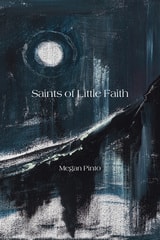
Saints of Little Faith
Megan Pinto
Four Way Books, 2024
The energies animating Saints of Little Faith, Megan Pinto’s electrifying debut in poetry, are a forceful quiet, a loud stillness, the caesura between a lightning strike and the sound of thunder. Everywhere, the speaker sees the numinous power of language, the incipience of things to come, even a kind of catastrophic grace in desolation and destruction — as if within the terrain of her own obsession, she recognizes the familiar, ever-changing seasons. Fierce and intimate, this poet’s meditative transformations engage with South Asian experiences of addiction, domestic violence, and mental illness, refusing to ignore narratives treated as unspeakable and overlooked by the English canon. Mapping the collision of abuse, psychosis, and rage, Pinto sees beyond them, buoyed by an inscrutable but abiding faith in the holiness of life itself, in a cold God nevertheless capable of gentleness. Once, “desire was an arrow, but now desire / is the field.” Pinto presides over this expanse, deciding, “I have three choices: to drift through life / anesthetized, to soften. . .” In that unspoken “or,” the merciful lacuna of that ellipsis, reside the lyrical mystery and medicine that feed this astonishing collection and strengthen resolve, both ours and the speaker’s: “The lake looks frozen, but it is not.”
Saints of Little Faith
Megan Pinto
Four Way Books, 2024
The energies animating Saints of Little Faith, Megan Pinto’s electrifying debut in poetry, are a forceful quiet, a loud stillness, the caesura between a lightning strike and the sound of thunder. Everywhere, the speaker sees the numinous power of language, the incipience of things to come, even a kind of catastrophic grace in desolation and destruction — as if within the terrain of her own obsession, she recognizes the familiar, ever-changing seasons. Fierce and intimate, this poet’s meditative transformations engage with South Asian experiences of addiction, domestic violence, and mental illness, refusing to ignore narratives treated as unspeakable and overlooked by the English canon. Mapping the collision of abuse, psychosis, and rage, Pinto sees beyond them, buoyed by an inscrutable but abiding faith in the holiness of life itself, in a cold God nevertheless capable of gentleness. Once, “desire was an arrow, but now desire / is the field.” Pinto presides over this expanse, deciding, “I have three choices: to drift through life / anesthetized, to soften. . .” In that unspoken “or,” the merciful lacuna of that ellipsis, reside the lyrical mystery and medicine that feed this astonishing collection and strengthen resolve, both ours and the speaker’s: “The lake looks frozen, but it is not.”
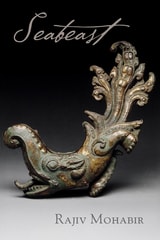
Seabeast
Rajiv Mohabir
Four Way Books, 2025
Mohabir's language ingeniously plumbs the depths, illustrating how the objectification fundamental to the construction and preservation of animal taxonomy mirrors the internecine violence of humankind on both a broad and intimate scale. "We were misnamed / again and again: first Hindu, / then Hindoo, then Indian, then / Coolie, all subhuman / much like this precursory cetacean / of the Eocene, named / in Latin great lizard— / anguilliform, what to make / of twist and tear, teeth / gnashing sharks and durodons / into pulp, judged by fossilized / gouges in enamel and finger / holes on skulls?"
Through the invention of race, the conquest and consumption of land, and the cultural amnesia enforced on the subaltern, imperialism threatens human survival on this planet just as we have misunderstood, taken captive, and hunted whales nearly to extinction. Meditating on the results of genetic testing, Mohabir details how, like his white ex-spouse's "ancestors / from northern Germany / played bone flutes / for their dead at gravesites," a lab "one day exhumed" them all "in perfect pentatonic scales." Meanwhile, he wonders what of his Indo-Caribbean heritage, complicated by the obfuscating forces of indenture, ethnic oppression, and frequent relocation, "can be revived" from this "wastebasket taxon, / us unnamed hoard of no future?" Of the Irrawaddy Dolphin once "known for / herding shoals of fish / for fisherfolk / in whose nets / they now drown," Mohabir observes that "learning human / language opens you // to betrayal." "Trust me," he urges, "though I am no // hairless dolphin— / I once had a husband." Standing at the confluence of these prehistoric, mythological, and contemporary tributaries feeding our attitude toward whales, Mohabir asks, who is the seabeast, really? The namer or the named? The answer prompts us to see that, if we recognize the legacy of human barbarism in the whale's long history with us, we can also locate a new reserve of resilience and survival. It is their example Mohabir uses, not the "bright honey" of their blubber that once would "fuel lanterns," to power his own spiritual refortification. "Maybe I will, from filling my lungs, blood / rushing to my core, / into a finned thing, / transform."
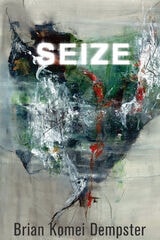
Seize
Brian Komei Dempster
Four Way Books, 2020

Serial Fu Manchu
The Chinese Supervillain and the Spread of Yellow Peril IdeologyRuth Mayer
Temple University Press, 2013
In the series Asian American History and Culture, edited by Sucheng Chan, David Palumbo-Liu, Michael Omi, K. Scott Wong, and Linda Trinh Võ
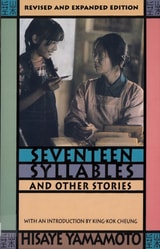
Seventeen Syllables and Other Stories
Yamamoto, Hisaye
Rutgers University Press, 2001
In addition to the contents of the original volume, this edition brings back into print the following works:
- Death Rides the Rails to Poston
- Eucalyptus
- A Fire in Fontana
- Florentine Gardens
Seventeen Syllables and Other Stories
Yamamoto, Hisaye
Rutgers University Press, 2001
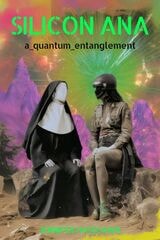
Silicon Ana
A Quantum EntanglementJennifer Hasegawa
Omnidawn, 2026
Poetry tracing the parallel lives of two characters as they grapple with transcendence, selfhood, technology, and desire.
In Silicon Ana: A Quantum Entanglement, two narratives weave across each page: Ana, a stigmatic visionary navigating miraculous healings and supernatural visitations, and Nan, discovering sexuality and selfhood through a found Penthouse magazine. Across seven movements, their stories braid and diverge—hospital beds mirror bedroom paralysis, religious ecstasy meets erotic awakening, strange prophecies echo in both realms. Through tightly wound five-line stanzas, this double helix of consciousness explores possession in all its forms: spiritual, sexual, psychological, and technological. Each stanza creates a chamber where sacred and profane collapse into each other. Written in an era of AI awakening and quantum computing, where consciousness becomes suspect, this collection asks what happens when the experiment becomes self-aware. As Ana ascends toward cosmic transcendence and Nan navigates earthly desire, their entangled fates ask if we are observing one entity being split across an unfathomable divide or two that are bound by invisible threads. Silicon Ana is a fevered meditation on bodies that refuse singular interpretation in an age of infinite possible selves.
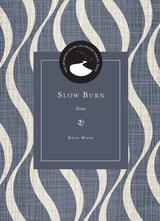
Slow Burn
PoemsEvan Wang, Ching-In Chen
Northwestern University Press, 2026
Winner of the 2024 Drinking Gourd Chapbook Poetry Prize
Persistent yet flickering, Slow Burn unveils a passionate world where love is both impossible and inevitable. Divided into three sections, Evan Wang’s debut chapbook traces the confrontation of the self through a cyclical journey of discovery and contradiction, ultimately leading to the choice of allowance: that which is made by the reader. These poems slowly burn first through our own inner silence, then through the thick dark of night, and finally to abstract closure—or lack thereof. They urge and hold us back, begging us to understand how, amid cultural, societal, and political suppression of the self, we kiss the muscled mouths of the world by carrying our bodies through it. Slow Burn is a romantic’s answer to the search for love, and the strangely comforting realization that the effects of the world mark us all.

Softly Undercover
Hanae Jonas
The Ohio State University Press, 2024
Son of Amity
Peter Nathaniel Malae
Oregon State University Press, 2018
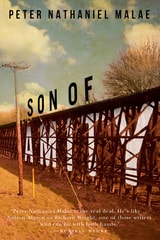
Determined to escape the past, these characters find themselves sharing the same torn-down house, bordering tweaker poverty and bucolic wine country. Violence and penance, family and legacy, recidivism and post-traumatic stress disorder linger with the heavy rain of desperation. At the center of this storm is five-year old Benji, whose wide-eyed energy and openhearted faith could show all of them how to still be saved.
In this unforgettable tale, award-winning author Peter Nathaniel Malae explores the depths of human pain and trauma with genuine cultural authority. Son of Amity is a novel whose voices cry out with truth and vulnerability, never betraying that slight tilt toward hope needed to make the long, hard trek to tomorrow.
Southwest Asia
The Transpacific Geographies of Chicana/o LiteratureJayson Gonzales Sae-Saue
Rutgers University Press, 2016
Spider Love Song and Other Stories
Nancy Au
Acre Books, 2019
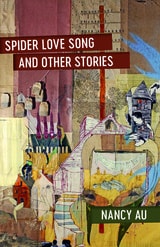
Au excels at inhabiting the minds and hearts of children and the elderly. In the title story, Sophie Chu dresses daily in her increasingly shabby elephant costume to ensure her missing parents recognize her upon their return. In “The Unfed,” a village elder seeks to revive, with her dimming magic, a mountain community struck by tragedy. “Louise” follows, with deceptive hilarity (involving a one-eyed duck), the nuanced give and take between May Zhou and Lai, dissimilar yet passionate partners considering parenthood. The volume also offers sparkling speculative work that taps into the strength of nature—fox spirits and fire beetles, swollen rivers and rippling clouds—to showcase the sometimes surreal transformations of Au’s protagonists.
Spider Love Song and Other Stories treads the fault line that forms between lovers, families, friends, cultures—exposing injuries and vulnerabilities, but also the strength and courage necessary to recast resentment and anger into wonder and power. Au’s lyrical style, humor, and tender attention to her characters’ fancies and failings make this powerful debut a delight to read.
Spoiled
Asian American Hostility and the Damage of RepairSummer Kim Lee
Duke University Press, 2025
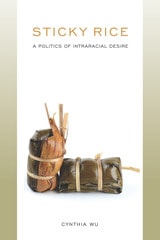
Sticky Rice
A Politics of Intraracial DesireCynthia Wu
Temple University Press, 2018
Cynthia Wu’s provocative Sticky Rice examines representations of same-sex desires and intraracial intimacies in some of the most widely read pieces of Asian American literature. Analyzing canonical works such as John Okada’s No-No Boy, Monique Truong’s The Book of Salt, H. T. Tsiang’s And China Has Hands, and Lois-Ann Yamanaka’s Blu’s Hanging, as well as Philip Kan Gotanda’s play, Yankee Dawg You Die, Wu considers how male relationships in these texts blur the boundaries among the homosocial, the homoerotic, and the homosexual in ways that lie beyond our concepts of modern gay identity.
The “sticky rice” of Wu’s title is a term used in gay Asian American culture to describe Asian American men who desire other Asian American men. The bonds between men addressed in Sticky Rice show how the thoughts and actions founded by real-life intraracially desiring Asian-raced men can inform how we read the refusal of multiple normativities in Asian Americanist discourse. Wu lays bare the trope of male same-sex desires that grapple with how Asian America’s internal divides can be resolved in order to resist assimilation.

Storage Unit for the Spirit House
Maw Shein Win
Omnidawn, 2020
Assemblages of both earthly and noncorporeal possessions throughout the collection become resonant and alive, and Win must summon “a circle of drums and copper bells” to appease the nats who have moved into a long-ago family house. This careful curation of unlikely objects and images becomes an act of ritual collection that uses language to interrogate how pain in life can transform someone into a nat or a siren that lives on. Restrained lines request our imagination as we move with the poet through haunted spaces and the objects that inhabit them.
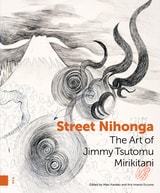
Street Nihonga
The Art of Jimmy Tsutomu MirikitaniMaki Kaneko
Amsterdam University Press, 2026
This volume features 163 color illustrations alongside scholarly essays and reflections that frame Mirikitani’s practice as both artistic achievement and political intervention. Maki Kaneko’s introduction situates the exhibition within the artist’s distinctive “street Nihonga” aesthetic—a collaged form of artmaking, storytelling, and community collaboration. Contributors Noriko Murai, Scott Tsuchitani, Yukinori Okamura, and Kris Ercums offer wide-ranging perspectives, including the transnational legacy of Nihonga, the memory politics of Japanese American incarceration, the evolving lineage of “A-bomb art,” and the curatorial process behind the exhibition. Linda Hattendorf and Masa Yoshikawa, Mirikitani’s close friends and documentarians, provide intimate insights into his life and art.
At once scholarly and inviting, Street Nihonga encourages readers to encounter Mirikitani not as an artist of the margins but as a radical reinterpreter of convention and a witness to histories often left untold. This catalogue remains open-ended—a living collage and a call to engage with Mirikitani’s extraordinary life and work.
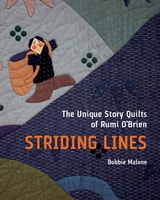
Striding Lines
The Unique Story Quilts of Rumi O'BrienBobbie Malone
University of Wisconsin Press, 2019
Bobbie Malone reaches beyond the quilts to tell O'Brien's own story, from her initial foray into the quilting world to her developed dedication to the craft. Contributions from leaders in the art, textile and quilting community, including Melanie Herzog and Marin Hanson, contextualize O'Brien's work in the greater community of quiltmakers and artists. This book celebrates the life and ingenuity of a Japanese-born American immigrant whose oeuvre is equally Japanese and Wisconsinite—and entirely distinctive.
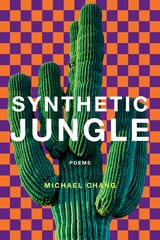
Synthetic Jungle
PoemsMichael Chang
Northwestern University Press, 2023
A vital breath of life arrives in American poetry with Synthetic Jungle, the latest collection from acclaimed poet Michael Chang. With poems in a register both hilarious and scathing, Synthetic Jungle effortlessly bashes convention while simultaneously rebuilding the language we use to communicate our fears and joys.
Synthetic Jungle is a collection written by a brilliant jester who winks at you as you catch their every reference before sharing a laugh at your own self-satisfaction. Themes of identity, sexuality, and literacy play out in a dizzying rhythm of microtheaters. Readers will find themselves giggling, snorting, and guffawing their way through this work: whether at a repudiation of the literary landscape or a critique of a failing justice system, to laugh along with Chang is to recognize your mistakes and, ultimately, grow from them.
Fractal and kinetic in the quick-witted spirit of John Ashbery and Emily Dickinson, Chang’s tender poems dance around, between, and through the personal and philosophical. Synthetic Jungle is as sweet as it is grand, and beneath its sarcastic grin reverberates an immense, open heart.