Results by title
95 books match the query 'Australia' and 6 start with s
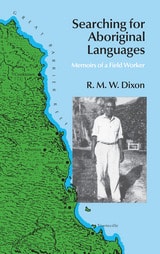
Searching for Aboriginal Languages
Memoirs of a Field WorkerR. M. W. Dixon
University of Chicago Press, 1989
In 1963 R. M. W. (Bob) Dixon set off for Australia, where he was to record, chart, and preserve several of the complex and nearly extinct Aboriginal languages. Beginning with his introduction to these languages while a graduate student at the University of Edinburgh and his difficulties in getting to the Australian bush, Dixon's fourteen-year tale is one of frustration and enlightenment, of setbacks and discoveries.
As he made his way through northern Australia, Dixon was dependent on rumors of Aboriginal speakers, the unreliable advice of white Australians, and the faulty memories of many of the remaining speakers of the languages. Suggestions of informants led him on a circuitous trail through the bush, to speakers such as the singer Willie Kelly in Ravenshoe, who wanted his recordings sent to the south, "where white people would pay big money to hear a genuine Aborigine sing" and Chloe Grant in Murray Upper, who told tales in four dialects of digging wild yams, of the blue-tongue lizard Banggara, and of the arrival of Captain Cook. Dixon tells of obtaining the trust of possible informants, of learning the customs and terrain of the country, and of growing understanding of the culture and tradition of his subjects. And he explains his surprise at his most unexpected discovery: that the rich oral tradition of the "primitive" Aborigines could yield a history of a people, as told by that people, that dates to almost ten millenia before.
As he made his way through northern Australia, Dixon was dependent on rumors of Aboriginal speakers, the unreliable advice of white Australians, and the faulty memories of many of the remaining speakers of the languages. Suggestions of informants led him on a circuitous trail through the bush, to speakers such as the singer Willie Kelly in Ravenshoe, who wanted his recordings sent to the south, "where white people would pay big money to hear a genuine Aborigine sing" and Chloe Grant in Murray Upper, who told tales in four dialects of digging wild yams, of the blue-tongue lizard Banggara, and of the arrival of Captain Cook. Dixon tells of obtaining the trust of possible informants, of learning the customs and terrain of the country, and of growing understanding of the culture and tradition of his subjects. And he explains his surprise at his most unexpected discovery: that the rich oral tradition of the "primitive" Aborigines could yield a history of a people, as told by that people, that dates to almost ten millenia before.
[more]
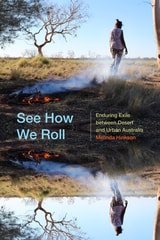
See How We Roll
Enduring Exile between Desert and Urban AustraliaMelinda Hinkson
Duke University Press, 2021
In See How We Roll Melinda Hinkson follows the experiences of Nungarrayi, a Warlpiri woman from the Central Australian desert, as she struggles to establish a new life for herself in the city of Adelaide. Banished from her hometown, Nungarrayi energetically navigates promises of transformation as well as sedimented racialized expectations on the urban streets. Drawing on a decades-long friendship, Hinkson explores these circumstances through Nungarrayi's relationships: those between her country and kin that sustain and confound life beyond the desert, those that regulate her marginalized citizenship, and the new friendships called out by displacement and metropolitan life. An intimate ethnography, See How We Roll provides great insight into the enduring violence of the settler colonial state while illuminating the efforts of Indigenous people to create lives of dignity and shared purpose in the face of turbulence, grief, and tightening governmental controls.
[more]
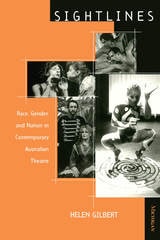
Sightlines
Race, Gender, and Nation in Contemporary Australian TheatreHelen Gilbert
University of Michigan Press, 1998
Sightlines: Race, Gender, and Nation in Contemporary Australian Theatre asserts the centrality of theater to the ongoing negotiations of the Australian context. By exploring ways in which ideas about race, gender, and nation are expressed in concrete theatrical contexts, the performative qualities of theatrical representation are revealed as compelling, important sites of critique. Helen Gilbert discusses an exciting variety of plays, drawing examples from marginalized groups as well as from the theatrical mainstream. While fully engaged with the discourses of contemporary critical thought, Sightlines remains focused on the material stuff of the theater, grounding its discussion in the visual elements of costume, movement, and scenography. And although focused specifically on performance, the author's insistent interest in historical and political contexts also speaks to the broader concerns of cultural studies. The book's recurrent concern with representations of Aboriginality, particularly in the works of nonindigenous playwrights, draws attention to racial politics as a perennial motif in postcolonial nations. Its illumination of the relationships between patriarchy and imperialism is supported by an extensive discussion of plays by and about women. This nomadic approach marks Sightlines as a groundbreaking study of recent Australian theater, a provocative application of postcolonial theory to the embodied qualities of theatrical representation. "An impressive and ground-breaking study that provides a coherent postcolonial approach to Australian drama." --Bill Ashcroft, University of New South Wales "Elegantly written, and always beautifully lucid in its argument. . . . this is a very original work, particularly in its marriage of performance theory and postcolonial analysis." --Deidre Coleman, University of Sydney Helen Gilbert is Lecturer in Drama and Theatre Studies, University of Queensland, and co-author, with Joanne Tompkins, of Post-Colonial Drama: Theory, Practice, Politics.
[more]
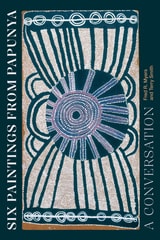
Six Paintings from Papunya
A ConversationFred R. Myers and Terry Smith
Duke University Press, 2024
In the early 1970s at Papunya, a remote settlement in the Central Australian desert, a group of Indigenous artists decided to communicate the sacred power of their traditional knowledge to the wider worlds beyond their own. Their exceptional, innovative efforts led to an outburst of creative energy across the continent that gave rise to the contemporary Aboriginal art movement that continues to this day. In their new book, anthropologist Fred Myers and art critic Terry Smith discuss six Papunya paintings featured in a 2022 exhibition in New York. They draw on several discourses that have developed around First Nations art—notably anthropology, art history, and curating as practiced by Indigenous and non-Indigenous interpreters. Their focus on six key paintings enables unusually close and intense insight into the works’ content and extraordinary innovation. Six Paintings from Papunya also includes a reflection by Indigenous curator and scholar Stephen Gilchrist, who considers the nature and significance of this rare transcultural conversation.
[more]

Spirit of Australia
The Crime Fiction of Arthur W. UpfieldUniversity of Wisconsin Press, 1988
In the world of crime fiction, Arthur W. Upfield stands among the giants. His detective-inspector Napoleon Bonaparte, is one of the most memorable of all crime fighters. Upfield was an independent, fiercely self-assertive ex-Britisher, who loved Australia, especially the Outback. In many ways Upfield became Outback Australia—the “Spirit of Australia.”
Library of Congress subject headings for this publication:
Upfield, Arthur William, -- 1888-1964 -- Criticism and interpretation.
Detective and mystery stories, Australian -- History and criticism.
Bonaparte, Napoleon, Inspector (Fictitious character)
National characteristics, Australian, in literature.
Australia -- In literature.
Police in literature.
Crime in literature.