Results by title
67 books match the query 'Austria' and 3 start with s
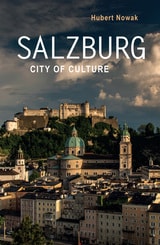
Salzburg
City of CultureHubert Nowak
Haus Publishing, 2020
Now in paperback, Nowak reveals the lesser-known side of Salzburg through stories of those who have lived there over the centuries.
Situated in the shadow of the Eastern Alps, Salzburg is known for its majestic baroque architecture, music, cathedrals, and gardens. The city grew in power and wealth as the seat of prince-bishops, found international fame as the birthplace of the beloved composer Mozart, and expanded to become a global destination for travel as a festival city. With all its stunning sights and rich history, Salzburg has become Austria’s second most visited city, drawing visitors from around the world.
Hubert Nowak sets out to reveal the lesser-known side of Salzburg, a small town with international renown. Leaving the famed festival district, he plunges into the narrow façade-lined streets of the old quarter, creating one of the most extensive accounts of the city published in English. Through the stories of those who visited and lived in the city over the centuries, he gives the reader a fresh perspective and gives the old city new life.
[more]

Soviet Occupation of Romania, Hungary, and Austria 1944/45–1948/49
László Borhi
Central European University Press, 2015
This book compares the various aspects – political, military economic – of Soviet occupation in Austria, Hungary and Romania. Using documents found in Austrian, Hungarian, Romanian and Russian archives the authors argue that the nature of Soviet foreign policy has been misunderstood. Existing literature has focused on the Soviet foreign policy from a political perspective; when and why Stalin made the decision to introduce Bolshevik political systems in the Soviet sphere of influence. This book will show that the Soviet conquest of East-Central Europe had an imperial dimension as well and allowed the Soviet Union to use the territory it occupied as military and economic space. The final dimension of the book details the tragically human experiences of Soviet occupation: atrocities, rape, plundering and deportations.
[more]
Style and Seduction
Jewish Patrons, Architecture, and Design in Fin de Siècle ViennaElana Shapira
Brandeis University Press, 2016
A recent surge of interest in Jewish patronage during the golden years of Vienna has led to the question, Would modernism in Vienna have developed in the same fashion had Jewish patrons not been involved? This book uniquely treats Jewish identification within Viennese modernism as a matter of Jews active fashioning of a new language to convey their aims of emancipation along with their claims of cultural authority. In this provocative reexamination of the roots of Viennese modernism, Elana Shapira analyzes the central role of Jewish businessmen, professionals, and writers in the evolution of the city’s architecture and design from the 1860s to the 1910s. According to Shapira, these patrons negotiated their relationship with their non-Jewish surroundings and clarified their position within Viennese society by inscribing Jewish elements into the buildings, interiors, furniture, and design objects that they financed, produced, and co-designed. In the first book to investigate the cultural contributions of the banker Eduard Todesco, the steel tycoon Karl Wittgenstein, the textile industrialist Fritz Waerndorfer, the author Peter Altenberg, the tailor Leopold Goldman, and many others, Shapira reconsiders theories identifying the crisis of Jewish assimilation as a primary creative stimulus for the Jewish contribution to Viennese modernism. Instead, she argues that creative tensions between Jews and non-Jews—patrons and designers who cooperated and arranged well-choreographed social encounters with one another—offer more convincing explanations for the formation of a new semantics of modern Viennese architecture and design than do theories based on assimilation. This thoroughly researched and richly illustrated book will interest scholars and students of Jewish studies, Vienna and Viennese culture, and modernism.
[more]