Results by title
208 books match the query 'Autobiography' and 10 start with s
Sab and Autobiography
By Gertrudis Gómez de Avellaneda y Arteaga
University of Texas Press, 1993
Eleven years before Uncle Tom's Cabin fanned the fires of abolition in North America, an aristocratic Cuban woman told an impassioned story of the fatal love of a mulatto slave for his white owner's daughter. So controversial was Sab's theme of miscegenation and its parallel between the powerlessness and enslavement of blacks and the economic and matrimonial subservience of women that the book was not published in Cuba until 1914, seventy-three years after its original 1841 publication in Spain.
Also included in the volume is Avellaneda's Autobiography (1839), whose portrait of an intelligent, flamboyant woman struggling against the restrictions of her era amplifies the novel's exploration of the patriarchal oppression of minorities and women.
Self as Nation
Contemporary Hebrew AutobiographyTamar S. Hess
Brandeis University Press, 2016
Shared Selves
Latinx Memoir and Ethical Alternatives to HumanismSuzanne Bost
University of Illinois Press, 2019
Signifying Bodies
Disability in Contemporary Life WritingG. Thomas Couser
University of Michigan Press, 2010
"Thomas Couser's Signifying Bodies comes at a crucial moment when debates about physician assisted suicide, genetic engineering, and neo-natal screening are raising the question of what constitutes a 'life worth living' for persons with disabilities. Couser's work engages these debates by exploring the extensive number of personal narratives by or about persons with disabilities. As Couser brilliantly demonstrates through synoptic readings, these works challenge the 'preferred rhetorics' by which such narratives are usually written (triumphalist, gothic, nostalgic) while making visible the variegated nature of embodied life."
---Michael Davidson, University of California, San Diego
"Signifying Bodies shows us that life writing about disability is . . . everywhere. . . . From obituary to documentary film to ethnography to literary memoir to the law, the book casts a wide net, detailing how various written and filmed responses to disability both enact and resist conventional narrative patterns. [This] not only broadens our idea about where to look for life writing, but also demonstrates how thoroughly stereotypes about disability mediate our social and artistic languages---even when an author has (so-called) the best intentions."
---Susannah B. Mintz, Skidmore College
Memoirs have enjoyed great popularity in recent years, experiencing significant sales, prominent reviews, and diverse readerships. Signifying Bodies shows that at the heart of the memoir phenomenon is our fascination with writing that focuses on what it means to live in, or be, an anomalous body---in other words, what it means to be disabled. Previous literary accounts of the disabled body have often portrayed it as a stable entity possibly signifying moral deviance or divine disfavor, but contemporary writers with disabilities are defining themselves and depicting their bodies in new ways. Using the insights of disability studies and source material ranging from the Old and New Testaments to the works of authors like Lucy Grealy and Simi Linton and including contemporary films such as Million Dollar Baby, G. Thomas Couser sheds light on a broader cultural phenomenon, exploring topics such as the ethical issues involved in disability memoirs, the rhetorical patterns they frequently employ, and the complex relationship between disability narrative and disability law.
G. Thomas Couser is Professor of English at Hofstra University.
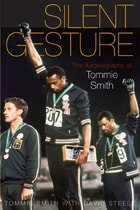
Silent Gesture
The Autobiography of Tommie SmithTommie Smith with David Steele
Temple University Press, 2008
n 1968, Tommie Smith and his teammate John Carlos won the gold and silver medals, respectively, for the 200 meter dash. Receiving their medals on the dais, they raised their fists and froze a moment in time that will forever be remembered as a powerful day of protest. In this, his autobiography, Smith tells the story of that moment, and of his life before and after it, to explain what that moment meant to him.
In Silent Gesture, Smith recounts his life before and after the 1968 Olympics: his life-long commitment to athletics, education, and human rights. He dispels some of the myths surrounding his and Carlos' act on the dais -- contrary to legend, Smith wasn't a member of the Black Panthers, but a member of the US Olympic Project for Human Rights -- and describes in detail the planning and risks involved in his protest. Smith also details his many years after Mexico City of devotion to human rights, athletics, and education. A unique resource for anyone concerned with international sports, history, and the African American experience, Silent Gesture contributes a complete picture of one of the most famous moments in sports history, and of a man whose actions always matched his words.
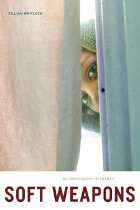
Soft Weapons
Autobiography in TransitGillian Whitlock
University of Chicago Press, 2007
Azar Nafisi’s Reading Lolita in Tehran,Marjane Satrapi’s comics, and “Baghdad Blogger” Salam Pax’s Internet diary are just a few examples of the new face of autobiography in an age of migration, globalization, and terror. But while autobiography and other genres of life writing can help us attend to people whose experiences are frequently unseen and unheard, life narratives can also be easily co-opted into propaganda. In Soft Weapons, Gillian Whitlock explores the dynamism and ubiquity of contemporary life writing about the Middle East and shows how these works have been packaged, promoted, and enlisted in Western controversies.
Considering recent autoethnographies of Afghan women, refugee testimony from Middle Eastern war zones, Jean Sasson’s bestsellers about the lives of Arab women, Norma Khouri’s fraudulent memoir Honor Lost, personal accounts by journalists reporting the war in Iraq, Satrapi’s Persepolis, Nafisi’s book, and Pax’s blog, Whitlock explores the contradictions and ambiguities in the rapid commodification of life memoirs. Drawing from the fields of literary and cultural studies, Soft Weapons will be essential reading for scholars of life writing and those interested in the exchange of literary culture between Islam and the West.

Solitary Song
An AutobiographyPauline Koner
Duke University Press, 1989
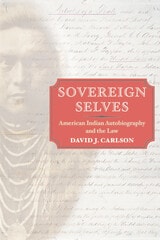
Sovereign Selves
American Indian Autobiography and the LawDavid J. Carlson
University of Illinois Press, 2005
Carlson argues that by drawing on the conventions of early colonial treaty-making, nineteenth- and early twentieth-century Indian autobiographers sought to adapt and redefine the terms of Indian law as a way to assert specific property-based and civil rights. Focusing primarily on the autobiographical careers of two major writers (William Apess and Charles Eastman), Sovereign Selves traces the way that their sustained engagement with colonial legal institutions gradually enabled them to produce a new rhetoric of "Indianness."
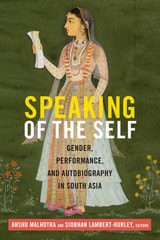
Speaking of the Self
Gender, Performance, and Autobiography in South AsiaAnshu Malhotra and Siobhan Lambert-Hurley, editors
Duke University Press, 2015
Contributors: Asiya Alam, Afshan Bokhari, Uma Chakravarti, Kathryn Hansen, Siobhan Lambert-Hurley, Anshu Malhotra, Ritu Menon, Shubhra Ray, Shweta Sachdeva Jha, Sylvia Vatuk
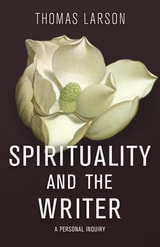
Spirituality and the Writer
A Personal InquiryThomas Larson
Ohio University Press, 2019
Today, the surprisingly elastic form of the memoir embraces subjects that include dying, illness, loss, relationships, and self-awareness. Writing to reveal the inner self—the pilgrimage into one’s spiritual and/or religious nature—is a primary calling. Contemporary memoirists are exploring this field with innovative storytelling, rigorous craft, and new styles of confessional authorship. Now, Thomas Larson brings his expertise as a critic, reader, and teacher to the boldly evolving and improvisatory world of spiritual literature.
In his book-length essay Spirituality and the Writer, Larson surveys the literary insights of authors old and new who have shaped religious autobiography and spiritual memoir—from Augustine to Thomas Merton, from Peter Matthiessen to Cheryl Strayed. He holds them to an exacting standard: they must render transcendent experience in the writing itself. Only when the writer’s craft prevails can the fleeting and profound personal truths of the spirit be captured. Like its predecessor, Larson’s The Memoir and the Memoirist,Spirituality and the Writer will find a home in writing classrooms and book groups, and be a resource for students, teachers, and writers who seek guidance with exploring their spiritual lives.