Results by title
56 books match the query 'Aviation & Space' and 5 start with s
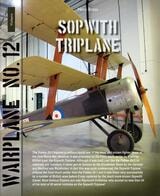
Sopwith Triplane
Nico Braas
Amsterdam University Press, 2022

Spaceflight and the Myth of Presidential Leadership
Edited by Roger D. Launius and Howard E. McCurdy
University of Illinois Press, 1997
Setting the tone for the collection, NASA chief historian Roger D. Launius and Howard McCurdy maintain that the nation's presidency had become imperial by the mid-1970s and that supporters of the space program had grown to find relief in such a presidency, which they believed could help them obtain greater political support and funding. Subsequent chapters explore the roles and political leadership, vis-à-vis government policy, of presidents Eisenhower, Kennedy, Johnson, Nixon, Ford, Carter, and Reagan.
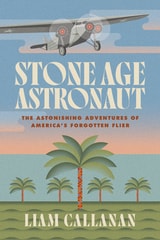
Stone Age Astronaut
The Astonishing Adventures of America’s Forgotten FlierLiam Callanan
Wisconsin Historical Society Press, 2026
A soaring adventure, a riveting biography, and a reclamation of a great American story lost to history.
In Stone Age Astronaut, award-winning author Liam Callanan uncovers the astonishing life of Lester Maitland—the Milwaukee-born aviator who, in 1927, became the first person to fly to Hawaii, earning national acclaim on par with Charles Lindbergh’s transatlantic triumph. For a brief moment, the two men shared headlines, White House invitations, and fame. But while Lindbergh’s legacy grew, Maitland’s all but vanished.
Callanan brings Maitland back into the spotlight, tracing his meteoric early career: flight instructor at nineteen; one of the US Army’s first test pilots; the first American to fly faster than 200 mph; and the pioneering airman whose Pacific crossing earned him the Distinguished Flying Cross.
Just twenty-two days after becoming Executive Officer of the Far East Air Service Command—and one day after Pearl Harbor—Maitland witnessed the destruction of much of the Far East Air Force in the Philippines. Later, he commanded the 386th Bomb Group in Europe, making him World War II’s oldest bomber pilot, only to be abruptly and mysteriously retired weeks before D-Day. After the war, Maitland experienced a series of professional and personal disappointments, and he quietly faded into obscurity. He eventually became an Episcopal priest, serving small parishes far from the glamour of his early days in the cockpit.
The pages of Stone Age Astronaut hum with the tension and excitement of early aviation, rendered in a richly detailed narrative and Callanan’s research—spanning archives, newspapers, interviews, and travel to key sites—to reveal the remarkable sweep of Lester Maitland’s world. Along the way, readers encounter a constellation of notable figures: Amelia Earhart, Billy Mitchell, Ernest Hemingway, Gerald Ford, Richard Bong, the Dole Pineapple King, Harry Houdini, and even a Skull and Bones–affiliated aviation official.
With sparkling prose and a storyteller’s instinct for detail, Callanan resurrects a man whose life intersected with major events, eras, and personalities—but who has inexplicably slipped through the cracks of American memory.
A gripping portrait of ambition, innovation, fame, failure, and reinvention—and the enduring human urge to fly—Stone Age Astronaut ensures that Lester Maitland’s extraordinary story will no longer be forgotten.
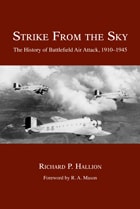
Strike From the Sky
The History of Battlefield Air Attack, 1910-1945Richard P. Hallion, foreword by R. A. Mason
University of Alabama Press, 2010
The definitive history of how air power transformed the battlefield between two world wars.
Strike from the Sky: The History of Battlefield Air Attack, 1910–1945 is a comprehensive examination of the emergence and evolution of battlefield aviation during the first half of the twentieth century. Written by renowned aviation historian Richard P. Hallion, the book traces the development of air-ground warfare from the earliest military use of aircraft in combat through the decisive campaigns of World War II. Combining operational history with analysis of doctrine, technology, and leadership, Hallion reveals how battlefield air attack became a critical element of modern military strategy.
The study explores major conflicts including the First World War, the Spanish Civil War, colonial campaigns, and the global battles of World War II. Hallion examines the evolution of close air support, air interdiction, reconnaissance, command and control systems, and the aircraft that carried out these missions. He also analyzes how military organizations adapted to the challenges of integrating air and ground forces, creating doctrines that continue to influence military operations today.
Strike from the Sky demonstrates how advances in aviation transformed the battlefield and altered the conduct of war. It remains an essential resource for understanding the origins of modern air power and the technological and strategic innovations that reshaped twentieth-century combat.
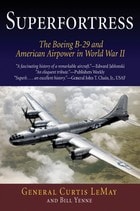
Superfortress
The Boeing B-29 and American Airpower in World War IICurtis LeMay
Westholme Publishing, 2007
"A fascinating history of a remarkable aircraft."—Edward Jablonski
"An eloquent tribute." —Publishers Weekly
"Superb. . . . an excellent history." —General John T. Chain, Jr. USAF
Among the most sophisticated aircraft flown during World War II, the Boeing B-29 Superfortress was designed to replace the B-17 as the primary long-range bomber of the U.S. Army Air Forces. With its distinctive glazed nose and long, thin wings that provided both speed at high altitude and stability at takeoff and landing, the Superfortress was the first operational bomber with a pressurized crew cabin and featured advanced radar and avionics. Armed with remote-controlled machine gun turrets and a 20,000 pound bomb load, it was the first USAAF bomber capable of mastering the vast distances of the Pacific Theater of World War II. The prototype flew in September 1942 but a series of post-production modifications delayed the bomber's first mission until April 1944. Superfortresses began attacking Japan in daylight with conventional ordnance from high altitude, but their mission was redirected in March 1945, with massive low-level formations dropping incendiary bombs! at night on Japanese cities. The ensuing firestorms, followed by the complete destruction of Hiroshima and Nagasaki by atomic bombs dropped from two specially modified "silverplate" B-29s, forced Japan to cease fighting.
Written by the man who led the B-29 into combat, Superfortress: The Boeing B-29 and American Airpower in World War II is an important document of one of the most turbulent times in world history. General Curtis LeMay recalls the early debate about whether or not the United States needed a long-range bomber, how the B-29 was created and produced despite the enormous logistical difficulties of the design, and the decision to conduct fire-bombings against Japan and ultimately drop the atomic bomb. Highly praised when it was first published, this new edition is complete with photographs, a new introduction, and statistical tables.