85 books match the query 'Black' and 8 start with s
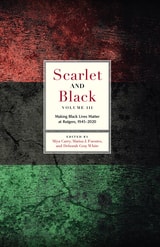
cover of Scarlet and Black, Volume Three: Making Black Lives Matter at Rutgers, 1945-2020

Scarlet and Black, Volume Three

Making Black Lives Matter at Rutgers, 1945-2020

Miya Carey

Rutgers University Press, 2021
The 250th anniversary of the founding of Rutgers University is a perfect moment for the Rutgers community to reconcile its past, and acknowledge its role in the enslavement and debasement of African Americans and the disfranchisement and elimination of Native American people and culture. Scarlet and Black, Volume Three, concludes this groundbreaking documentation of the history of Rutgers’s connection to slavery, which was neither casual nor accidental—nor unusual. Like most early American colleges, Rutgers depended on slaves to build its campuses and serve its students and faculty; it depended on the sale of black people to fund its very existence. This final of three volumes concludes the work of the Committee on Enslaved and Disenfranchised Population in Rutgers History. This latest volume includes essays about Black and Puerto Rican students' experiences; the development of the Black Unity League; the Conklin Hall takeover; the divestment movement against South African apartheid; anti-racism struggles during the 1990s; and the Don Imus controversy and the 2007 Scarlet Knights women's basketball team. To learn more about the work of the Committee on Enslaved and Disenfranchised Population in Rutgers History, visit the project's website at http://scarletandblack.rutgers.edu.
[more]
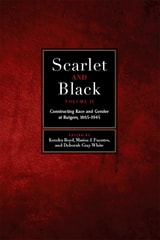
cover of Scarlet and Black, Volume Two: Constructing Race and Gender at Rutgers, 1865-1945

Scarlet and Black, Volume Two

Constructing Race and Gender at Rutgers, 1865-1945

Kendra Boyd

Rutgers University Press, 2020

The 250th anniversary of the founding of Rutgers University is a perfect moment for the Rutgers community to reconcile its past, and acknowledge its role in the enslavement and debasement of African Americans and the disfranchisement and elimination of Native American people and culture. Scarlet and Black, Volume 2, continues to document the history of Rutgers’s connection to slavery, which was neither casual nor accidental—nor unusual. Like most early American colleges, Rutgers depended on slaves to build its campuses and serve its students and faculty; it depended on the sale of black people to fund its very existence. This second of a planned three volumes continues the work of the Committee on Enslaved and Disenfranchised Population in Rutgers History. This latest volume includes: an introduction to the period studied (from the end of the Civil War through WWII) by Deborah Gray White; a study of the first black students at Rutgers and New Brunswick Theological Seminary; an analysis of African-American life in the City of New Brunswick during the period; and profiles of the earliest black women to matriculate at Douglass College.

To learn more about the work of the Committee on Enslaved and Disenfranchised Population in Rutgers History, visit the project's website at http://scarletandblack.rutgers.edu
[more]
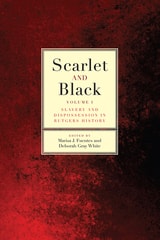
cover of Scarlet and Black: Slavery and Dispossession in Rutgers History

Scarlet and Black

Slavery and Dispossession in Rutgers History

Fuentes, Marisa J

Rutgers University Press, 2016

The 250th anniversary of the founding of Rutgers University is a perfect moment for the Rutgers community to reconcile its past, and acknowledge its role in the enslavement and debasement of African Americans and the disfranchisement and elimination of Native American people and culture.

Scarlet and Black documents the history of Rutgers’s connection to slavery, which was neither casual nor accidental—nor unusual. Like most early American colleges, Rutgers depended on slaves to build its campuses and serve its students and faculty; it depended on the sale of black people to fund its very existence. Men like John Henry Livingston, (Rutgers president from 1810–1824), the Reverend Philip Milledoler, (president of Rutgers from 1824–1840), Henry Rutgers, (trustee after whom the college is named), and Theodore Frelinghuysen, (Rutgers’s seventh president), were among the most ardent anti-abolitionists in the mid-Atlantic.

Scarlet and black are the colors Rutgers University uses to represent itself to the nation and world. They are the colors the athletes compete in, the graduates and administrators wear on celebratory occasions, and the colors that distinguish Rutgers from every other university in the United States. This book, however, uses these colors to signify something else: the blood that was spilled on the banks of the Raritan River by those dispossessed of their land and the bodies that labored unpaid and in bondage so that Rutgers could be built and sustained. The contributors to this volume offer this history as a usable one—not to tear down or weaken this very renowned, robust, and growing institution—but to strengthen it and help direct its course for the future.

The work of the Committee on Enslaved and Disenfranchised Population in Rutgers History.

Visit the project's website at http://scarletandblack.rutgers.edu
 

[more]
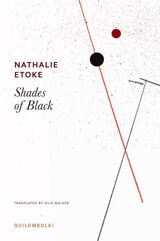
cover of Shades of Black

Shades of Black

Nathalie Etoke

Seagull Books, 2021

One might say that the womb of death—the Middle Passage, slavery, and colonization—gave birth to Black populations. Taking this observation as her point of departure, Nathalie Etoke examines Black existence today in her riveting new book, Shades of Black. In a white supremacist world, Black bodies hold a specific position, invested with a range of meaning that maintains them in a fixed role, with a script they did not write. The white world has invented and defined the Black person according to its own interests, endowing her with a bereaved humanity. The Black person is confronted with an essential paradox—exist as Black or as a human being? Does the Black person exist for herself or for the other? In the white world, is the Black race the embodiment of a sub-humanity?

Situated at the crossroads of three countries—Cameroon, France, and, now, the United States—Nathalie Etoke is uniquely positioned for this polyphonic reflection on race. She examines what happens when race obliterates historical, social, cultural, and political differences among populations of African descent from different parts of the world. Focusing on recent and ongoing topics in the United States, including the murder of George Floyd, police brutality, the complex symbolism of Barack Obama and Kamala Harris, Etoke explores the relations of violence, oppression, dispossession, and inequalities that have brought us here, face to face with these existential questions: Are you breathing? Are we breathing?

[more]
cover of Shades of Black: Assembling Black Arts in 1980s Britain

Shades of Black

Assembling Black Arts in 1980s Britain

David A. Bailey, Ian Baucom, and Sonia Boyce, eds.

Duke University Press, 2005

In the 1980s—at the height of Thatcherism and in the wake of civil unrest and rioting in a number of British cities—the Black Arts Movement burst onto the British art scene with breathtaking intensity, changing the nature and perception of British culture irreversibly. This richly illustrated volume presents a history of that movement. It brings together in a lively dialogue leading artists, curators, art historians, and critics, many of whom were actively involved in the Black Arts Movement. Combining cultural theory with anecdote and experience, the contributors debate how the work of the black British artists of the 1980s should be viewed historically. They consider the political, cultural, and artistic developments that sparked the movement even as they explore the extent to which such a diverse body of work can be said to constitute a distinct artistic movement—particularly given that “black” in Britain in the 1980s encompassed those of South Asian, North and sub-Saharan African, and Caribbean descent, referring as much to shared experiences of disenfranchisement as to shades of skin.

In thirteen original essays, the contributors examine the movement in relation to artistic practice, public funding, and the transnational art market and consider its legacy for today’s artists and activists. The volume includes a unique catalog of images, an extensive list of suggested readings, and a descriptive timeline situating the movement vis-à-vis relevant artworks and films, exhibitions, cultural criticism, and political events from 1960 to 2000. A dynamic living archive of conversations, texts, and images, Shades of Black will be an essential resource.

Contributors. Stanley Abe, Jawad Al-Nawab, Rasheed Araeen, David A. Bailey, Adelaide Bannerman, Ian Baucom, Dawoud Bey, Sonia Boyce, Allan deSouza, Jean Fisher, Stuart Hall, Lubaina Himid, Naseem Khan, susan pui san lok, Kobena Mercer, Yong Soon Min, Keith Piper, Zineb Sedira, Gilane Tawadros, Leon Wainwright, Judith Wilson
[more]
cover of Shades of Black: Diversity in African American Identity

Shades of Black

Diversity in African American Identity

William Cross

Temple University Press, 1991

[more]
cover of Songs in Black and Lavender: Race, Sexual Politics, and Women's Music

Songs in Black and Lavender

Race, Sexual Politics, and Women's Music

Eileen M. Hayes, Foreword by Linda Tillery

University of Illinois Press, 2010

Drawing on fieldwork conducted at eight women's music festivals, Eileen M. Hayes shows how studying these festivals--attended by predominately white lesbians--provides critical insight into the role of music and lesbian community formation. She argues that the women's music festival is a significant institutional site for the emergence of black feminist consciousness in the contemporary period. Hayes also offers sage perspectives on black women's involvement in the women's music festival scene, the ramifications of their performances as drag kings in those environments, and the challenges and joys of a black lesbian retreat based on the feminist festival model. With acuity and candor, longtime feminist activist Hayes elucidates why this music scene matters. Veteran vocalist, percussionist, producer, and cultural historian Linda Tillery provides a foreword.
[more]
cover of Stories in Red and Black: Pictorial Histories of the Aztecs and Mixtecs

Stories in Red and Black

Pictorial Histories of the Aztecs and Mixtecs

By Elizabeth Hill Boone

University of Texas Press, 2000

Winner, Arvey Award, Association for Latin American Art, 2001
Honorable Mention, Honorable Mention, George Wittenborn Memorial Book Award, Art Libraries Society of North America, 2001

The Aztecs and Mixtecs of ancient Mexico recorded their histories pictorially in images painted on hide, paper, and cloth. The tradition of painting history continued even after the Spanish Conquest, as the Spaniards accepted the pictorial histories as valid records of the past. Five Pre-Columbian and some 150 early colonial painted histories survive today.

This copiously illustrated book offers the first comprehensive analysis of the Mexican painted history as an intellectual, documentary, and pictorial genre. Elizabeth Hill Boone explores how the Mexican historians conceptualized and painted their past and introduces the major pictorial records: the Aztec annals and cartographic histories and the Mixtec screenfolds and lienzos.

Boone focuses her analysis on the kinds of stories told in the histories and on how the manuscripts work pictorially to encode, organize, and preserve these narratives. This twofold investigation broadens our understanding of how preconquest Mexicans used pictographic history for political and social ends. It also demonstrates how graphic writing systems created a broadly understood visual "language" that communicated effectively across ethnic and linguistic boundaries.

[more]