Results by title
171 books match the query 'Books & Reading' and 3 start with s
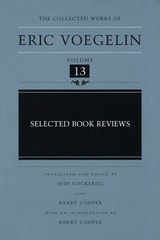
Selected Book Reviews (CW13)
Eric Voegelin, Edited & Translated by Jodi Cockerill and Barry Cooper, & Intro by Jodi Cockerill
University of Missouri Press, 2001
Over the course of his varied and distinguished academic life, Eric Voegelin was often called upon by review editors of scholarly journals as well as by editors in the popular press to examine, summarize, and critically assess the work of other scholars, of statesmen, and of men of affairs. The contents of the books Voegelin reviewed mirror his changing interests over the years, including questions of method, points of legal philosophy and jurisprudence, and issues of race, war, and the aftermath of war. Of course, he was frequently called upon as well to review standard texts and new editions and monographs across the full range of political science.
This collection of Voegelin's reviews amounts to a reflection in miniature of many of the problems Voegelin tackled in his essays, articles, and books from the 1920s until the 1950s, when, owing to the press of other business, he began to decline requests to review the work of others. Some of his reviews are little more than clinical summaries; others are analytic essays. A few are extended engagements with a text or a set of problems. Occasionally, particularly among the later reviews originally written in English, one finds flashes of Voegelin's legendary wit and a restrained impatience with the inadequate approaches or sheer incompetence of others. These book reviews will be of interest to all students and scholars of Eric Voegelin's work.
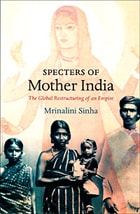
Specters of Mother India
The Global Restructuring of an EmpireMrinalini Sinha
Duke University Press, 2006
Sinha provides a rich historical narrative of the controversy surrounding Mother India, from the book’s publication through the passage in India of the Child Marriage Restraint Act in the closing months of 1929. She traces the unexpected trajectory of the controversy as critics acknowledged many of the book’s facts only to overturn its central premise. Where Mayo located blame for India’s social backwardness within the beliefs and practices of Hinduism, the critics laid it at the feet of the colonial state, which they charged with impeding necessary social reforms. As Sinha shows, the controversy became a catalyst for some far-reaching changes, including a reconfiguration of the relationship between the political and social spheres in colonial India and the coalescence of a collective identity for women.
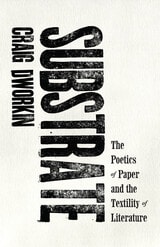
Substrate
The Poetics of Paper and the Textility of LiteratureCraig Dworkin
University of Chicago Press, 0
A study of the signifying potential of paper, the foundational material for literary texts in the modern era.
For ease of reading, the paper of a printed page must recede far enough into the background to make ink legible. Yet paper—the primary substrate for literary texts—has its own signifying potential, its own poetics. Craig Dworkin shows that looking at the page, rather than through its illusory withdrawal, can unlock interpretive insights that readers would otherwise miss. What often seems incidental can prove to be as semantically important as the words of the text themselves.
Substrate argues that the material affordances of paper in general—its pliability, fibrous weave, and capacity to fold, tear, crumple, and shuffle—variously inform the poetics of William Blake, Stéphane Mallarmé, Jen Bervin, and Susan Howe. For all four of these poets, the qualities of paper serve as models for structuring the language of their poems in innovative ways. Dworkin further shows how each poet in turn engages paper at another level by incorporating it within the thematic ambit of key poems. The full meaning of these poems is thus inextricable from their printing. Substrate is a brilliant inquiry in poetics and the logic of media more generally.