Results by title
379 books match the query 'Botany' and 11 start with s
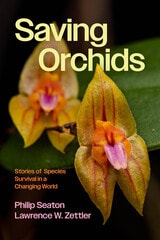
Saving Orchids
Stories of Species Survival in a Changing WorldPhilip Seaton and Lawrence W. Zettler
University of Chicago Press, 2025
A gorgeously illustrated ode to the beauty and significance of orchids—and to those fighting to save these unique plants across the globe.
Until recently, a myriad of lifeforms enriched our lives. In some places, listening to a nighttime chorus of frogs in the neighborhood marsh was an archetypal touchstone of childhood. Children would search for tadpoles, just steps away from native Lady’s Tresses orchids. Year by year, the chorus became quieter. Today, only a few frogs and orchids remain. Is this the world we want our children to inherit? Do we want orchids to slip through our fingers and, eventually, to vanish?
For biologists Philip Seaton and Lawrence W. Zettler, and the intrepid orchid defenders they introduce in this book, the answer is no. Seaton and Zettler have traveled the world over the past three decades, studying orchids—flagship species for plant conservation. Stunningly illustrated, this book is a culmination of stories about the people—young and old alike—dedicated to protecting these remarkable plants from extinction. In the 19th century, collectors removed, shipped, and sold vast numbers of orchids from the wild. Today, scientists strive to reverse this harm—to protect and rebuild remnants of orchids’ original habitats against human disruption, including climate change. Seaton and Zettler reveal these plants’ bizarre pollination partners, risky liaisons with fungi, and adaptation to human domestication to show that learning orchids’ scientific secrets—and finding human helpers—is key to these plants’ survival.
Seaweeds of the Northwest Atlantic
Arthur C. Mathieson
University of Massachusetts Press, 2017
The introductory chapter provides a historical review of seaweed studies as well as a description of 15 geographical sites designated in the text. Three chapters on the green, brown, and red alga include more than 256 genera, 510 species, 10 subspecies, 21 varieties, and 14 forms. New taxonomic combinations and descriptions of several previously undescribed taxa are also included in the text. The modern classification reviews molecular as well as reproductive, morphological, and biological data. The work represents more than forty years of research on Northwest Atlantic seaweeds and will aid researchers throughout the Northeast and Southwest Atlantic coasts. The authors detail the taxonomy, morphology, cytology, and name derivation of various taxonomic entities, as well as the ecology and distribution patterns of over 555 taxa. The text includes keys to genera and species, a glossary, and sources of further information.
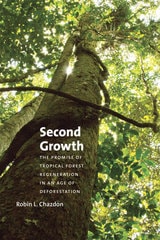
Second Growth
The Promise of Tropical Forest Regeneration in an Age of DeforestationRobin L. Chazdon
University of Chicago Press, 2014
Even as human activities result in extensive fragmentation and deforestation, tropical forests demonstrate a great capacity for natural and human-aided regeneration. Although these damaged landscapes can take centuries to regain the characteristics of old growth, Chazdon shows here that regenerating—or second-growth—forests are vital, dynamic reservoirs of biodiversity and environmental services. What is more, they always have been.
With chapters on the roles these forests play in carbon and nutrient cycling, sustaining biodiversity, providing timber and non-timber products, and integrated agriculture, Second Growth not only offers a thorough and wide-ranging overview of successional and restoration pathways, but also underscores the need to conserve, and further study, regenerating tropical forests in an attempt to inspire a new age of local and global stewardship.

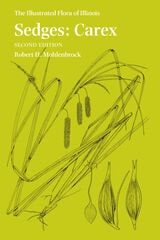
Sedges
CarexRobert H. Mohlenbrock. Illustrated by Paul Nelson
Southern Illinois University Press, 1999
Unique in several respects, Carex is by far the most numerous genus of plants in Illinois. Because of the vast number of species, the similarity of many of the species, and the relatively small size of the critical reproductive structures, the members of this genus are extremely confusing to identify. This book, with its detailed descriptions, key, and precise illustrations, should aid the interested person in the identification of these plants.
Since more than three-fourths of the species of Carex in Illinois are inhabitants of wetlands, an understanding of the genus is critical for those working in wetlands. Amateur and professional botanists will find the information extremely valuable, as well as environmental and conservation groups, garden clubs, farm bureaus, home extension groups, scout organizations, and school libraries. Persons working in natural areas programs and in rare and endangered species programs and those working on environmental impact assessments and wildlife management projects will also find the information pertinent.
Sedges
CarexRobert H. Mohlenbrock
Southern Illinois University Press, 2011
Since the volume’s original publication in 1999, thirty-four additional species of plants have been recognized in Illinois. Some are discoveries from recent field work, some are from more thorough searches of herbaria, and others are from different taxonomic philosophies.
For each species of Carex in Illinois, there is a full illustration showing the habit of the plant and close-ups of various vegetative and reproductive structures that are crucial for the identification of the individual species. There is also a complete description of each species as well as a detailed discussion of the nomenclature and habitats. Range maps show the county distribution of each species in Illinois. A new and detailed key is provided for identification of the species.
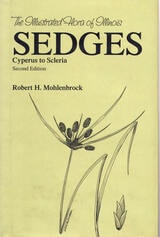
Sedges
Cyperus to ScleriaRobert H. Mohlenbrock
Southern Illinois University Press, 2001
This second edition of Sedges: Cyperus to Scleria brings up to date the identification of species of sedges in Illinois (except Carex) since publication of the first edition in 1976.
During the intervening years, several additions to the sedge flora of Illinois have been made, and many new distributional records have been added. Also, a large number of nomenclatural changes have taken place, resulting in several alterations of scientific names. New illustrations have been provided for all of the additions.
In his introductory material, Robert H. Mohlenbrock discusses the morphology of sedges and the habitats where they can be found. Although the semitechnical keys and descriptions are familiar to experienced botanists, he has simplified them as much as possible to accommodate the novice in sedge identification. He has also included a new key to the sedges and to each genus in which additional species have been added.
For each species, Mohlenbrock has provided a description, statement of habitat and range, Illinois distribution map, discussion, synonymy, and line illustrations showing its diagnostic features. Sedges: Cyperus to Scleria contains 128 illustrations.
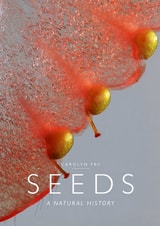
Seeds
A Natural HistoryCarolyn Fry
University of Chicago Press, 2016
With Seeds, Carolyn Fry offers a celebration of these vital but unassuming packages of life. She begins with a sweeping tour through human history, designed to help us understand why we should appreciate and respect these floral parcels. Wheat, corn, and rice, she reminds us, supply the foundations of meals eaten by people around the world. Countless medicines, oils, clothing materials, and building supplies are available only because of the versatility and variety of seed-bearing plants. Fry then provides a comprehensive history of the evolution of seeds, explaining the myriad ways that they have adapted, survived, and thrived across the globe. Delving deeper into the science of seeds, she reveals the fascinating processes of dormancy, reproduction, germination, and dispersal, and showcases the estimable work conservationists are doing today to gather and bank seeds in order to prevent species from going extinct.
Enriched by a stunning array of full-color images, Seeds offers a comprehensive exploration of some of the most enduring and essential players in the natural world.

Sex on the Kitchen Table
The Romance of Plants and Your FoodNorman C. Ellstrand
University of Chicago Press, 2018
In Sex on the Kitchen Table, Norman C. Ellstrand takes us on a vegetable-laced tour of this entire sexual adventure. Starting with the love apple (otherwise known as the tomato) as a platform for understanding the kaleidoscopic ways that plants can engage in sex, successive chapters explore the sex lives of a range of food crops, including bananas, avocados, and beets, finally ending with genetically engineered squash—a controversial, virus-resistant vegetable created by a process that involves the most ancient form of sex. Peppered throughout are original illustrations and delicious recipes, from sweet and savory tomato pudding to banana puffed pancakes, avocado toast (of course), and both transgenic and non-GMO tacos.
An eye-opening medley of serious science, culinary delights, and humor, Sex on the Kitchen Table offers new insight into fornicating flowers, salacious squash, and what we owe to them. So as we sit down to dine and ready for that first bite, let us say a special grace for our vegetal vittles: let’s thank sex for getting them to our kitchen table.
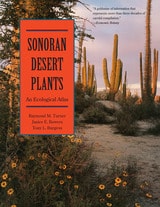
Sonoran Desert Plants
An Ecological AtlasRaymond M. Turner, Janice E. Bowers, and Tony L. Burgess
University of Arizona Press, 1995
An encyclopedia as well as an atlas, this monumental work describes the taxonomy, geographic distribution, and ecology of 339 plants, most of them common and characteristic trees, shrubs, or succulants. Also included is valuable information on natural history and ethnobotanical, commercial, and horticultural uses of these plants. The entry for each species includes a range map, an elevational profile, and a narrative account. The authors also include an extensive bibliography, referring the reader to the latest research and numerous references of historical importance, with a glossary to aid the general reader. Sonoran Desert Plants is a monumental work, unlikely to be superseded in the next generation. As the region continues to attract more people, there will be an increasingly urgent need for basic knowledge of plant species as a guide for creative and sustainable habitation of the area. This book will stand as a landmark resource for many years to come.
Spring Flora of Wisconsin
A Manual of Plants Growing without Cultivation and Flowering Before June 15Norman C. Fassett; Revised and enlarged by Olive S. Thomson
University of Wisconsin Press, 1976
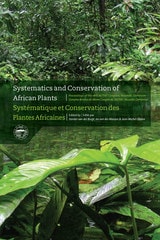
Systematics and Conservation of African Plants
Proceedings of the 18th AETFAT Congress, Yaoundé, CameroonEdited by Xander van der Burgt
Royal Botanic Gardens, Kew, 2010
An edited volume based on the proceedings of the eighteenth Association for the Taxonomic Study of the Flora of Tropical Africa Congress held in Yaoundé, Cameroon, Systematics and Conservation of African Plants includes one hundred research papers in separate sections on taxonomy, phytogeography, ethnobotany, and the conservation and sustainable use of African plants. Topics covered include recent advances in reproductive biology, vegetation, and Podostometaceae in Africa. A separate section on African floras reflects the present state of knowledge and progress towards our understanding and documentation of the plants of Africa.