Results by title
62 books match the query 'British' and 5 start with s
Sherlock Holmes and the Ice Palace Murders
Larry Millett
University of Minnesota Press, 2010
Sherlock Holmes and the Red Demon
Larry Millett
University of Minnesota Press, 2010
The manuscript contains the story of how Sherlock Holmes and Watson traveled to Minnesota to track a murderous arsonist—known only as the Red Demon—who is threatening both Hill and his Great Northern Railway. Set against the backdrop of the real, devastating Hinckley forest fire of 1894, Sherlock Holmes and the Red Demon is the tense and atmospheric first novel in Larry Millett’s classic series of adventures that brought Sherlock Holmes and Dr. Watson to Minnesota.
Sherlock Holmes and the Secret Alliance
Larry Millett
University of Minnesota Press, 2012
As the city of Minneapolis prepares for a visit from President William McKinley, someone else prepares for murder. On the day before the visit, a union activist is found hanged, naked, outside a ruined mansion. A placard around his neck reads “THE SECRET ALLIANCE HAS SPOKEN.” Who is the alliance? What does it want? How was the victim involved with the city’s corrupt mayor? And why did he possess a photograph of a prominent citizen in a compromising position? Shadwell Rafferty searches for answers, encountering bribery, corruption, union organizers, anarchists, and conspiracy, putting himself in danger. But as luck would have it, his old friends Sherlock Holmes and Dr. John H. Watson are on their way.
In this fourth installment of Larry Millett’s Minnesota Mystery series, Shadwell Rafferty commands center stage in a brand-new city. Packed with Millett’s signature historical and architectural detail, this book is deviously delightful.
Something We Have That They Don't
British and American Poetic Relations since 1925Steve & Mark Clark & Ford
University of Iowa Press, 2004
(I like the way the English spell it
They’re so clever about some things
Probably smarter generally than we are
Although there is supposed to be something
We have that they don’'t—'don’t ask me
What it is. . . .)
—John Ashbery, “Tenth Symphony”
Something We Have That They Don’t presents a variety of essays on the relationship between British and American poetry since 1925. The essays collected here all explore some aspect of the rich and complex history of Anglo-American poetic relations of the last seventy years. Since the dawn of Modernism poets either side of the Atlantic have frequently inspired each other’s developments, from Frost’s galvanizing advice to Edward Thomas to rearrange his prose as verse, to Eliot’s and Auden’s enormous influence on the poetry of their adopted nations (“whichever Auden is,” Eliot once replied when asked if he were a British or an American poet, “I suppose, I must be the other”); from the impact of Charles Olson and other Black Mountain poets on J. H. Prynne and the Cambridge School, to the widespread influence of Frank O'Hara and Robert Lowell on a diverse range of contemporary British poets. Clark and Ford’s study aims to chart some of the currents of these ever-shifting relations. Poets discussed in these essays include John Ashbery, W. H. Auden, Elizabeth Bishop, T. S. Eliot, Mark Ford, Robert Graves, Thom Gunn, Lee Harwood, Geoffrey Hill, Michael Hofmann, Susan Howe, Robert Lowell, and W. B. Yeats.
“Poetry and sovereignty,” Philip Larkin remarked in an interview of 1982, “are very primitive things”: these essays consider the ways in which even seemingly very “unprimitive” poetries can be seen as reflecting and engaging with issues of national sovereignty and self-interest, and in the process they pose a series of fascinating questions about the national narratives that currently dominate definitions of the British and American poetic traditions.
This innovative and exciting new collection will be of great interest to students and scholars of British and American poetry and comparative literature.
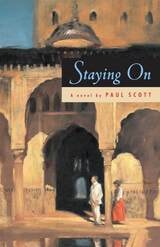
Staying On
A NovelPaul Scott
University of Chicago Press, 1977
"Staying On far transcends the events of its central action. . . . [The work] should help win for Scott . . . the reputation he deserves—as one of the best novelists to emerge from Britain's silver age."—Robert Towers, Newsweek
"Scott's vision is both precise and painterly. Like an engraver cross-hatching in the illusion of fullness, he selects nuances that will make his characters take on depth and poignancy."—Jean G. Zorn, New York Times Book Review
"A graceful comic coda to the earlier song of India. . . . No one writing knows or can evoke an Anglo-Indian setting better than Scott."—Paul Gray, Time
"Staying On provides a sort of postscript to [Scott's] deservedly acclaimed The Raj Quartet. . . . He has, as it were, summoned up the Raj's ghost in Staying On. . . . It is the story of the living death, in retirement, and the final end of a walk-on character from the quartet. . . . Scott has completed the task of covering in the form of a fictional narrative the events leading up to India's partition and the achievement of independence in 1947. It is, on any showing, a creditable achievement."—Malcolm Muggeridge, New York Times Book Review