Results by title
211 books match the query 'Campaigns & Elections' and 7 start with s
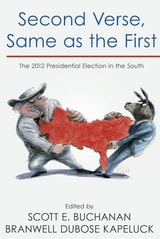
Second Verse, Same as the First
The 2012 Presidential Election in the SouthScott E. Buchanan
University of Arkansas Press, 2014
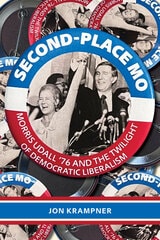
Second-Place Mo
Morris Udall ’76 and the Twilight of Democratic LiberalismJon Krampner
Michigan State University Press, 2027
Second-Place Mo examines the rightward drift of the Democratic Party that began in earnest with Jimmy Carter’s defeat of Morris “Mo” Udall for the Democratic presidential nomination in 1976—a turning point that set the party toward a free-market economy and away from economic liberalism.
The candidacy of Mo Udall, a congressman from Arizona, was the first time in almost a century that a member of the House of Representatives had a chance to become president; it also promised a continuation of the Democrats’ tradition of New Deal liberalism, which had been the party’s guiding star since the 1930s. But the Udall campaign was rocked by events beyond its control, its own mistakes, and the whirlwind candidacy of Jimmy Carter, who went on to win the nomination and the presidency.
Mo Udall chalked up eight second-place primary finishes without a victory. His candidacy was memorable for his dogged persistence, sunny good humor, and unabashed liberalism. This book chronicles a Democratic primary filled with memorable candidates, including the militarist and arch-Zionist Scoop Jackson; the newly minted more-populist-than-thou Fred Harris; the Hamlet-like figures of Birch Bayh and Hubert Humphrey; the fading, injured apostle of the Confederate South, George Wallace; the affable yet ineffective Kennedy in-law, Sargent Shriver; the anti-abortion housewife from Long Island, Ellen McCormack; and others. All are vividly brought to life—including Jimmy Carter, a thrower of sharp elbows before he became the beloved, humanitarian former president—set against the backdrop of Udall’s doomed effort.
Second-Place Mo examines why Udall’s 1976 campaign failed and what lessons his near misses hold for contemporary politics. Along the way, it recovers a figure whose principled liberalism and self-deprecating humor offer an instructive contrast to the politics of our own moment.
Selecting Women, Electing Women
Political Representation and Candidate Selection in Latin AmericaMagda Hinojosa
Temple University Press, 2012
Selecting Women, Electing Women is a groundbreaking book that examines how the rules for candidate selection affect women’s political representation in Latin America. Focusing particularly on Chile and Mexico, Magda Hinojosa presents counterintuitive assumptions about factors that promote the election of women. She argues that primaries—which are regularly thought of as the most democratic process for choosing candidates—actually produce fewer female nominees than centralized and seemingly exclusionary candidate selection procedures.
Hinojosa astutely points out the role of candidate selection processes in explaining variation in women’s representation that exists both across and within political parties. Selecting Women, Electing Women makes critical inroads to the study of gender and politics, candidate selection, and Latin American politics.

Separate Destinations
Migration, Immigration, and the Politics of PlacesJames G. Gimpel
University of Michigan Press, 1999

Shaping Citizenship through Talk Radio
Listening to the 2024 UK ElectionStephen Coleman
Intellect Books, 2026
Can the mass media contribute to meaningful public debate in the run-up to an election?
Talk radio in the United States is said to have contributed to a political atmosphere in which the loudest, crudest, and simplest arguments prevail. Is there a different model of public talk that can contribute to a kinder, wiser, more empathetic democracy? In the run-up to the 2024 UK general election, Stephen Coleman listened to callers to the BBC’s daily phone-in show in the hope of finding answers to these questions. In this year-long study, we see the public expressing its mood, telling its stories, and testing its arguments.
Shaping Citizenship through Talk Radio argues that even in a time of democratic anxiety and rising division, people are still finding ways to talk, listen, and act together. It explains why democracies need reliable public spaces that help citizens connect and communicate across their differences. Reporting on what he found, Coleman also proposes a way forward for a more empathetic democratic discourse.
Small Change
Money, Political Parties, and Campaign Finance ReformRaymond J. La Raja
University of Michigan Press, 2010
Reformers lament that, with every effort to regulate the sources of campaign funding, candidates creatively circumvent the new legislation. But in fact, political fundraisers don't need to look for loopholes because, as Raymond J. La Raja proves, legislators intentionally design regulations to gain advantage over their partisan rivals.
La Raja traces the history of the U.S. campaign finance system from the late nineteenth century through the passage of the Bipartisan Campaign Reform Act (BCRA) of 2002. Then, using the 2004 presidential election as a case study, he compares the ways in which Democrats and Republicans adapted their national fund-raising and campaigning strategies to satisfy BCRA regulations. Drawing upon this wealth of historical and recent evidence, he concludes with recommendations for reforming campaign finance in ways that promote fair competition among candidates and guarantee their accountability to voters.
Small Change offers an engaging account of campaign finance reforms' contradictory history; it is a must-read for anyone concerned about influence of money on democratic elections.
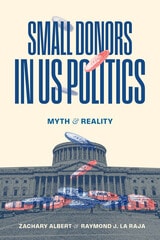
Small Donors in US Politics
Myth and RealityZachary Albert and Raymond J. La Raja
University of Chicago Press, 2026
A myth-busting investigation of small donors: who they are, how they spend their money, and whose campaigns actually benefit from their donations.
Many political reformers argue that more robust small donor participation in US campaigns would reduce the influence of the wealthiest Americans and improve political responsiveness to ordinary citizens. Drawing on extensive data, including surveys and campaign records, Zachary Albert and Raymond J. La Raja largely dispel this myth, offering the first comprehensive portrait to date of small donors in US elections.
Although small donor contributions to high-profile, national races have increased markedly since 2018, the US campaign finance system allows for even larger sums of money from Super PACs and other independent spending groups. Moreover, small donors are mostly similar to their larger contributor counterparts: both are socioeconomically advantaged, strongly partisan, ideologically extreme, and distinct from non-donors. Small donors can also be impulsive: they tend to give mostly to high-profile candidates on the ideological extremes, empowering media celebrities and norm-breakers rather than consensus-builders, and they underinvest in competitive and down-ballot races. Importantly, the candidates who rely most heavily on small donor support are not necessarily better legislators or representatives.
Yet, the story is not entirely bleak. Small donors bring energy and resources, especially for challengers and outsider candidates. The book shows how reforms could channel this energy more productively—by strengthening political parties, emphasizing local representation, and creating systems that broaden participation beyond the most ideological citizens.
Timely, accessible, and grounded in data, Small Donors in US Politics reveals both the promise and the peril of small donor politics—and what it will take to make money in politics serve democracy, not undermine it.