Results by title
159 books match the query 'Change' and 12 start with s
Seeds of Change
The Story of ACORN, America's Most Controversial Antipoverty Community Organizing GroupJohn Atlas
Vanderbilt University Press, 2010
Seeds of Change goes beyond the headlines of the last Presidential campaign to describe what really happened in ACORN's massive voter registration drives, why it triggered an unrelenting attack by Fox News and the Republican Party, and how it confronted its internal divisions and scandals.
Based on Atlas's own eyewitness original reporting, as the only journalist to have access to ACORN's staff and board meetings, this book documents the critical transition from founder Wade Rathke, a white New Orleans radical to Bertha Lewis, a Brooklyn African American activist.
The story begins in the 1970s, when a small group of young men and women, led by a charismatic college dropout, began a quest to help the powerless help themselves. In a tale full of unusual characters and dramatic conflicts, the book follows the ups and downs of ACORN's organizers and members as they confront big corporations and unresponsive government officials in Albuquerque, Brooklyn, Chicago, Detroit, Little Rock, New Orleans, Philadelphia, and the Twin Cities.
The author follows the course of local and national campaigns to organize unions, fight the subprime mortgage crisis, promote living wages for working people, struggle for affordable housing and against gentrification, and help Hurricane Katrina's survivors return to New Orleans.
The book dispels the conservative myth that we can only help the poor through private soup kitchens and charity and the liberal myth that the solution rests simply with more government services. Seeds of Change, not only provides a gripping look at ACORN's four decades of effective organizing, but also offers a hopeful analysis of the potential for a revival of real American democracy.
An offering of The Progressive Book Club.

Shimmering Images
Trans Cinema, Embodiment, and the Aesthetics of ChangeEliza Steinbock
Duke University Press, 2019

Signs of Change
New Directions in Theatre EducationJoan Lazarus
Intellect Books, 2012

Social Control and Social Change
Edited by John Paul Scott and Sarah F. Scott
University of Chicago Press, 1971
Social Inequality in Oaxaca
A History of Resistance and ChangeArthur Murphy
Temple University Press, 1991
Southeastern Mesoamerica
Indigenous Interaction, Resilience, and ChangeWhitney A. Goodwin
University Press of Colorado, 2020
Drawing on archaeological evidence ranging back to the late Pleistocene as well as extensive documentation from the historic period, contributors show how Southeastern Mesoamericans created unique identities, strategically incorporating cosmopolitan influences from cultures to the north and south with their own long-lived traditions. These populations developed autochthonous forms of monumental architecture and routes and methods of exchange and had distinct social, cultural, political, and economic traits. They also established unique long-term human-environment relations that were the result of internal creativity and inspiration influenced by local social and natural trajectories.
Southeastern Mesoamerica calls upon archaeologists, anthropologists, historians, ethnohistorians, and others working in Mesoamerica, Central America, and other cultural boundaries around the world to reexamine the role Indigenous resilience and agency play in these areas and in the cultural developments and interactions that occur within them.
Contributors: Edy Barrios, Christopher Begley, Walter Burgos, Mauricio Díaz García, William R. Fowler, Rosemary A. Joyce, Gloria Lara-Pinto, Eva L. Martínez, William J. McFarlane, Cameron L. McNeil, Lorena D. Mihok, Pastor Rodolfo Gómez Zúñiga, Timothy Scheffler, Edward Schortman, Russell Sheptak, Miranda Suri, Patricia Urban, Antolín Velásquez, E. Christian Wells
Sowing the Seeds of Change
The Story of the Community Food Bank of Southern ArizonaSeth Schindler
University of Arizona Press, 2021
The numbers are no less shocking in southern Arizona: one in six residents, and one in four children, are food insecure. How can this be in the richest country in the world? This book explores that paradox and the innovative solutions that one organization has developed to create a healthier, more secure tomorrow for the less fortunate among us.
The Community Food Bank of Southern Arizona (CFB) is one of the oldest and most respected food banks in America. It is a widely recognized leader not simply in providing hunger relief but in attacking the root causes of hunger and poverty through community development, education, and advocacy. In 2018, Feeding America—the national organization of food banks—named it “Food Bank of the Year.” The CFB serves as a model for all nonprofits to follow, no matter their mission.
This profusely illustrated book chronicles the CFB’s amazing success and evolution from a tiny grassroots hunger-relief organization to one with more than six thousand workers and an annual budget exceeding $100 million. The book gives voice to the thousands of CFB participants past and present, weaving their profiles and quotes throughout the book. These profiles personalize the history of the CFB and give readers an insider’s perspective on the people and events that shaped the food bank’s success. It shows how individuals working together can help prevent hunger and break the cycle of poverty that is its cause.
The aim of Sowing the Seeds of Change is not to laud the CFB’s achievements. It is to demonstrate to readers that the war against hunger, despite the obstacles, can be won. And not tomorrow. Now!
Stability and Change in Guale Indian Pottery, A.D. 1300-1702
Rebecca Saunders
University of Alabama Press, 2000
Through a comprehensive study of changing pottery attributes, Saunders documents the clash of Spanish and Native American cultures in the 16th-century southeastern United States.
By studying the ceramic traditions of the Guale Indians, Rebecca Saunders provides evidence of change in Native American lifeways from prehistory through European contact and the end of the Mission period. The Guale were among the first southeastern groups to come into contact with Spanish and French colonists, and they adapted various strategies in order to ensure their own social survival. That adaptation is reflected, Saunders shows, in the changing attributes of pottery recovered on archaeological sites on the coasts of Georgia and Florida.
Saunders traces the evolution of Guale pottery from the late prehistoric Irene phase through the Mission period at the three archaeological sites. She uses both technological and stylistic attributes to monitor change, paying particular attention to changes in execution and frequency of the filfot cross—a stylized cross that is a symbol of Guale cosmology. The frequency of this symbol in different ceramic components, according to Saunders, is a measure of change in the worldview of the missionized Guale. Although the symbol abruptly changed after the first Spanish contact, it showed remarkable stability through the Mission period, suggesting that traditional craft training and production remained strong despite high mortality rates and frequent relocation.
Only after 1684, when the Guale were relocated to Amelia Island in present-day Florida, did the use of the cross motif decline, suggesting that the Guale who remained in Spanish territory may have conceived of their place in the cosmos differently from their forebears or their contemporaries who fled to the interior.
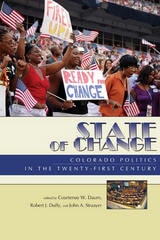
State of Change
Colorado Politics in the Twenty-first CenturyCourtenay W. Daum
University Press of Colorado, 2011
The increased use of direct democracy has resulted in the adoption of term limits, major reconstruction of fiscal policy, and many other changes in both statutory and constitutional law. Individual chapters address these changes within a range of contexts--electoral, political, partisan, and institutional--as well as their ramifications. Contributors also address the possible impacts of these changes on the state in the future, concluding that the current state of affairs is fated to be short-lived.
State of Change is the most up-to-date book on Colorado politics available and will be of value to undergraduate- and graduate-level students, academics, historians, and anyone involved with or interested in Colorado politics.
Streetwise
Race, Class, and Change in an Urban CommunityElijah Anderson
University of Chicago Press, 1990
"The sharpness of his observations and the simple clarity of his prose recommend his book far beyond an academic audience. Vivid, unflinching, finely observed, Streetwise is a powerful and intensely frightening picture of the inner city."—Tamar Jacoby, New York Times Book Review
"The book is without peer in the urban sociology literature. . . . A first-rate piece of social science, and a very good read."—Glenn C. Loury, Washington Times
Studies in Culture Contact
Interaction, Culture Change, and ArchaeologyEdited by James G. Cusick
Southern Illinois University Press, 1998
People have long been fascinated about times in human history when different cultures and societies first came into contact with each other, how they reacted to that contact, and why it sometimes occurred peacefully and at other times was violent or catastrophic.
Studies in Culture Contact: Interaction, Culture Change, and Archaeology, edited by James G. Cusick,seeks to define the role of culture contact in human history, to identify issues in the study of culture contact in archaeology, and to provide a critical overview of the major theoretical approaches to the study of culture and contact.
In this collection of essays, anthropologists and archaeologists working in Europe and the Americas consider three forms of culture contact—colonization, cultural entanglement, and symmetrical exchange. Part I provides a critical overview of theoretical approaches to the study of culture contact, offering assessments of older concepts in anthropology, such as acculturation, as well as more recently formed concepts, including world systems and center-periphery models of contact. Part II contains eleven case studies of specific contact situations and their relationships to the archaeological record, with times and places as varied as pre- and post-Hispanic Mexico, Iron Age France, Jamaican sugar plantations, European provinces in the Roman Empire, and the missions of Spanish Florida.
Studies in Culture Contact provides an extensive review of the history of culture contact in anthropological studies and develops a broad framework for studying culture contact’s role, moving beyond a simple formulation of contact and change to a more complex understanding of the amalgam of change and continuity in contact situations.
Sustainable Values, Sustainable Change
A Guide to Environmental Decision MakingBryan G. Norton
University of Chicago Press, 2015
While economists, philosophers, and ecologists argue about what in nature is valuable, and why, Norton here offers an action-oriented, pragmatic response to the disconnect between public and academic discourse around sustainability. Looking to the arenas in which decisions are made—and the problems that are driving these decisions—Norton reveals that the path to sustainability cannot be guided by fixed, utopian objectives projected into the future; sustainability will instead be achieved through experimentation, incremental learning, and adaptive management. Drawing inspiration from Aldo Leopold’s famed metaphor of “thinking like a mountain” for a spatially explicit, pluralistic approach to evaluating environmental change, Norton replaces theory-dependent definitions with a new decision-making process guided by deliberation and negotiation across science and philosophy, encompassing all stakeholders and activists and seeking to protect as many values as possible. Looking across scales to today’s global problems, Norton urges us to learn to think like a planet.