Results by title
77 books match the query 'Characters' and 10 start with s
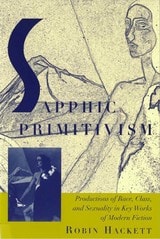
Sapphic Primitivism
Productions of Race, Class, and Sexuality in Key Works of Modern FictionHackett, Robin
Rutgers University Press, 2003
In this book, Robin Hackett examines portrayals of race, class, and sexuality in modernist texts by white women to argue for the existence of a literary device that she calls “Sapphic primitivism.” The works vary widely in their form and content and include Olive Schreiner’s proto-modernist exploration of New Womanhood, The Story of an African Farm; Virginia Woolf’s high modernist “play-poem,” The Waves; Sylvia Townsend Warner’s historical novel, Summer Will Show; and Willa Cather’s Southern pastoral, Sapphira and the Slave Girl. In each, blackness and working-class culture are figured to represent sexual autonomy, including lesbianism, for white women. Sapphic primitivism exposes the ways several classes of identification were intertwined with the development of homosexual identities at the turn of the century. Sapphic primitivism is not, however, a means of disguising lesbian content. Rather, it is an aesthetic displacement device that simultaneously exposes lesbianism and exploits modern, primitivist modes of self-representation. Hackett’s revelations of the mutual interests of those who study early twentieth-century constructions of race and sexuality and twenty-first-century feminists doing anti-racist and queer work are a major contribution to literary studies and identity theory.
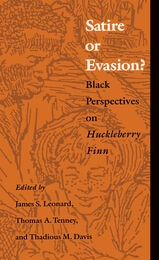
Satire or Evasion?
Black Perspectives on Huckleberry FinnJames S. Leonard, Thomas A. Tenney and Thadious M. Davis, eds.
Duke University Press, 1992
Ranging from the laudatory to the openly hostile, these essays include personal impressions of Huckleberry Finn, descriptions of classroom experience with the book, evaluations of its ironic and allegorical aspects, explorations of its nineteenth-century context, and appraisal of its effects on twentieth-century African American writers. Among the issues the authors contend with are Twain’s pervasive use of the word “nigger,” his portrayal of the slave Jim according to the conventions of the minstrel show “darky,” and the thematic chaos created by the “evasion” depicted in the novel’s final chapters.
Sure to provoke thought and stir debate, Satire or Evasion? provides a variety of new perspectives on one of this country’s most troubling classics.
Contributors. Richard K. Barksdale, Bernard W. Bell, Mary Kemp Davis, Peaches M. Henry, Betty Harris Jones, Rhett S. Jones, Julius Lester, Donnarae MacCann, Charles H. Nichols, Charles H. Nilon, Arnold Rampersad, David L. Smith, Carmen Dubryan, John H. Wallace, Kenny Jackson Williams, Fredrick Woodard
Satiric Advice on Women and Marriage
From Plautus to ChaucerWarren S. Smith, Editor
University of Michigan Press, 2005
Advice on sex and marriage in the literature of antiquity and the middle ages typically stressed the negative: from stereotypes of nagging wives and cheating husbands to nightmarish visions of women empowered through marriage. Satiric Advice on Women and Marriage brings together the leading scholars of this fascinating body of literature. Their essays examine a variety of ancient and early medieval writers' cautionary and often eccentric marital satire beginning with Plautus in the third century B.C.E. through Chaucer (the only non-Latin author studied). The volume demonstrates the continuity in the Latin tradition which taps into the fear of marriage and intimacy shared by ancient ascetics (Lucretius), satirists (Juvenal), comic novelists (Apuleius), and by subsequent Christian writers starting with Tertullian and Jerome, who freely used these ancient sources for their own purposes, including propaganda for recruiting a celibate clergy and the promotion of detachment and asceticism as Christian ideals.
Warren S. Smith is Professor of Classical Languages at the University of New Mexico.

Searching for Emma
Gustave Flaubert and Madame BovaryDacia Maraini
University of Chicago Press, 1997
Maraini argues that in their desire to claim Emma Bovary as a standard-bearer of revolt, women have often overlooked the bitter, pitiless way in which Flaubert evokes Emma's insignificance and vulgarity. Searching for Emma guides the reader through Flaubert's novel and many of his letters, seeking out the sources of his obsessive cruelty toward Emma. Maraini relates Flaubert's contempt for Emma to his relationship with his mistress, Louise Colet, to his general terror of women, and to his own self-loathing. It was entirely in spite of himself, Maraini writes, that Flaubert created the female Don Quixote so admired for her restlessness and determination.
Searching for Emma offers a novelist's insight into the complex relationship between author and character, and into the deepest motivations of fiction.
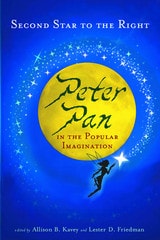
Second Star to the Right
Peter Pan in the Popular ImaginationFriedman, Lester D
Rutgers University Press, 2008
Since 2003 the characters from this story have had a highly visible presence in nearly every genre of popular culture: two major films, a literary sequel to the original adventures, a graphic novel featuring a grown-up Wendy Darling, and an Argentinean novel about a children's book writer inspired by J. M. Barrie. Simultaneously, Barrie surfaced as the subject of two major biographies and a feature film. The engaging essays in Second Star to the Right approach Pan from literary, dramatic, film, television, and sociological perspectives and, in the process, analyze his emergence and preservation in the cultural imagination.
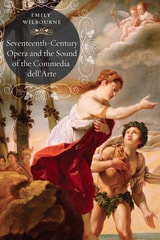
Seventeenth-Century Opera and the Sound of the Commedia dell’Arte
Emily Wilbourne
University of Chicago Press, 2016
Wilbourne considers a series of case studies structured around the most important and widely explored operas of the period: Monteverdi’s lost L’Arianna, as well as his Il Ritorno d’Ulisse and L’incoronazione di Poppea; Mazzochi and Marazzoli’s L’Egisto, ovvero Chi soffre speri; and Cavalli’s L’Ormindo and L’Artemisia. As she demonstrates, the sound-in-performance aspect of commedia dell’arte theater—specifically, the use of dialect and verbal play—produced an audience that was accustomed to listening to sonic content rather than simply the literal meaning of spoken words. This, Wilbourne suggests, shaped the musical vocabularies of early opera and facilitated a musicalization of Italian theater.
Highlighting productive ties between the two worlds, from the audiences and venues to the actors and singers, this work brilliantly shows how the sound of commedia performance ultimately underwrote the success of opera as a genre.
Shakespeare the Actor and the Purposes of Playing
Meredith Anne Skura
University of Chicago Press, 1993
Despite the obvious differences between our theater and Shakespeare's, sixteenth-century testimony suggests that the experience of acting has not changed much over the centuries. Beginning with a psychoanalytically informed account of acting today, Skura shows how this intense and ambivalent experience appears not only in literal references to acting in Shakespearean drama but also in recurring narrative concerns, details of language, and dramatic strategies used to engage the audience. Looking at the plays in the context of both public and private worlds outside the theater, Skura rereads the canon to identify new configurations in the plays and new ways of understanding theatrical self-consciousness in Renaissance England. Rich in theatrical, psychoanalytic, biographical, and historical insight, this book will be invaluable to students of Shakespeare and instructive to all readers interested in the dynamics of performance.
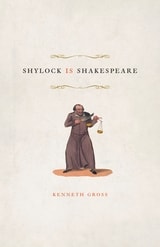
Shylock Is Shakespeare
Kenneth Gross
University of Chicago Press, 2006
Marvelously speculative and articulate, Gross’s book argues that Shylock is a breakthrough for Shakespeare the playwright, an early realization of the Bard’s power to create dramatic voices that speak for hidden, unconscious, even inhuman impulses—characters larger than the plays that contain them and ready to escape the author’s control. Shylock is also a mask for Shakespeare’s own need, rage, vulnerability, and generosity, giving form to Shakespeare’s ambition as an author and his uncertain bond with the audience. Gross’s vision of Shylock as Shakespeare’s covert double leads to a probing analysis of the character’s peculiar isolation, ambivalence, opacity, and dark humor. Addressing the broader resonance of Shylock, both historical and artistic, Gross examines the character’s hold on later readers and writers, including Heinrich Heine and Philip Roth, suggesting that Shylock mirrors the ambiguous states of Jewishness in modernity.
A bravura critical performance, Shylock Is Shakespeare will fascinate readers with its range of reference, its union of rigor and play, and its conjectural—even fictive—means of coming to terms with the question of Shylock, ultimately taking readers to the very heart of Shakespeare’s humanizing genius.
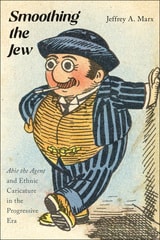
Smoothing the Jew
"Abie the Agent" and Ethnic Caricature in the Progressive EraJeffrey A. Marx
Rutgers University Press, 2024
Smoothing the Jew investigates how Jewish artists of the time attempted to “smooth over” these demeaning portrayals by focusing on the first Jewish comic strip published in English, Harry Hershfield’s Abie the Agent. Jeffrey Marx demonstrates how Hershfield created a Jewish protagonist who in part reassured nativists of the Jews’ ability to assimilate into American society while also encouraging immigrants and their children that, over time, they would be able to adopt American customs without losing their distinctly Jewish identity.

Society and its Outsiders in the Novels of Jakob Wassermann
Katharina Volckmer
University of London Press, 2016