236 books match the query 'Children's Studies' and 10 start with s
cover of Saving Face: The Emotional Costs of the Asian Immigrant Family Myth

Saving Face

The Emotional Costs of the Asian Immigrant Family Myth

Angie Y. Chung

Rutgers University Press, 2016
Tiger Mom. Asian patriarchy. Model minority children. Generation gap. The many images used to describe the prototypical Asian family have given rise to two versions of the Asian immigrant family myth. The first celebrates Asian families for upholding the traditional heteronormative ideal of the “normal (white) American family” based on a hard-working male breadwinner and a devoted wife and mother who raises obedient children. The other demonizes Asian families around these very same cultural values by highlighting the dangers of excessive parenting, oppressive hierarchies, and emotionless pragmatism in Asian cultures.
 
Saving Face cuts through these myths, offering a more nuanced portrait of Asian immigrant families in a changing world as recalled by the people who lived them first-hand: the grown children of Chinese and Korean immigrants. Drawing on extensive interviews, sociologist Angie Y. Chung examines how these second-generation children negotiate the complex and conflicted feelings they have toward their family responsibilities and upbringing. Although they know little about their parents’ lives, she reveals how Korean and Chinese Americans assemble fragments of their childhood memories, kinship narratives, and racial myths to make sense of their family experiences. However, Chung also finds that these adaptive strategies come at a considerable social and psychological cost and do less to reconcile the social stresses that minority immigrant families endure today.
 
Saving Face not only gives readers a new appreciation for the often painful generation gap between immigrants and their children, it also reveals the love, empathy, and communication strategies families use to help bridge those rifts. 
 
[more]
cover of Saving Our Children From Poverty: What the United States Can Learn From France

Saving Our Children From Poverty

What the United States Can Learn From France

Barbara R. Bergmann

Russell Sage Foundation, 1996
More than one in five American children live below the poverty line, a proportion that exceeds that of any other advanced nation. Although large numbers of Western European children live with single or unemployed parents, or belong to disadvantaged minorities, they are better shielded from severe deprivation by carefully designed public assistance programs. Saving Our Children from Poverty describes one of the most successful European systems of assistance for families, that of France, and through comparison with American programs offers a valuable guide to improving our own safety net for children and reforming our dysfunctional welfare system. Saving Our Children from Poverty details the array of benefits available to both high- and low-income families in France. Government-run nursery schools provide free, high-quality care for almost all children between the ages of three and six. Children also receive guaranteed medical care under a national health insurance plan. The French system offers married couples most of the same benefits as single parents, and creates strong incentives to seek and hold jobs rather than remain on welfare. A French single mother who chooses to work still receives substantial income supplements, housing assistance, subsidized health care, and access to public child care facilities. In stark contrast, her American counterpart loses most of her cash benefits if she takes a job and receives no government assistance with child care. Because American policies focus disproportionately on aiding the poorest non-working families, parents forced to rely on low-wage jobs are frequently left without the resources to provide their children with an adequate standard of living. As the public debate on welfare reform continues to rage, ever more American children fall into poverty. Why does the nation remain so unresponsive to their plight? Saving Our Children from Poverty probes the American aversion to national assistance programs, citing the negative attitudes that have seeped into the current political discourse. A lack of faith in the federal government's administrative abilities has bolstered a trend toward decentralization of programs, as well as a growing resistance to taxation. Racial antipathies and a belief that financial support encourages irresponsibility further undermine the development of programs for those in need. Saving Our Children from Poverty illustrates what a nation no wealthier than ours can realistically accomplish and afford, and concludes with a viable blueprint for successfully applying aspects of France's system to the United States.
[more]
cover of Securing the Future: Investing in Children From Birth to College

Securing the Future

Investing in Children From Birth to College

Sheldon Danziger

Russell Sage Foundation, 2000
More than ever, the economic health of a country depends upon the skills, knowledge, and capacities of its people. How does a person acquire these human assets and how can we promote their development? Securing the Future assembles an interdisciplinary team of scholars to investigate the full range of factors—pediatric, psychological, social, and economic—that bear on a child's development into a well-adjusted, economically productive member of society. A central purpose of the volume is to identify sound interventions that will boost human assets, particularly among the disadvantaged. The book provides a comprehensive evaluation of current initiatives and offers a wealth of new suggestions for effective public and private investments in child development. While children from affluent, highly educated families have good quality child care and an expensive education provided for them, children from poor families make do with informal child care and a public school system that does not always meet their needs. How might we best redress this growing imbalance? The contributors to this volume recommend policies that treat academic attainment together with psychological development and social adjustment. Mentoring programs, for example, promote better school performance by first fostering a young person's motivation to learn. Investments made early in life, such as preschool education, are shown to have the greatest impact on later learning for the least cost. In their focus upon children, however, the authors do not neglect the important links between generations. Poverty and inequality harm the development of parents and children alike. Interventions that empower parents to fight for better services and better schools are also of great benefit to their children. Securing the Future shows how investments in child development are both a means to an end and an end in themselves. They benefit the child directly and they also help that child contribute to the well-being of society. This book points us toward more effective strategies for promoting the economic success and the social cohesion of future generations. A Volume in the Ford Foundation Series on Asset Building
[more]
cover of Securitizing Youth: Young People’s Roles in the Global Peace and Security Agenda

Securitizing Youth

Young People’s Roles in the Global Peace and Security Agenda

Marisa O. Ensor

Rutgers University Press, 2021
Securitizing Youth offers new insights on young people’s engagement in a wide range of contexts related to the peace and security field. It presents empirical findings on the challenges and opportunities faced by young women and men in their efforts to build more peaceful, inclusive, and environmentally secure societies. The chapters included in this edited volume examine the diversity and complexity of young people’s engagement for peace and security in different countries across the globe and in different types and phases of conflict and violence, including both conflict-affected and relatively peaceful societies. Chapter contributors, young peacebuilders, and seasoned scholars and practitioners alike propose ways to support youth’s agency and facilitate their meaningful participation in decision-making. The chapters are organized around five broad thematic issues that correspond to the 5 Pillars of Action identified by UN Security Council Resolution 2250. Lessons learned are intended to inform the global youth, peace, and security agenda so that it better responds to on-the-ground realities, hence promoting more sustainable and inclusive approaches to long-lasting peace.
 
[more]
cover of Sesame Street Revisited

Sesame Street Revisited

Thomas D. Cook

Russell Sage Foundation, 1975
In the course of its television lifetime, "Sesame Street" has taught alphabet-related skills to hundreds of thousands of preschool children. But the program may have attracted more of its regular viewers from relatively affluent homes in which the parents were better educated. Analyzing and reevaluating data drawn from several sources, principally the Educational Testing Service's evaluations of "Sesame Street," the authors of this book open fresh lines of inquiry into how much economically disadvantaged children learned from viewing the series for six months and into whether the program is widening the gap that separates the academic achievement of disadvantaged preschoolers from that of their more affluent counterparts.  The authors define as acute dilemma currently facing educational policymakers: what positive results are achieved when a large number of children learn some skills at a younger age if this absolute increase in knowledge is associated with an increase in the difference between social groups?  
[more]
cover of Sexting Panic: Rethinking Criminalization, Privacy, and Consent

Sexting Panic

Rethinking Criminalization, Privacy, and Consent

Amy Adele Hasinoff

University of Illinois Press, 2015
Sexting Panic illustrates how anxieties about technology and teen girls' sexuality distract from critical questions about how to adapt norms of privacy and consent for new media. Though mobile phones can be used to cause harm, Amy Adele Hasinoff notes that criminalization and abstinence policies meant to curb sexting often fail to account for the distinction between consensual sharing and the malicious distribution of a private image. Hasinoff challenges the idea that sexting inevitably victimizes young women. Instead, she encourages us to recognize young people's capacity for choice and recommends responses to sexting that are realistic and nuanced rather than based on misplaced fears about deviance, sexuality, and digital media.
[more]
cover of Sold Separately: Children and Parents in Consumer Culture

Sold Separately

Children and Parents in Consumer Culture

Seiter, Ellen

Rutgers University Press, 1995

"A radical approach to children's TV. . . . Seiter argues cogently that watching Saturday cartoons isn't a passive activity but a tool by which even the very young decode and learn about their culture, and develop creative imagination as well. Bolstered by social, political, developmental, and media research, Seiter ties middle-class aversion to children's TV and mass-market toys to an association with the 'uncontrollable consumerism'––and hence supposed moral failure––of working class members, women, and 'increasingly, children.' . . . Positive guidance for parents uncertain of the role of TV and TV toys in their children's lives."––Kirkus Reviews

"Sold Separately is about television and toys, and the various roles that they play in the lives of children and parents. In particular, Seiter examines toy advertising, both in print media and on television; TV commercials; toy-based video for girls, with an in-depth look at "My Little Pony"; action TV for boys, using "Slimer and the Real Ghostbusters" as her case study; and the stores where toys are sold, both Toys "R" Us and the more upscale shops . . . contains many provocative observations."––Women's Review of Books

"Ellen Seiter has a holiday message for yuppie parents who feel guilty shopping at Toys "R" Us. The mass-produced toys that dominate the chain's shelves need not be the enemy of every right-thinking parent. "Ghostbuster" figurines and "My Little Pony" can share the toy chest with those sensible wooden blocks."––Chronicle of Higher Education

"Emphasizing problems of socioeconomic class, gender, and race stereotyping, this study acknowledges the usual parental complaints about toys like Barbie and G.I. Joe, but insists that they do play an important role in children's culture, especially for working class families. A thought-provoking analysis."––Wilson Library Journal

"In this thought provoking study, Seiter reasonably urges parents and others to put aside their own tastes and to understand that children's consumer culture promotes solidarity and sociability among youngsters."––Publishers Weekly

"An important book for those desiring an overview of the toy industry's impact on consumer culture . . . [it] presents a fair and well-balanced view of the industry."––Kathleen M. Carson, associate editor, Playthings

"A refreshing, thoughtful, and insightful investigation of an enormously important subject––consumer culture for kids. . . . I can't recommend it highly enough."––Janice Radway, Duke University, author of Reading the Romance
[more]
cover of Spirit Children: Illness, Poverty, and Infanticide in Northern Ghana

Spirit Children

Illness, Poverty, and Infanticide in Northern Ghana

Aaron R. Denham

University of Wisconsin Press, 2019

In parts of West Africa, some babies and toddlers are considered spirit children—nonhumans sent from the forest to cause misfortune and destroy the family. These are usually deformed or ailing infants, the very young whose births coincide with tragic events, or children who display unusual abilities. In some of these cases, families seek a solution in infanticide. Many others do not.

Refusing to generalize or oversimplify, Aaron R. Denham offers an ethnographic study of the spirit child phenomenon in Northern Ghana that considers medical, economic, religious, and political realities. He examines both the motivations of the families and the structural factors that lead to infanticide, framing these within the context of global public health. At the same time, he turns the lens on Western societies and the misunderstandings that prevail in discourse about this controversial practice. Engaging the complexity of the context, local meanings, and moral worlds of those confronting a spirit child, Denham offers visceral accounts of families' life and death decisions.
[more]
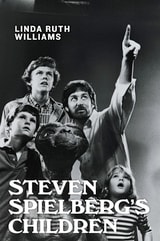
cover of Steven Spielberg's Children

Steven Spielberg's Children

Linda Ruth Williams

Rutgers University Press, 2025

Why has Steven Spielberg’s work been so often identified with childhood and children? How does the director elicit such complex performances from his young actors? Steven Spielberg’s Children is the first book to investigate children, childhood, and Spielberg’s employment of child actors together and in depth. Through a series of lively readings of both the celebrated performances he elicits from his young stars in films such as E.T.: The Extra Terrestrial, A.I.: Artificial Intelligence, and Empire of the Sun, as well as less discussed roles in films such as War of the Worlds, The BFG, and Jurassic Park, this book shows children to be key players in the director’s articulation of childhood since the 1970s.
 
Steven Spielberg’s Children presents children and childhood in some surprising ways, not only analyzing boyhood and girlhood according to Spielberg, but considering children as alien, adult-children who refuse to grow up, and children who aren’t even human. It discusses the way in which children have served to cast Spielberg as a sentimentalist, but also how they are more frequently framed as complex, cruel, and canny. The child might be dangled as bait in an exploitation horror scenario (Jaws), might become the image of universal higher beings (Close Encounters of the Third Kind), or might be a young cultural creator like the director was himself (The Fabelmans), "born with a camera glued to [his] eye." The child, on both sides of the camera, is a resonant image, signifying all that adult culture wants it to be, yet resisting this through authorship of their own stories. The book also looks at Spielberg's young actors in the long history of child stars in theater and cinema, and how Spielberg’s children have fared as performers and celebrities.
 
[more]
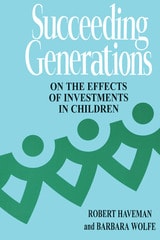
cover of Succeeding Generations: On the Effects of Investments in Children

Succeeding Generations

On the Effects of Investments in Children

Robert Haveman

Russell Sage Foundation, 1994

Drawn from an extensive two-decade longitudinal survey of American families, Succeeding Generations traces a representative group of America's children from their early years through young adulthood. It evaluates the many background factors that are most influential in determining how much education children will obtain, whether or not they will become teen parents, and how economically active they will be when they reach their twenties. Succeeding Generations demonstrates how our children's future has been placed at risk by social and economic conditions such as fractured families, a troubled economy, rising poverty rates, and neighborhood erosion. The authors also pinpoint some significant causes of children's later success, emphasizing the importance of parents' education and, despite the apparent loss of time spent with children, the generally positive influence of maternal employment. Haveman and Wolfe supplement their research with a comprehensive review of the many debates among economists, sociologists, developmental psychologists, and other experts on how best to improve the lot of America's children. "A state-of-the-art investigation of the determinants of children's success in the United States....Clearly written, highly readable, and compelling."—Contemporary Sociology "Haveman and Wolfe are professors of economics who bring sophisticated statistical and econometric techniques to the analysis of the economic and educational success of children as they progress into young adulthood."—Choice "This study is one of the most comprehensive of its kind, in part because the researchers collected detailed information about a wide range of children each year for more than two decades." —Wisconsin State Journal "The research at the core of this book addresses critically important questions in social science...an important contribution to the literature." —Robert Plotnick, University of Washington
[more]