Results by title
74 books match the query 'Church' and 6 start with s

Separation of Church and State in the United States
Alvin W. Johnson and Frank H. Yost
University of Minnesota Press, 1948
Separation of Church and State in the United States was first published in 1948. Minnesota Archive Editions uses digital technology to make long-unavailable books once again accessible, and are published unaltered from the original University of Minnesota Press editions.
This book is more than a revised and enlarged edition of Dr. Johnson's Legal Status of Church-State Relationships in the United States. Besides rewriting and bringing up to date much of the original material, the authors have added a number of chapters dealing with subjects that have gained prominence in recent years: citizenship and the bearing of arms, saluting the flag, distribution of religious literature, and freedom of speech for Communists. Such recent cases as the Supreme Court decision in McCollum v. Board of Education—better known as the Champaign, Illinois, case—are discussed in some detail.
School administrators will find the book of great practical value, for it deals predominantly with church-state relationships in the public schools, one of the chief areas of conflict. These conflicts include such questions as Bible readings and religious instruction in the public schools, dismissed and released time for religious education, the allowing of credit for religious instruction, public aid to sectarian schools, the wearing of religious garb, furnishing free textbooks and transportation for students in parochial schools.

Separation of Church and State
Dina de-Malkhuta Dina in Jewish LawGil Graff
University of Alabama Press, 1985
Exploring the enduring dialogue between Jewish law and the law of the state.
For the Jewish community, the end of the Middle Ages and the emergence of the modern nation-state brought the promise of equal citizenship as well as the possible loss of Jewish corporate identity. The legal maxim dina de-malkhuta dina (the law of the State is law) invoked in Talmidic times to justify the acceptance of the king’s law and qualified in the Middle Ages by Maimonides and Rashbam to include the requirement of consent by the governed underwent further redefinition by Jews in the Napoleonic age. Graff focuses on the struggle between 18th and 19th-century Jewish religious reformers and traditionalists in defining the limits of dina de-malkhuta dina. He traces the motivations of the reformers who, in their zeal to gain equality for the formerly disenfranchised Jewish communities in Western Europe, were prepared to render unto the State compromising authority over Jewish religious life under the rubric of dina de-malkhuta dina was intended to strike a balance between synagogue and state and not to be used as a pretext for the liquidation of the community’s corporate existence.
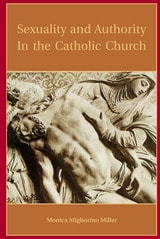
Sexuality and Authority in the Catholic Church
Monica Migliorino Miller
University of Scranton Press, 1995
If authority is derived from Eucharistic worship, then authority is fundamentally the authority of a covenant. This book shows that this covenant is spoken according to a primordial sexual language rooted in creation itself.
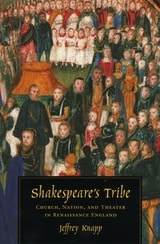
Shakespeare's Tribe
Church, Nation, and Theater in Renaissance EnglandJeffrey Knapp
University of Chicago Press, 2004
To be sure, Renaissance playwrights rarely sermonized in their plays, which seemed preoccupied with sex, violence, and crime. During a time when acting was regarded as a kind of vice, many theater professionals used their apparent godlessness to advantage, claiming that it enabled them to save wayward souls the church could not otherwise reach. The stage, they argued, made possible an ecumenical ministry, which would help transform Reformation England into a more inclusive Christian society.
Drawing on a variety of little-known as well as celebrated plays, along with a host of other documents from the English Renaissance, Shakespeare's Tribe changes the way we think about Shakespeare and the culture that produced him.
Winner of the Best Book in Literature and Language from the Association of American Publishers' Professional/Scholarly division, the Conference on Christianity and Literature Book Award, and the Roland H. Bainton Prize for Literature from the Sixteenth Century Society and Conference.
St. Augustine on Marriage and Sexuality (Selections from the Fathers of the Church, Volume 1)
Saint Augustine
Catholic University of America Press, 1996
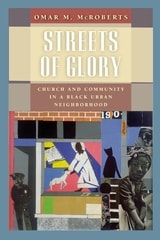
Streets of Glory
Church and Community in a Black Urban NeighborhoodOmar M. McRoberts
University of Chicago Press, 2003
McRoberts finds, for example, that most of the churches in Four Corners are attended and run by people who do not live in the neighborhood but who worship there because of the low overhead. These churches, McRoberts argues, are communities in and of themselves, with little or no attachment to the surrounding area. This disconnect makes the churches less inclined to cooperate with neighborhood revitalization campaigns and less likely to respond to the immediate needs of neighborhood residents. Thus, the faith invested in inner-city churches as beacons of local renewal might be misplaced, and the decision to count on them to administer welfare definitely should be revisited.
As the federal government increasingly moves toward delivering social services through faith-based organizations, Streets of Glory must be read for its trenchant revisionist view of how churches actually work in depressed urban areas.