Results by title
91 books match the query 'Citizen participation' and 9 start with s

Scarface Al and the Crime Crusaders
Chicago's Private War Against CaponeDennis E. Hoffman
Southern Illinois University Press, 1993
According to the Eliot Ness myth, which has been widely disseminated through books, television shows, and movies, Ness and the Untouchables defeated Al Capone by marshaling superior firepower. In Scarface Al and the Crime Crusaders, Dennis Hoffman presents a fresh new perspective on the downfall of Al Capone. To debunk the Eliot Ness myth, he shows how a handful of private citizens brought Capone to justice by outsmarting him rather than by outgunning him.
Drawing on previously untapped sources, Hoffman dissects what he terms a “private war” against Capone. He traces the behind-the-scenes work of a few prominent Chicago businessmen from their successful lobbying of presidents Coolidge and Hoover on behalf of federal intervention to the trial, sentencing, and punishment of Al Capone. Hoffman also reconstructs in detail a number of privately sponsored citizen initiatives directed at stopping Capone. These private ventures included prosecuting the gangsters responsible for election crimes; establishing a crime lab to assist in gangbusting; underwriting the costs of the investigation of the Jake Lingle murder; stigmatizing Capone; and protecting the star witnesses for the prosecution in Al Capone’s income tax evasion case.
Hoffman suggests that as American society continues to be threatened by illegal drugs, gangs, and widespread violence, it is important to remember that the organized crime and political corruption of Prohibition-era Chicago were checked through the efforts of private citizens.
Dennis E. Hoffman is an associate professor of criminal justice at the University of Nebraska at Omaha.
Science by the People
Participation, Power, and the Politics of Environmental KnowledgeAya H. Kimura
Rutgers University Press, 2019
Citizen science—research involving nonprofessionals in the research process—has attracted both strong enthusiasts and detractors. Many environmental professionals, activists, and scholars consider citizen science part of their toolkit for addressing environmental challenges. Critics, however, contend that it represents a corporate takeover of scientific priorities. In this timely book, two sociologists move beyond this binary debate by analyzing the tensions and dilemmas that citizen science projects commonly face. Key lessons are drawn from case studies where citizen scientists have investigated the impact of shale oil and gas, nuclear power, and genetically engineered crops. These studies show that diverse citizen science projects face shared dilemmas relating to austerity pressures, presumed boundaries between science and activism, and difficulties moving between scales of environmental problems. By unpacking the politics of citizen science, this book aims to help people negotiate a complex political landscape and choose paths moving toward social change and environmental sustainability.
Seeds of Change
The Story of ACORN, America's Most Controversial Antipoverty Community Organizing GroupJohn Atlas
Vanderbilt University Press, 2010
Seeds of Change goes beyond the headlines of the last Presidential campaign to describe what really happened in ACORN's massive voter registration drives, why it triggered an unrelenting attack by Fox News and the Republican Party, and how it confronted its internal divisions and scandals.
Based on Atlas's own eyewitness original reporting, as the only journalist to have access to ACORN's staff and board meetings, this book documents the critical transition from founder Wade Rathke, a white New Orleans radical to Bertha Lewis, a Brooklyn African American activist.
The story begins in the 1970s, when a small group of young men and women, led by a charismatic college dropout, began a quest to help the powerless help themselves. In a tale full of unusual characters and dramatic conflicts, the book follows the ups and downs of ACORN's organizers and members as they confront big corporations and unresponsive government officials in Albuquerque, Brooklyn, Chicago, Detroit, Little Rock, New Orleans, Philadelphia, and the Twin Cities.
The author follows the course of local and national campaigns to organize unions, fight the subprime mortgage crisis, promote living wages for working people, struggle for affordable housing and against gentrification, and help Hurricane Katrina's survivors return to New Orleans.
The book dispels the conservative myth that we can only help the poor through private soup kitchens and charity and the liberal myth that the solution rests simply with more government services. Seeds of Change, not only provides a gripping look at ACORN's four decades of effective organizing, but also offers a hopeful analysis of the potential for a revival of real American democracy.
An offering of The Progressive Book Club.

Shaping Science and Technology Policy
The Next Generation of ResearchEdited by David H. Guston and Daniel Sarewitz
University of Wisconsin Press, 2006
With scientific progress occurring at a breathtaking pace, science and technology policy has never been more important than it is today. Yet there is a very real lack of public discourse about policy-making, and government involvement in science remains shrouded in both mystery and misunderstanding. Who is making choices about technology policy, and who stands to win or lose from these choices? What criteria are being used to make decisions and why? Does government involvement help or hinder scientific research?
Shaping Science and Technology Policy brings together an exciting and diverse group of emerging scholars, both practitioners and academic experts, to investigate current issues in science and technology policy. Essays explore such topics as globalization, the shifting boundary between public and private, informed consent in human participation in scientific research, intellectual property and university science, and the distribution of the costs and benefits of research.
Contributors: Charlotte Augst, Grant Black, Mark Brown, Kevin Elliott, Patrick Feng, Pamela M. Franklin, Carolyn Gideon, Tené N. Hamilton, Brian A. Jackson, Shobita Parthasarathy, Jason W. Patton, A. Abigail Payne, Bhaven Sampat, Christian Sandvig, Sheryl Winston Smith, Michael Whong-Barr
Showroom City
Real Estate and Resistance in the Furniture Capital of the WorldJohn Joe Schlichtman
University of Minnesota Press, 2022
A unique and engaging account of local urban decision-making within the globalizing world
High Point, North Carolina, is known as the “Furniture Capital of the World.” Once a manufacturing stronghold, most of its furniture factories have closed over the past forty years, with production shipped off to low-wage countries. Yet as manufacturing left, the city tightened its hold on a biannual global exposition that serves as the world’s furniture fashion runway. At the High Point Market, visitors from more than one hundred nations traverse twelve million square feet of meticulous design. Downtown buildings—once courthouses, movie theaters, post offices, and gas stations—are now chic showroom spaces, even as many sit empty between each exposition.
In Showroom City, John Joe Schlichtman applies an ethnographic lens to the global exposition’s relationship with High Point after it defeated rival Chicago in the 1960s and established itself as the world’s dominant furniture center. In recent decades, following trends in global finance, private equity firms were increasingly behind downtown High Point’s real estate transactions, coordinated by buyers far removed from the region. Then, in one massive transaction in 2011, a firm funded by Bain Capital purchased every major showroom building, and the majority of downtown real estate was under one owner.
Showroom City is a story of exclusionary growth and unchecked development, of a city flailing to fill the void left by its dwindling factories. But beyond that Schlichtman engages the general lessons behind both High Point’s deindustrialization and its stunning reinvention as a furniture fashion, merchandising, and design node. With great nuance, he delves deeply to reveal how power operates locally and how citizens may affirm, exploit, influence, and resist the takeover of their community.

Siege of the Spirits
Community and Polity in BangkokMichael Herzfeld
University of Chicago Press, 2016
Herzfeld argues that even though the residents of Pom Mahakan have lost every legal battle the city government has dragged them into, they have won every public relations contest, highlighting their struggle as one against bureaucrats who do not respect the age-old values of Thai/Siamese social and cultural order. Such values include compassion for the poor and an understanding of urban space as deeply embedded in social and ritual relations. In a gripping account of their standoff, Herzfeld—who simultaneously argues for the importance of activism in scholarship—traces the agile political tactics and styles of the community’s leadership, using their struggle to illuminate the larger difficulties, tensions, and unresolved debates that continue to roil Thai society to this day.
Sixties Sandstorm
The Fight over Establishment of a Sleeping Bear Dunes National Lakeshore, 1961-1970Brian C. Kalt
Michigan State University Press, 2001
Sixties Sandstorm is not a book about dunes as much as it is a book about people and their government. It chronicles the public meetings, bills, protests, and congressional interactions that led to the signing of the Sleeping Bear Sand Dunes Act in 1970. The Dunes park fight is a case study of the politics, the legislative process, citizen response to the expanded role of government in the 1960s, and the rise of the environmental movement in America during that decade. Since Hart's legislation was made law, millions of Americans have traveled to the Sleeping Bear Sand Dunes National Lakeshore. Few imagine what the area would look like today if not for the efforts of people like Senator Hart. On the other hand, few appreciate the sacrifice of the landowners who-not always willingly-gave up their property in this place where, as one resident put it, "stars are closer to the earth than anywhere else in the world."
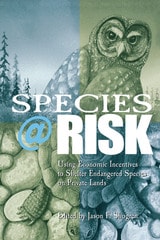
Species at Risk
Using Economic Incentives to Shelter Endangered Species on Private LandsEdited by Jason F. Shogren
University of Texas Press, 2005
Protecting endangered species of animals and plants is a goal that almost everyone supports in principle—but in practice private landowners have often opposed the regulations of the Endangered Species Act, which, they argue, unfairly limits their right to profit from their property. To encourage private landowners to cooperate voluntarily in species conservation and to mitigate the economic burden of doing so, the government and nonprofit land trusts have created a number of incentive programs, including conservation easements, leases, habitat banking, habitat conservation planning, safe harbors, candidate conservation agreements, and the "no surprise" policy.
In this book, lawyers, economists, political scientists, historians, and zoologists come together to assess the challenges and opportunities for using economic incentives as compensation for protecting species at risk on private property. They examine current programs to see how well they are working and also offer ideas for how these programs could be more successful. Their ultimate goal is to better understand how economic incentive schemes can be made both more cost-effective and more socially acceptable, while respecting a wide range of views regarding opportunity costs, legal standing, biological effectiveness, moral appropriateness, and social context.
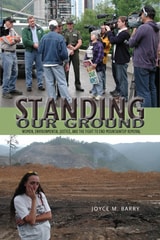
Standing Our Ground
Women, Environmental Justice, and the Fight to End Mountaintop RemovalJoyce M. Barry
Ohio University Press, 2012
Standing Our Ground: Women, Environmental Justice, and the Fight to End Mountaintop Removal examines women’s efforts to end mountaintop removal coal mining in West Virginia. Mountaintop removal coal mining, which involves demolishing the tops of hills and mountains to provide access to coal seams, is one of the most significant environmental threats in Appalachia, where it is most commonly practiced.
The Appalachian women featured in Barry’s book have firsthand experience with the negative impacts of Big Coal in West Virginia. Through their work in organizations such as the Coal River Mountain Watch and the Ohio Valley Environmental Coalition, they fight to save their mountain communities by promoting the development of alternative energy resources. Barry’s engaging and original work reveals how women’s tireless organizing efforts have made mountaintop removal a global political and environmental issue and laid the groundwork for a robust environmental justice movement in central Appalachia.