172 books match the query 'Citizenship' and 7 start with s
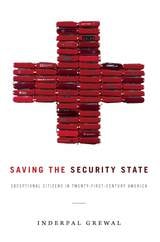
cover of Saving the Security State: Exceptional Citizens in Twenty-First-Century America

Saving the Security State

Exceptional Citizens in Twenty-First-Century America

Inderpal Grewal

Duke University Press, 2017
In Saving the Security State Inderpal Grewal traces the changing relations between the US state and its citizens in an era she calls advanced neoliberalism. Marked by the decline of US geopolitical power, endless war, and increasing surveillance, advanced neoliberalism militarizes everyday life while producing the “exceptional citizens”—primarily white Christian men who reinforce the security state as they claim responsibility for protecting the country from racialized others. Under advanced neoliberalism, Grewal shows, others in the United States strive to become exceptional by participating in humanitarian projects that compensate for the security state's inability to provide for the welfare of its citizens. In her analyses of microfinance programs in the global South, security moms, the murders at a Sikh temple in Wisconsin, and the post-9/11 crackdown on Muslim charities, Grewal exposes the fissures and contradictions at the heart of the US neoliberal empire and the centrality of race, gender, and religion to the securitized state.
[more]
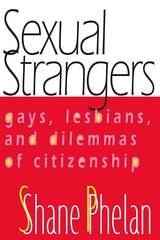
cover of Sexual Strangers: Gays, Lesbians, and Dilemmas of Citizenship

Sexual Strangers

Gays, Lesbians, and Dilemmas of Citizenship

Shane Phelan

Temple University Press, 2001

Is the United States a heterosexual regime? If it is, how may we understand the political position of those who cannot or will not align themselves with heterosexuality? With these provocative questions, Shane Phelan raises the issue of whether lesbians, gays, bisexuals, and transgendered people can be seen as citizens at all. Can citizenship be made queer? Or does citizenship require the exclusion of those who are regarded as queer to preserve the "equality" that it promises?

In Sexual Strangers, Shane Phelan argues that, in the United States, queers are strangers -- not exactly the enemy, since they are not excluded from all rights of  citizenship, but not quite members. Rather, they are ambiguous figures who trouble the border between "us" and "them," a border just as central to liberal regimes as to other states. Life on this border structures both the exclusion of sexual minorities and their ambivalence about becoming part of the "mainstream."

Sexual Strangers addresses questions of long-standing importance to minority group politics: the meaning and terms of inclusion, respect, and resistance. Phelan looks at citizenship as including not only equal protection and equal rights to such institutions as marriage and military service, but also political and cultural visibility, as inclusion in the national imaginary. She  discusses the continuing stigmatization of bisexuals and transgendered people within lesbian and gay communities as a result of the attempt to flee from strangeness, a flight that inevitably produces new strangers. Her goal is to convince students of politics, both academic and activist, to embrace the rewards of strangeness as a means of achieving inclusive citizenship, rather than a citizenship that defines itself by what it will not accept.
[more]
cover of Shakespearean Educations: Power, Citizenship, and Performance

Shakespearean Educations

Power, Citizenship, and Performance

Coppélia Kahn

University of Delaware Press, 2011

Shakespearean Educations examines how and why Shakespeare’s works shaped the development of American education from the colonial period through the 1934 Chicago World’s Fair, taking the reader up to the years before the Servicemen’s Readjustment Act of 1944 (popularly known as the GI Bill), coeducation, and a nascent civil rights movement would alter the educational landscape yet again. The essays in this collection query the nature of education, the nature of citizenship in a democracy, and the roles of literature, elocution, theater, and performance in both. Expanding the notion of “education” beyond the classroom to literary clubs, private salons, public lectures, libraries, primers, and theatrical performance, this collection challenges scholars to consider how different groups in our society have adopted Shakespeare as part of a specifically “American” education. Shakespearean Educations maps the ways in which former slaves, Puritan ministers, university leaders, and working class theatergoers used Shakespeare not only to educate themselves about literature and culture, but also to educate others about their own experience.

Published by University of Delaware Press. Distributed worldwide by Rutgers University Press.
[more]
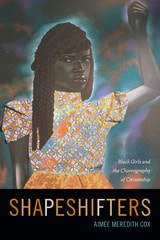
cover of Shapeshifters: Black Girls and the Choreography of Citizenship

Shapeshifters

Black Girls and the Choreography of Citizenship

Aimee Meredith Cox

Duke University Press, 2015
In Shapeshifters Aimee Meredith Cox explores how young Black women in a Detroit homeless shelter contest stereotypes, critique their status as partial citizens, and negotiate poverty, racism, and gender violence to create and imagine lives for themselves. Based on eight years of fieldwork at the Fresh Start shelter, Cox shows how the shelter's residents—who range in age from fifteen to twenty-two—employ strategic methods she characterizes as choreography to disrupt the social hierarchies and prescriptive narratives that work to marginalize them. Among these are dance and poetry, which residents learn in shelter workshops. These outlets for performance and self-expression, Cox shows, are key to the residents exercising their agency, while their creation of alternative family structures demands a rethinking of notions of care, protection, and love. Cox also uses these young women's experiences to tell larger stories: of Detroit's history, the Great Migration, deindustrialization, the politics of respectability, and the construction of Black girls and women as social problems. With Shapeshifters Cox gives a voice to young Black women who find creative and non-normative solutions to the problems that come with being young, Black, and female in America.
[more]
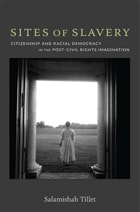
cover of Sites of Slavery: Citizenship and Racial Democracy in the Post–Civil Rights Imagination

Sites of Slavery

Citizenship and Racial Democracy in the Post–Civil Rights Imagination

Salamishah Tillet

Duke University Press, 2012
More than forty years after the major victories of the civil rights movement, African Americans have a vexed relation to the civic myth of the United States as the land of equal opportunity and justice for all. In Sites of Slavery Salamishah Tillet examines how contemporary African American artists and intellectuals—including Annette Gordon-Reed, Barbara Chase-Riboud, Bill T. Jones, Carrie Mae Weems, and Kara Walker—turn to the subject of slavery in order to understand and challenge the ongoing exclusion of African Americans from the founding narratives of the United States. She explains how they reconstruct "sites of slavery"—contested figures, events, memories, locations, and experiences related to chattel slavery—such as the allegations of a sexual relationship between Thomas Jefferson and Sally Hemings, the characters Uncle Tom and Topsy in Harriet Beecher Stowe's novel Uncle Tom's Cabin, African American tourism to slave forts in Ghana and Senegal, and the legal challenges posed by reparations movements. By claiming and recasting these sites of slavery, contemporary artists and intellectuals provide slaves with an interiority and subjectivity denied them in American history, register the civic estrangement experienced by African Americans in the post–civil rights era, and envision a more fully realized American democracy.
[more]
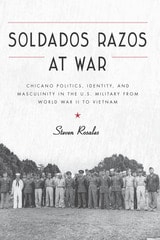
cover of Soldados Razos at War: Chicano Politics, Identity, and Masculinity in the U.S. Military from World War II to Vietnam

Soldados Razos at War

Chicano Politics, Identity, and Masculinity in the U.S. Military from World War II to Vietnam

Steven Rosales

University of Arizona Press, 2017

What were the catalysts that motivated Mexican American youth to enlist or readily accept their draft notices in World War II, Korea, or Vietnam? In Soldados Razos at War, historian and veteran Steven Rosales chronicles the experiences of Chicano servicemen who fought for the United States, explaining why these men served, how they served, and the impact of their service on their identity and political consciousness.

As a social space imbued with its own martial and masculine ethos, the U.S. military offers an ideal way to study the aspirations and behaviors that carried over into the civilian lives of these young men. A tradition of martial citizenship forms the core of the book. Using rich oral histories and archival research, Rosales investigates the military’s transformative potential with a particular focus on socioeconomic mobility, masculinity, and postwar political activism across three generations.

The national collective effort characteristic of World War II and Korea differed sharply from the highly divisive nature of American involvement in Vietnam. Thus, for Mexican Americans, military service produced a wide range of ideological reactions, with the ideals of each often in opposition to the others. Yet a critical thread connecting these diverse outcomes was a redefined sense of self and a willingness to engage in individual and collective action to secure first-class citizenship.

[more]
cover of Suffrage and citizenship in Ireland, 1912-18

Suffrage and citizenship in Ireland, 1912-18

Senia Pašeta

University of London Press, 2019

Professor Senia Pašeta argues that our understanding of modern Irish and British politics would be enormously enriched if we recognized two things: that the Irish and British suffrage movements were deeply connected; and that the women’s suffrage movement across the United Kingdom was shaped in fundamental ways by the Irish Question from the late nineteenth century and into the twentieth. In other words, the women’s suffrage movement did not exist in a political vacuum. It interacted with, influenced and was influenced by the other main political questions of the day, and with the main political question of the day - Ireland.
[more]