Results by title
50 books match the query 'Colonialism' and 3 start with s
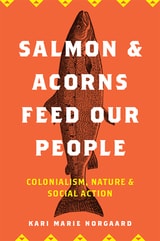
Salmon and Acorns Feed Our People
Colonialism, Nature, and Social ActionKari Marie Norgaard
Rutgers University Press, 2019
Finalist for the 2020 C. Wright Mills Award from the Society for the Study of Social Problems
Since time before memory, large numbers of salmon have made their way up and down the Klamath River. Indigenous management enabled the ecological abundance that formed the basis of capitalist wealth across North America. These activities on the landscape continue today, although they are often the site of intense political struggle. Not only has the magnitude of Native American genocide been of remarkable little sociological focus, the fact that this genocide has been coupled with a reorganization of the natural world represents a substantial theoretical void. Whereas much attention has (rightfully) focused on the structuring of capitalism, racism and patriarchy, few sociologists have attended to the ongoing process of North American colonialism. Salmon and Acorns Feed Our People draws upon nearly two decades of examples and insight from Karuk experiences on the Klamath River to illustrate how the ecological dynamics of settler-colonialism are essential for theorizing gender, race and social power today.
Since time before memory, large numbers of salmon have made their way up and down the Klamath River. Indigenous management enabled the ecological abundance that formed the basis of capitalist wealth across North America. These activities on the landscape continue today, although they are often the site of intense political struggle. Not only has the magnitude of Native American genocide been of remarkable little sociological focus, the fact that this genocide has been coupled with a reorganization of the natural world represents a substantial theoretical void. Whereas much attention has (rightfully) focused on the structuring of capitalism, racism and patriarchy, few sociologists have attended to the ongoing process of North American colonialism. Salmon and Acorns Feed Our People draws upon nearly two decades of examples and insight from Karuk experiences on the Klamath River to illustrate how the ecological dynamics of settler-colonialism are essential for theorizing gender, race and social power today.
[more]
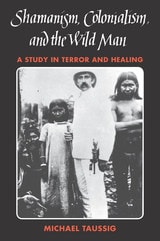
Shamanism, Colonialism, and the Wild Man
A Study in Terror and HealingMichael Taussig
University of Chicago Press, 1987
Working with the image of the Indian shaman as Wild Man, Taussig reveals not the magic of the shaman but that of the politicizing fictions creating the effect of the real.
"This extraordinary book . . . will encourage ever more critical and creative explorations."—Fernando Coronil, [I]American Journal of Sociology[/I]
"Taussig has brought a formidable collection of data from arcane literary, journalistic, and biographical sources to bear on . . . questions of evil, torture, and politically institutionalized hatred and terror. His intent is laudable, and much of the book is brilliant, both in its discovery of how particular people perpetrated evil and others interpreted it."—Stehen G. Bunker, Social Science Quarterly
[more]
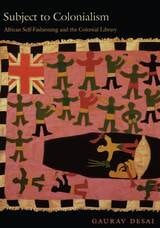
Subject to Colonialism
African Self-Fashioning and the Colonial LibraryGaurav Desai
Duke University Press, 2001
Subject to Colonialism provides a much needed revisionist perspective on the way twentieth-century Africa is viewed and analyzed among scholars. Employing literary, historical, and anthropological techniques, Gaurav Desai attempts to generate a new understanding of issues that permeate discussions of Africa by disrupting the centrality of postcolonial texts and focusing instead on the cultural and intellectual production of colonial Africans. In particular, Desai calls for a reevaluation of the “colonial library”—that set of representations and texts that have collectively “invented” Africa as a locus of difference and alterity.
Presenting colonialism not as a singular, monolithic structure but rather as a practice frought with contradictions and tensions, Desai works to historicize the foundation of postcolonialism by decentering both canonical texts and privileged categories of analysis such as race, capitalism, empire, and nation. To achieve this, he focuses on texts that construct or reform—rather than merely reflect—colonialism, placing explicit emphasis on processes, performances, and the practices of everyday life. Reading these texts not merely for the content of their assertions but also for how they were created and received, Desai looks at works such as Jomo Kenyatta’s ethnography of the Gikuyu and Akiga Sai’s history of the Tiv and makes a particular plea for the canonical recuperation of African women’s writing.
Scholars in African history, literature, and philosophy, postcolonial studies, literary criticism, and anthropology will welcome publication of this book.
[more]