Results by title
121 books match the query 'Comic books, strips, etc' and 9 start with s
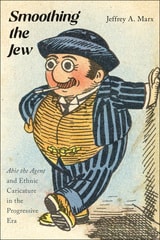
Smoothing the Jew
"Abie the Agent" and Ethnic Caricature in the Progressive EraJeffrey A. Marx
Rutgers University Press, 2024
Smoothing the Jew investigates how Jewish artists of the time attempted to “smooth over” these demeaning portrayals by focusing on the first Jewish comic strip published in English, Harry Hershfield’s Abie the Agent. Jeffrey Marx demonstrates how Hershfield created a Jewish protagonist who in part reassured nativists of the Jews’ ability to assimilate into American society while also encouraging immigrants and their children that, over time, they would be able to adopt American customs without losing their distinctly Jewish identity.

Sovereign Traces, Volume 1
Not (Just) (An)OtherGordon D. Henry Jr.
Michigan State University Press, 2018
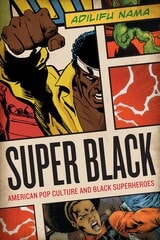
Super Black
American Pop Culture and Black SuperheroesBy Adilifu Nama
University of Texas Press, 2011
Winner, American Book Award, Before Columbus Foundation, 2012
Super Black places the appearance of black superheroes alongside broad and sweeping cultural trends in American politics and pop culture, which reveals how black superheroes are not disposable pop products, but rather a fascinating racial phenomenon through which futuristic expressions and fantastic visions of black racial identity and symbolic political meaning are presented. Adilifu Nama sees the value—and finds new avenues for exploring racial identity—in black superheroes who are often dismissed as sidekicks, imitators of established white heroes, or are accused of having no role outside of blaxploitation film contexts.
Nama examines seminal black comic book superheroes such as Black Panther, Black Lightning, Storm, Luke Cage, Blade, the Falcon, Nubia, and others, some of whom also appear on the small and large screens, as well as how the imaginary black superhero has come to life in the image of President Barack Obama. Super Black explores how black superheroes are a powerful source of racial meaning, narrative, and imagination in American society that express a myriad of racial assumptions, political perspectives, and fantastic (re)imaginings of black identity. The book also demonstrates how these figures overtly represent or implicitly signify social discourse and accepted wisdom concerning notions of racial reciprocity, equality, forgiveness, and ultimately, racial justice.
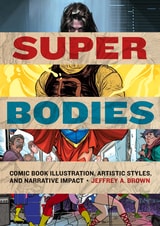
Super Bodies
Comic Book Illustration, Artistic Styles, and Narrative ImpactJeffrey A. Brown
University of Texas Press, 2023
Finalist — San Diego Comic-Con International 2024 Eisner Award in Best Academic/Scholarly Work
2024 MPCA/ACA Best Book for Use in the Classroom, Midwest Popular Culture Association / Midwest American Culture Association (MPCA/ACA)
An examination of the art in superhero comics and how style influences comic narratives.
For many, the idea of comic book art implies simplistic four-color renderings of stiff characters slugging it out. In fact, modern superhero comic books showcase a range of complex artistic styles, with diverse connotations. Leading comics scholar Jeffrey A. Brown assesses six distinct approaches to superhero illustration—idealism, realism, cute, retro, grotesque, and noir—examining how each visually represents the superhero as a symbolic construct freighted with meaning.
Whereas comic book studies tend to focus on text and narrative, Super Bodies gives overdue credit to the artwork, which is not only a principal source of the appeal of comic books but also central to the values these works embody. Brown argues that superheroes are to be taken not as representations of people but as iconic types, and the art conveys this. Even the most realistic comic illustrations are designed to suggest not persons but ideas—ideas about bodies and societies. Thus the appearance of superheroes both directly and indirectly influences the story being told as well as the opinions readers form concerning justice, authority, gender, puberty, sexuality, ethnicity, violence, and other concepts central to political and cultural life.
Superhero Ethics
10 Comic Book Heroes; 10 Ways to Save the World; Which One Do We Need Most Now?Travis Smith
Templeton Press, 2018
Although these outlandish figures—in their capes, masks, and tights, with their unbelievable origins and preternatural powers—are often dismissed as juvenile amusements, they really are profound metaphors for different approaches to shaping one’s character and facing the challenges of life.
But, given the choice, which superhero should we follow today? Who is most worthy of our admiration? Whose goals are most noble? Whose ethics should we strive to emulate?
To decide, Travis Smith takes ten top superheroes and pits them one against another, chapter by chapter. The hero who better exemplifies how we ought to live advances to the final round. By the end of the book, a single superhero emerges victorious and is crowned most exemplary for our times.
How, then, shall we live?
- How can we overcome our beastly nature and preserve our humanity? (The Hulk vs. Wolverine)
- How far can we rely on our willpower and imagination to improve the human condition? (Iron Man vs. Green Lantern)
- What limits must we observe when protecting our neighborhood from crime and corruption? (Batman vs. Spider-Man)
- Will the pursuit of an active life or a contemplative life bring us true fulfillment? (Captain America vs. Mr. Fantastic)
- Should we put our faith in proven tradition or in modern progress to achieve a harmonious society? (Thor vs. Superman)
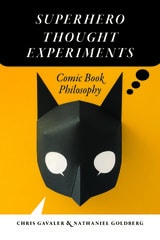
Superhero Thought Experiments
Comic Book PhilosophyChris Gavaler and Nathaniel Goldberg
University of Iowa Press, 2019
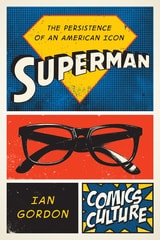
Superman
The Persistence of an American IconGordon, Ian
Rutgers University Press, 2017
Superman: Persistence of an American Icon examines the many iterations of the character in comic books, comic strips, radio series, movie serials, feature films, television shows, animation, toys, and collectibles over the past eight decades. Demonstrating how Superman’s iconic popularity cannot be attributed to any single creator or text, comics expert Ian Gordon embarks on a deeper consideration of cultural mythmaking as a collective and dynamic process. He also outlines the often contentious relationships between the various parties who have contributed to the Superman mythos, including corporate executives, comics writers, artists, nostalgic commentators, and collectors.
Armed with an encyclopedic knowledge of Superman’s appearances in comics and other media, Gordon also digs into comics archives to reveal the prominent role that fans have played in remembering, interpreting, and reimagining Superman’s iconography. Gordon considers how comics, film, and TV producers have taken advantage of fan engagement and nostalgia when selling Superman products. Investigating a character who is equally an icon of American culture, fan culture, and consumer culture, Superman thus offers a provocative analysis of mythmaking in the modern era.
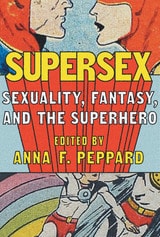
Supersex
Sexuality, Fantasy, and the SuperheroEdited by Anna F. Peppard
University of Texas Press, 2020
2021 Comic Studies Society Prize for Edited Collection
From Superman and Batman to the X-Men and Young Avengers, Supersex interrogates the relationship between heroism and sexuality, shedding new light on our fantasies of both.
From Superman, created in 1938, to the transmedia DC and Marvel universes of today, superheroes have always been sexy. And their sexiness has always been controversial, inspiring censorship and moral panic. Yet though it has inspired jokes and innuendos, accusations of moral depravity, and sporadic academic discourse, the topic of superhero sexuality is like superhero sexuality itself—seemingly obvious yet conspicuously absent. Supersex: Sexuality, Fantasy, and the Superhero is the first scholarly book specifically devoted to unpacking the superhero genre’s complicated relationship with sexuality.
Exploring sexual themes and imagery within mainstream comic books, television shows, and films as well as independent and explicitly pornographic productions catering to various orientations and kinks, Supersex offers a fresh—and lascivious—perspective on the superhero genre’s historical and contemporary popularity. Across fourteen essays touching on Superman, Batman, the X-Men, and many others, Anna F. Peppard and her contributors present superhero sexuality as both dangerously exciting and excitingly dangerous, encapsulating the superhero genre’s worst impulses and its most productively rebellious ones. Supersex argues that sex is at the heart of our fascination with superheroes, even—and sometimes especially—when the capes and tights stay on.
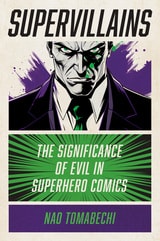
Supervillains
The Significance of Evil in Superhero ComicsNao Tomabechi
Rutgers University Press, 2025
Bringing together different approaches and critical perspectives across disciplines, author Nao Tomabechi troubles overly hero-centered works in comics studies to reconsider the modern American myths of the superheroes. Considering the likes of Lex Luthor, the Joker, Catwoman, Harley Quinn, Loki, Venom, and more, Supervillians explores themes such as gender and sexuality, disability, and many forms of Otherness in relation to the notion of evil as it appears in the superhero genre. The book investigates how supervillains uphold and, at times, trouble dominant ideals expressed by the heroism of our superheroes.