Results by title
82 books match the query 'Conservatism' and 5 start with s

Saints, Sinners, and Sovereign Citizens
The Endless War over the West's Public LandsJohn L. Smith
University of Nevada Press, 2026
Listed as one of the Reno News & Review's "New Books from Nevada Authors," December 29, 2021
The grazing rights battle between Nevada rancher Cliven Bundy and the federal government, resulting in a tense, armed standoff between Bundy’s supporters and federal law enforcement officers, garnered international media attention in 2014. Saints, Sinners, and Sovereign Citizens places the Bundy conflict into the larger context of the Sagebrush Rebellion and the long struggle over the use of federal public lands in the American West.
Author John L. Smith skillfully captures the drama of the Bundy legal tangle amid the current political climate. Although no shots were fired during the standoff itself, just weeks later self-proclaimed Bundy supporters murdered two Las Vegas police officers and a civilian. In Eastern Oregon, other Bundy supporters occupied the federal offices of the Malheur National Wildlife Refuge, and one of them died in a hail of bullets.
While examining the complex history of federal public land policies, Smith exposes both sides of this story. He shows that there are passionate true believers on opposite sides of the insurrection, along with government agents and politicians in Washington complicit in efforts to control public lands for their wealthy allies and campaign contributors. With the promise of billions of dollars in natural resource profits and vast tracts of environmentally sensitive lands hanging in the balance, the West’s latest range war is the most important in the nation’s history. This masterful exposé raises serious questions about the fate of America’s public lands and the vehement arguments that are framing the debate from all sides.
[more]
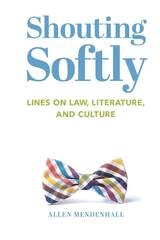
Shouting Softly
Lines on Law, Literature, and CultureAllen Mendenhall
St. Augustine's Press, 2020
In Shouting Softly, literary lawyer and proud Southerner Allen Mendenhall provides valuable insights into perennial questions about the fundamental features of civil society. His expansive commentaries and criticism on law, literature, and culture reveal an abiding commitment to ordered liberty, the decentralization and diffusion of power, bottom-up and localized forms of voluntary governance, time-tested wisdom, and aesthetic sensibility. This vigorous work cautions against hubris and misguided certitude, predicating its arresting arguments on the proposition that human reason, however awesome and inspiring, is limited and fallible. Covering a wide range of issues and historical figures, Mendenhall espouses conservative yet melioristic approaches to complex subjects, rebutting the hollow claims and fashionable theories that captivate ‘purposefully’ leftist law and humanities faculties across the United States. His is the measured voice of a book-loving polymath who appreciates beauty, imagination, humility, clarity, cooperation, and sound argumentation.
The work is given in three parts. The first section on law explores legal minds, rules and commentary on seminal jurisprudence. The second part explores literature and the influence of the writer and the disconcerting truths stories often seek to convey. Thirdly, Mendenhall delves into culture and the more obvious situations wherein we gain insight into our manner of living, and here Mendenhall exudes a Southern accent that in no way compromises his universal bearings. One of the highlights is his echo of Larry Seidentop’s question: “If we in the West do not understand the moral depth of our own tradition, how can we hope to shape the conversation of mankind?” This is all the more meaningful given that Mendenhall is a member of the Millennial generation, and part of the intellectual minority who sees the urgency of “a studied appreciation for nuanced story and linguistic narrative.”
The work is given in three parts. The first section on law explores legal minds, rules and commentary on seminal jurisprudence. The second part explores literature and the influence of the writer and the disconcerting truths stories often seek to convey. Thirdly, Mendenhall delves into culture and the more obvious situations wherein we gain insight into our manner of living, and here Mendenhall exudes a Southern accent that in no way compromises his universal bearings. One of the highlights is his echo of Larry Seidentop’s question: “If we in the West do not understand the moral depth of our own tradition, how can we hope to shape the conversation of mankind?” This is all the more meaningful given that Mendenhall is a member of the Millennial generation, and part of the intellectual minority who sees the urgency of “a studied appreciation for nuanced story and linguistic narrative.”
[more]

Social Science for What?
Philanthropy and the Social Question in a World Turned Rightside UpAlice O'Connor
Russell Sage Foundation, 2007
Much like today, the early twentieth century was a period of rising economic inequality and political polarization in America. But it was also an era of progressive reform—a time when the Russell Sage Foundation and other philanthropic organizations were established to promote social science as a way to solve the crises of industrial capitalism. In Social Science for What? Alice O'Connor relates the history of philanthropic social science, exploring its successes and challenges over the years, and asking how these foundations might continue to promote progressive social change in our own politically divided era. The philanthropic foundations established in the early 1900s focused on research which, while intended to be objective, was also politically engaged. In addition to funding social science research, in its early years the Russell Sage Foundation also supported social work and advocated reforms on issues from child welfare to predatory lending. This reformist agenda shaped the foundation's research priorities and methods. The Foundation's landmark Pittsburgh Survey of wage labor, conducted in 1907-1908, involved not only social scientists but leaders of charities, social workers, and progressive activists, and was designed not simply to answer empirical questions, but to reframe the public discourse about industrial labor. After World War II, many philanthropic foundations disengaged from political struggles and shifted their funding toward more value-neutral, academic social inquiry, in the belief that disinterested research would yield more effective public policies. Consequently, these foundations were caught off guard in the 1970s and 1980s by the emergence of a network of right-wing foundations, which was successful in promoting an openly ideological agenda. In order to counter the political in-roads made by conservative organizations, O'Connor argues that progressive philanthropic research foundations should look to the example of their founders. While continuing to support the social science research that has contributed so much to American society over the past 100 years, they should be more direct about the values that motivate their research. In this way, they will help foster a more democratic dialogue on important social issues by using empirical knowledge to engage fundamentally ethical concerns about rising inequality. O'Connor's message is timely: public-interest social science faces unprecedented challenges in this era of cultural warfare, as both liberalism and science itself have come under assault. Social Science for What? is a thought-provoking critique of the role of social science in improving society and an indispensable guide to how progressives can reassert their voice in the national political debate. A Volume in the Russell Sage Foundation's Centennial Series
[more]

Spider Web
The Birth of American AnticommunismNick Fischer
University of Illinois Press, 2016
The McCarthy-era witch hunts marked the culmination of an anticommunist crusade launched after the First World War. With Bolshevism triumphant in Russia and public discontent shaking the United States, conservatives at every level of government and business created a network dedicated to sweeping away the "spider web" of radicalism they saw threatening the nation. In this groundbreaking study, Nick Fischer shines a light on right-wing activities during the interwar period. Conservatives, eager to dispel communism's appeal to the working class, railed against a supposed Soviet-directed conspiracy composed of socialists, trade unions, peace and civil liberties groups, feminists, liberals, aliens, and Jews. Their rhetoric and power made for devastating weapons in their systematic war for control of the country against progressive causes. But, as Fischer shows, the term spider web far more accurately described the anticommunist movement than it did the makeup and operations of international communism. Fischer details how anticommunist myths and propaganda influenced mainstream politics in America, and how its ongoing efforts paved the way for the McCarthyite Fifties--and augured the conservative backlash that would one day transform American politics.
[more]

Stations of the Cross
Adorno and Christian Right RadioPaul Apostolidis
Duke University Press, 2000
Since the 1970s, American society has provided especially fertile ground for the growth of the Christian right and its influence on both political and cultural discourse. In Stations of the Cross political theorist Paul Apostolidis shows how a critical component of this movement’s popular culture—evangelical conservative radio—interacts with the current U.S. political economy. By examining in particular James Dobson’s enormously influential program, Focus on the Family—its messages, politics, and effects—Apostolidis reveals the complex nature of contemporary conservative religious culture.
Public ideology and institutional tendencies clash, the author argues, in the restructuring of the welfare state, the financing of the electoral system, and the backlash against women and minorities. These frictions are nowhere more apparent than on Christian right radio. Reinvigorating the intellectual tradition of the Frankfurt School, Apostolidis shows how ideas derived from early critical theory—in particular that of Theodor W. Adorno—can illuminate the political and social dynamics of this aspect of contemporary American culture. He uses and reworks Adorno’s theories to interpret the nationally broadcast Focus on the Family, revealing how the cultural discourse of the Christian right resonates with recent structural transformations in the American political economy. Apostolidis shows that the antidote to the Christian right’s marriage of religious and market fundamentalism lies not in a reinvocation of liberal fundamentals, but rather depends on a patient cultivation of the affinities between religion’s utopian impulses and radical, democratic challenges to the present political-economic order.
Mixing critical theory with detailed analysis, Stations of the Cross provides a needed contribution to sociopolitical studies of mass movements and will attract readers in sociology, political science, philosophy, and history.
[more]