103 books match the query 'Conservatism & Liberalism' and 3 start with s
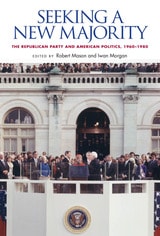
cover of Seeking a New Majority: The Republican Party and American Politics, 1960-1980

Seeking a New Majority

The Republican Party and American Politics, 1960-1980

Robert Mason

Vanderbilt University Press, 2013

The rise of the Republican Party from its mid-twentieth-century minority status between 1960 and 1980 had a profound impact on American politics that is still being felt in the second decade of the twenty-first century. The GOP would move to the right in its pursuit of electoral ascendancy, but considerable debate within the party surrounded this shift and its success was far from certain. Ultimately, however, this development would culminate in the transformational election of Ronald Reagan as president in 1980.


Seeking a New Majority assembles an international group of scholars to move beyond the ideas and activities of party leaders who have hitherto received the bulk of historical attention. It illuminates how the Republican Party expanded its regional base, especially in the South, appealed to new constituencies ranging from blue-collar workers to Christian fundamentalists, and enhanced the political appeal of conservatism. It also examines how Republicans engaged in a remarkable organizational and intellectual mobilization to challenge Democratic Party dominance--in search of a new majority.
[more]
cover of Small Donors in US Politics: Myth and Reality

Small Donors in US Politics

Myth and Reality

Zachary Albert and Raymond J. La Raja

University of Chicago Press, 2026

A myth-busting investigation of small donors: who they are, how they spend their money, and whose campaigns actually benefit from their donations.

Many political reformers argue that more robust small donor participation in US campaigns would reduce the influence of the wealthiest Americans and improve political responsiveness to ordinary citizens. Drawing on extensive data, including surveys and campaign records, Zachary Albert and Raymond J. La Raja largely dispel this myth, offering the first comprehensive portrait to date of small donors in US elections.

Although small donor contributions to high-profile, national races have increased markedly since 2018, the US campaign finance system allows for even larger sums of money from Super PACs and other independent spending groups. Moreover, small donors are mostly similar to their larger contributor counterparts: both are socioeconomically advantaged, strongly partisan, ideologically extreme, and distinct from non-donors. Small donors can also be impulsive: they tend to give mostly to high-profile candidates on the ideological extremes, empowering media celebrities and norm-breakers rather than consensus-builders, and they underinvest in competitive and down-ballot races. Importantly, the candidates who rely most heavily on small donor support are not necessarily better legislators or representatives.

Yet, the story is not entirely bleak. Small donors bring energy and resources, especially for challengers and outsider candidates. The book shows how reforms could channel this energy more productively—by strengthening political parties, emphasizing local representation, and creating systems that broaden participation beyond the most ideological citizens.

Timely, accessible, and grounded in data, Small Donors in US Politics reveals both the promise and the peril of small donor politics—and what it will take to make money in politics serve democracy, not undermine it.
[more]
cover of Superfluous Southerners: Cultural Conservatism and the South, 1920-1990

Superfluous Southerners

Cultural Conservatism and the South, 1920-1990

John J. Langdale III

University of Missouri Press, 2012

In Superfluous Southerners, John J. Langdale III tells the story of traditionalist conservatism and its boundaries in twentieth-century America. Because this time period encompasses both the rise of the modern conservative movement and the demise of southern regional distinctiveness, it affords an ideal setting both for observing the potentiality of American conservatism and for understanding the fate of the traditionalist “man of letters.” Langdale uses the intellectual and literary histories of John Crowe Ransom, Donald Davidson, and Allen Tate—the three principal contributors to the Agrarian manifesto I’ll Take My Stand—and of their three most remarkable intellectual descendants—Cleanth Brooks, Richard Weaver, and Melvin Bradford—to explore these issues.
Langdale begins his study with some observations on the nature of American exceptionalism and the intrinsic barriers which it presents to the traditionalist conservative imagination. While works like Louis Menand’s The Metaphysical Club have traced the origins of modern pragmatic liberalism during the late nineteenth century, the nature of conservative thought in postbellum America remains less completely understood. Accordingly, Langdale considers the origins of the New Humanism movement at the turn of the twentieth century, then turning to the manner in which midwesterners Irving Babbitt and Paul Elmer Moore stirred the imagination of the southern Agrarians during the 1920s.
After the publication of I’ll Take My Stand in 1930, Agrarianism splintered into three distinct modes of traditionalist conservatism: John Crowe Ransom sought refuge in literary criticism, Donald Davidson in sectionalism, and Allen Tate in an image of the religious-wayfarer as a custodian of language. Langdale traces the expansion of these modes of traditionalism by succeeding generations of southerners. Following World War II, Cleanth Brooks further refined the tradition of literary criticism, while Richard Weaver elaborated the tradition of sectionalism. However, both Brooks and Weaver distinctively furthered Tate’s notion that the integrity of language remained the fundamental concern of traditionalist conservatism.
Langdale concludes his study with a consideration of neoconservative opposition to M.E. Bradford’s proposed 1980 nomination as head of the National Endowment for the Humanities and its significance for the southern man of letters in what was becoming postmodern and postsouthern America. Though the post–World War II ascendance of neoconservatism drastically altered American intellectual history, the descendants of traditionalism remained largely superfluous to this purportedly conservative revival which had far more in common with pragmatic liberalism than with normative conservatism.
[more]