Results by title
54 books match the query 'Contemporary (1945-)' and 5 start with s
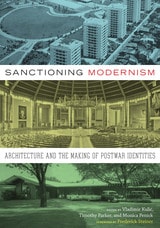
Sanctioning Modernism
Architecture and the Making of Postwar IdentitiesEdited by Vladimir Kulic, Timothy Parker, and Monica Penick
University of Texas Press, 2014
With new research on building programs in political, religious, and domestic settings in the United States and Europe, this collection of essays offers a fresh look at postwar modernism and the role that architecture played in constructing modern identities.
In the decades following World War II, modern architecture spread around the globe alongside increased modernization, urbanization, and postwar reconstruction—and it eventually won widespread acceptance. But as the limitations of conventional conceptions of modernism became apparent, modern architecture has come under increasing criticism. In this collection of essays, experienced and emerging scholars take a fresh look at postwar modern architecture by asking what it meant to be “modern,” what role modern architecture played in constructing modern identities, and who sanctioned (or was sanctioned by) modernism in architecture.
This volume presents focused case studies of modern architecture in three realms—political, religious, and domestic—that address our very essence as human beings. Several essays explore developments in Czechoslovakia, Romania, and Yugoslavia and document a modernist design culture that crossed political barriers, such as the Iron Curtain, more readily than previously imagined. Other essays investigate various efforts to reconcile the concerns of modernist architects with the traditions of the Roman Catholic Church and other Christian institutions. And a final group of essays looks at postwar homebuilding in the United States and demonstrates how malleable and contested the image of the American home was in the mid-twentieth century. These inquiries show the limits of canonical views of modern architecture and reveal instead how civic institutions, ecclesiastical traditions, individual consumers, and others sought to sanction the forms and ideas of modern architecture in the service of their respective claims or desires to be modern.
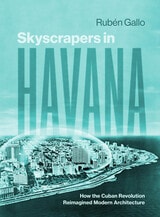
Skyscrapers in Havana
How the Cuban Revolution Reimagined Modern ArchitectureRubén Gallo
University of Chicago Press, 2027
Why Havana attracted the most important architects in the 1950s, and how the Cuban Revolution transformed the uses of these impressive skyscrapers.
During the 1950s, Havana’s Vedado district became an epicenter of modern architecture. Architects from around the world—including Mies van der Rohe, Richard Neutra, and Josep Lluis Sert—worked in Cuba and helped make Havana one of the most modern capitals in Latin America. After the Cuban Revolution, the buildings designed during Cuba’s American-influenced hyper-capitalist past had to be reimagined, about what use what use could luxury hotels, private condominiums, and golf clubs could have in a socialist society. Writers and artists from around the world including Simone de Beauvoir, Agnès Varda, Allen Ginsberg, Graham Greene, and Gabriel García Márquez flocked to Havana to witness the first socialist experiment in the Americas and marveled at the modern towers. French philosopher Jean-Paul Sartre wrote about “Skyscrapers in Havana” for his first journalistic piece about his trip. In contrast, modern architects abandoned Cuba after the Revolution: not even those designers who had built projects there set foot in the island again.
Considering Havana’s architecture as part of a larger Cuban modernity, Gallo places built projects in dialogue with film, literature, and other cultural texts, revealing how poets, novelists, filmmakers, and designers theorized the city’s urban fabric. Skyscrapers in Havana features six chapters, each devoted to an iconic modernist structure, as well as five shorter meditations on the architects, including Le Corbusier, who had the opportunity to go to Cuba after the Revolution but decided to stay away.
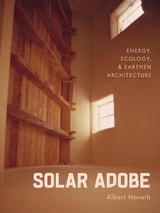
Solar Adobe
Energy, Ecology, and Earthen ArchitectureAlbert Narath
University of Minnesota Press, 2024
How a centuries-old architectural tradition reemerged as a potential solution to the political and environmental crises of the 1970s
Against the backdrop of a global energy crisis, a widespread movement embracing the use of raw earth materials for building construction emerged in the 1970s. Solar Adobe examines this new wave of architectural experimentation taking place in the United States, detailing how an ancient tradition became a point of convergence for issues of environmentalism, architecture, technology, and Indigenous resistance.
Utilized for centuries by the Pueblo people of the American Southwest and by Spanish colonialists, adobe construction found renewed interest as various groups contended with the troubled legacies of modern architecture and an increasingly urgent need for sustainable design practices. In this period of critical experimentation, design networks that included architects, historians, counterculture communities, government weapons labs, and Indigenous activists all looked to adobe as a means to address pressing environmental and political issues.
Albert Narath charts the unique capacities of adobe construction across a wide range of contexts, consistently troubling simple distinctions between traditional and modern technologies, high design and vernacular architecture. Drawing insightful parallels between architecture, environmentalism, and movements for Indigenous sovereignty, Solar Adobe stresses the importance of considering the history of the built environment in conjunction with architecture’s larger impact on the natural world.
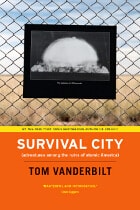
Survival City
Adventures among the Ruins of Atomic AmericaTom Vanderbilt
University of Chicago Press, 2002
On the road to Survival City, Tom Vanderbilt maps the visible and invisible legacies of the cold war, exhuming the blueprints for the apocalypse we once envisioned and chronicling a time when we all lived at ground zero. In this road trip among ruined missile silos, atomic storage bunkers, and secret test sites, a lost battleground emerges amid the architecture of the 1950s, accompanied by Walter Cotten’s stunning photographs. Survival City looks deep into the national soul, unearthing the dreams and fears that drove us during the latter half of the twentieth century.
“A crucial and dazzling book, masterful, and for me at least, intoxicating.”—Dave Eggers
“A genuinely engaging book, perhaps because [Vanderbilt] is skillful at conveying his own sense of engagement to the reader.”—Los Angeles Times
“A retracing of Dr. Strangelove as ordinary life.”—Greil Marcus, Bookforum
SynergiCity
Reinventing the Postindustrial CityEdited by Paul Hardin Kapp and Paul J. Armstrong
University of Illinois Press, 2012