Results by title
103 books match the query 'Conversations' and 9 start with s

Salud y Shalom
Conversations with Jewish Veterans of the Abraham Lincoln BrigadeJoseph Butwin
University of Illinois Press, 2025
Joseph Butwin’s oral history presents conversations with ten Jewish veterans of the ALB. Recorded from 1992–94 in the wake of European communism’s collapse, the interviews explore the milieus that formed the volunteers. Immigrants established the secular Yiddish-speaking socialism that became a part of many Jewish American communities. Their children, reacting to economic depression and the rise of fascism, enlisted in the ALB. Butwin follows their stories from their youthful motives and choices through their lives as Jews and leftists, and records the reckonings that took place as they reflected on their past.
Insightful and revealing, Salud y Shalom explores the forces of identity and history that led young Jewish leftists to fight fascism.
So Ask
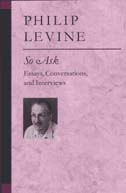
Essays, Conversations, and InterviewsPhilip Levine
University of Michigan Press, 2002

Speaking of Furniture
Conversations with 14 American MastersWarren Eames Johnson
The Artist Book Foundation, 2013
Speaking of Furniture: Conversations with 14 American Masters is a fresh, stimulating, and in-depth examination of the modus operandi of 14 accomplished—and diverse—furniture makers. An engaging history of studio furniture, this colorful, informative study includes engaging conversations with James Krenov, Wendell Castle, Jere Osgood, Judy Kensley McKie, David Ebner, Richard Scott Newman, Hank Gilpin, Alphonse Mattia, John Dunnigan, Wendy Maruyama, James Schriber, Timothy S. Philbrick, Michael Hurwitz, and Thomas Hucker. The insightful interviews illuminate how these creative and gifted craftspeople arrived professionally and what their craft means to them individually.
In his enlightening foreword, Edward S. Cook, Jr. maps out the background of the studio furniture movement. Author and furniture maker Roger Holmes offers an insider's perspective on the art and craft of producing exquisite contemporary furniture in his conversational introduction and maintains, "Art or craft, this is very personal work." This elegant presentation skillfully sheds light on the thought processes and techniques of a celebrated and exceptional gathering of studio furniture makers who are as unique as they are stellar. As sculptor and furniture designer Wendell Castle remarks, "What I admired was that... fine art and craft were the same thing."
Speaking of Indigenous Politics
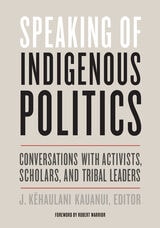
Conversations with Activists, Scholars, and Tribal LeadersJ. Kehaulani Kauanui
University of Minnesota Press, 2018
“A lesson in how to practice recognizing the fundamental truth that every inch of the Americas is Indigenous territory” —Robert Warrior, from the Foreword
Many people learn about Indigenous politics only through the most controversial and confrontational news: the Standing Rock Sioux Tribe’s efforts to block the Dakota Access Pipeline, for instance, or the battle to protect Bears Ears National Monument in Utah, a site sacred to Native peoples. But most Indigenous activism remains unseen in the mainstream—and so, of course, does its significance. J. Kēhaulani Kauanui set out to change that with her radio program Indigenous Politics. Issue by issue, she interviewed people who talked candidly and in an engaging way about how settler colonialism depends on erasing Native peoples and about how Native peoples can and do resist. Collected here, these conversations speak with clear and compelling voices about a range of Indigenous politics that shape everyday life.
Land desecration, treaty rights, political status, cultural revitalization: these are among the themes taken up by a broad cross-section of interviewees from across the United States and from Canada, Mexico, Chile, Bolivia, Peru, Australia, and New Zealand. Some speak from the thick of political action, some from a historical perspective, others from the reaches of Indigenous culture near and far. Writers, like Comanche Paul Chaat Smith, author of Everything You Know about Indians Is Wrong, expand on their work—about gaming and sovereignty, for example, or protecting Native graves, the reclamation of land, or the erasure of Indian identity. These conversations both inform and engage at a moment when their messages could not be more urgent.
Contributors: Jessie Little Doe Baird (Mashpee Wampanoag), Omar Barghouti, Lisa Brooks (Abenaki), Kathleen A. Brown-Pérez (Brothertown Indian Nation), Margaret “Marge” Bruchac (Abenaki), Jessica Cattelino, David Cornsilk (Cherokee Nation), Sarah Deer (Muskogee Creek Nation), Philip J. Deloria (Dakota), Tonya Gonnella Frichner (Onondaga Nation), Hone Harawira (Ngapuhi Nui Tonu), Suzan Shown Harjo (Cheyenne and Hodulgee Muscogee), Rashid Khalidi, Winona LaDuke (White Earth Ojibwe), Maria LaHood, James Luna (Luiseño), Aileen Moreton-Robinson (Quandamooka), Chief Mutáwi Mutáhash (Many Hearts) Marilynn “Lynn” Malerba (Mohegan), Steven Newcomb (Shawnee/Lenape), Jean M. O’Brien (White Earth Ojibwe), Jonathan Kamakawiwo‘ole Osorio (Kanaka Maoli), Steven Salaita, Paul Chaat Smith (Comanche), Circe Sturm (Mississippi Choctaw descendant), Margo Taméz (Lipan Apache), Chief Richard Velky (Schaghticoke), Patrick Wolfe.
Spilling the Beans in Chicanolandia
Conversations with Writers and ArtistsBy Frederick Luis Aldama
University of Texas Press, 2006
Since the 1980s, a prolific "second wave" of Chicano/a writers and artists has tremendously expanded the range of genres and subject matter in Chicano/a literature and art. Building on the pioneering work of their predecessors, whose artistic creations were often tied to political activism and the civil rights struggle, today's Chicano/a writers and artists feel free to focus as much on the aesthetic quality of their work as on its social content. They use novels, short stories, poetry, drama, documentary films, and comic books to shape the raw materials of life into art objects that cause us to participate empathetically in an increasingly complex Chicano/a identity and experience.
This book presents far-ranging interviews with twenty-one "second wave" Chicano/a poets, fiction writers, dramatists, documentary filmmakers, and playwrights. Some are mainstream, widely recognized creators, while others work from the margins because of their sexual orientations or their controversial positions. Frederick Luis Aldama draws out the artists and authors on both the aesthetic and the sociopolitical concerns that animate their work. Their conversations delve into such areas as how the artists' or writers' life experiences have molded their work, why they choose to work in certain genres and how they have transformed them, what it means to be Chicano/a in today's pluralistic society, and how Chicano/a identity influences and is influenced by contact with ethnic and racial identities from around the world.
Stegner
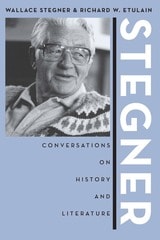
Conversations On History And LiteratureWallace Stegner
University of Nevada Press, 1996
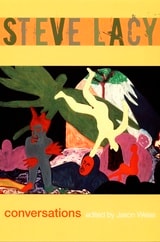
Steve Lacy
ConversationsJason Weiss, ed.
Duke University Press, 2006
This volume brings together interviews that appeared in a variety of magazines between 1959 and 2004. Conducted by writers, critics, musicians, visual artists, a philosopher, and an architect, the interviews indicate the evolution of Lacy’s extraordinary career and thought. Lacy began playing the soprano saxophone at sixteen, and was soon performing with Dixieland musicians much older than he. By nineteen he was playing with the pianist Cecil Taylor, who ignited his interest in the avant-garde. He eventually became the foremost proponent of Thelonious Monk’s music. Lacy played with a broad range of musicians, including Monk and Gil Evans, and led his own bands. A voracious reader and the recipient of a MacArthur “genius” grant, Lacy was particularly known for setting to music literary texts—such as the Tao Te Ching, and the work of poets including Samuel Beckett, Robert Creeley, and Taslima Nasrin—as well as for collaborating with painters and dancers in multimedia projects.
Lacy lived in Paris from 1970 until 2002, and his music and ideas reflect a decades-long cross-pollination of cultures. Half of the interviews in this collection originally appeared in French sources and were translated specifically for this book. Jason Weiss provides a general introduction, as well as short introductions to each of the interviews and to the selection of Lacy’s own brief writings that appears at the end of the book. The volume also includes three song scores, a selected discography of Lacy’s recordings, and many photos from the personal collection of his wife and longtime collaborator, Irene Aebi.
Interviews by: Derek Bailey, Franck Bergerot, Yves Bouliane, Etienne Brunet, Philippe Carles, Brian Case, Garth W. Caylor Jr., John Corbett, Christoph Cox, Alex Dutilh, Lee Friedlander, Maria Friedlander, Isabelle Galloni d'Istria, Christian Gauffre, Raymond Gervais, Paul Gros-Claude, Alain-René Hardy, Ed Hazell, Alain Kirili, Mel Martin, Franck Médioni, Xavier Prévost, Philippe Quinsac, Ben Ratliff, Gérard Rouy, Kirk Silsbee, Roberto Terlizzi, Jason Weiss

Still Moving
Conversations with Senior Professional Dancers Still PerformingSonia York-Pryce
Intellect Books, 2025
What does it mean to keep dancing against the tide of ageism? Still Moving offers an unprecedented glimpse into the lives of senior professional dancers, artists who continue to perform and create, defying expectations well beyond the conventional limits of a dancer’s career. Through in-depth conversations with twenty performers ranging from 41 to 109 years old, Sonia York-Pryce reveals stories of resilience, adaptation, and unwavering passion for movement.
These dancers, hailing from the United States, Canada, Europe, and Australia, challenge ingrained biases in the dance industry while embodying the limitless potential of an aging body. Their experiences inspire not only younger dancers wondering about longevity in their careers but also anyone invested in the intersections of creativity, aging, and well-being.
Still Moving is not simply a book about dance; it engages in a broader cultural dialogue about ageism and the evolving nature of artistic expression. For dancers, educators, researchers, and those in fields such as somatic practices, gerontology, and social sciences, this book champions a future where dance is not bound by age but enriched by experience.
Symbolic Violence
Conversations with BourdieuMichael Burawoy
Duke University Press, 2019