Results by title
115 books match the query 'Criminal Law' and 9 start with s
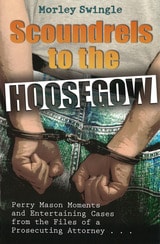
Scoundrels to the Hoosegow
Perry Mason Moments and Entertaining Cases from the Files of a Prosecuting AttorneyMorley Swingle
University of Missouri Press, 2007
I closed my direct examination of narcotics officer Bill Bohnert by asking, "Detective Bohnert, do you see in the courtroom today the man we just saw on the tape, selling the crack cocaine to Darren Bullard?"
Bohnert pointed to Robert Funt.
"He's right there. . . ."
I heard laughter in the courtroom. I glanced at the defendant, who had dutifully raised his hand.
The prisoners seated behind him were laughing. They recognized a Perry Mason moment when they saw one.
Bohnert continued, "He's the one with his hand raised in the air."
It has been said that the public prosecutor has more power over life, liberty, and reputation than any other person—a daunting proposition, but perhaps less intimidating when that official’s perspective is tempered by humor and compassion.
In Scoundrels to the Hoosegow, a veteran prosecutor who is also a consummate storyteller shares more than thirty entertaining legal stories drawn from real life, re-creating, with verve and wit, villains, heroes, and ordinary citizens. In cases both tragic and hilarious, Morley Swingle offers a behind-the-scenes look at the justice system, taking readers from the scene of the crime to the courtroom as he explores the worlds of judges, attorneys, police officers, and criminals.
Informed by a deep appreciation of Mark Twain, Swingle aims to do for his profession what Clemens did for riverboat piloting. He leads readers on an enjoyable romp through crime and punishment, while offering a clear exposition of legal points—from the subtleties of cross-examination to the role of plea bargaining.
In cases ranging from indecent exposure to conspiracy to commit murder, Swingle considers the fine line between pornography and obscenity and discusses sensitive issues surrounding first-degree murder and the death penalty. Whether describing a drunken but well-meaning probationer who frees the dogs on “death row” or the woman who tries to hire a reluctant hit man to dispose of her husband, he combines true crime and legal analysis with a healthy dose of humor—and shares the occasional “Perry Mason moment” in which a trial dramatically shifts direction.
Not since the author of Anatomy of a Murder, Robert Traver, wrote Small Town D.A. fifty years ago has an American prosecutor penned such a candid, revealing, and funny account of the job—an altogether satisfying book that sentences the reader to many hours of enjoyment.
Sentencing in Time
Linda Ross Meyer
Amherst College Press, 2017
Sentencing without Guidelines
Rhys Hester
Temple University Press, 2024
Sentencing without Guidelines is Rhys Hester’s deep dive into how South Carolina, which never passed sentencing guideline legislation, nonetheless created meaningful punishment reform. It achieved uniformity in sentencing with a traveling circuit of judges, informal norms among judges, and the unique phenomenon of the “Plea Judge” to manage cases.
Hester examines how prior convictions, race, and geographical differences impact sentences to explain why individuals get the criminal sentences they do. He also explores how legal reform mechanisms can influence punishment goals and policy. Sentencing without Guidelines shows the benefits and drawbacks South Carolina experienced as it met sentencing reform goals. These lessons can be translated into policy for other jurisdictions.
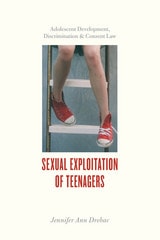
Sexual Exploitation of Teenagers
Adolescent Development, Discrimination, and Consent LawJennifer Ann Drobac
University of Chicago Press, 2016
When it comes to sexual relationships, adolescents pose a particular problem. Few teenagers possess all of the emotional and intellectual tools needed to navigate these threats, including the all too real advances made by supervisors, teachers, and mentors. In Sexual Exploitation of Teenagers, Jennifer Drobac explores the shockingly common problem of maturing adolescents who are harassed and exploited by adults in their lives. Reviewing the neuroscience and psychosocial evidence of adolescent development, she explains why teens are so vulnerable to adult harassers. Even today, in an age of increasing public awareness, criminal and civil law regarding the sexual abuse of minors remains tragically inept and irregular from state to state. Drobac uses six recent cases of teens suffering sexual harassment to illuminate the flaws and contradictions of this system, skillfully showing how our current laws fail to protect youths, and offering an array of imaginative legal reforms that could achieve increased justice for adolescent victims of sexual coercion.

Shadow Lives
The Forgotten Women of the War on TerrorVictoria Brittain
Pluto Press, 2013
Shadow Lives reveals the unseen side of the '9/11 wars': their impact on the wives and families of men incarcerated in Guantanamo, or in prison or under house arrest in Britain and the US. Victoria Brittain shows how these families have been made socially invisible and a convenient scapegoat for the state in order to exercise arbitrary powers under the cover of the 'War on Terror'.
A disturbing exposé of the perilous state of freedom and democracy in our society, the book reveals how a culture of intolerance and cruelty has left individuals at the mercy of the security services’ unverifiable accusations and punitive punishments.
Both a j'accuse and a testament to the strength and humanity of the families, Shadow Lives shows the methods of incarceration and social control being used by the British state and gives a voice to the families whose lives have been turned upside down. In doing so it raises urgent questions about civil liberties which no one can afford to ignore.
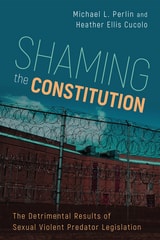
Shaming the Constitution
The Detrimental Results of Sexual Violent Predator LegislationMichael L. Perlin
Temple University Press, 2017
Convicted sexually violent predators are more vilified, more subject to media misrepresentation, and more likely to be denied basic human rights than any other population. Shaming the Constitution authors Michael Perlin and Heather Cucolo question the intentions of sex offender laws, offering new approaches to this most complex (and controversial) area of law and social policy.
The authors assert that sex offender laws and policies are unconstitutional and counter-productive. The legislation largely fails to add to public safety—even ruining lives for what are, in some cases, trivial infractions. Shaming the Constitution draws on law, behavioral sciences, and other disciplines to show that many of the “solutions” to penalizing sexually violent predators are “wrong,” as they create the most repressive and useless laws.
In addition to tracing the history of sex offender laws, the authors address the case of Jesse Timmendequas, whose crime begat “Megan’s Law;” the media’s role in creating a “moral panic;” recidivism statistics and treatments, as well as international human rights laws. Ultimately, they call attention to the flaws in the system so we can find solutions that contribute to public safety in ways that do not mock Constitutional principles.
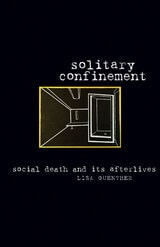
Solitary Confinement
Social Death and Its AfterlivesLisa Guenther
University of Minnesota Press, 2013
Prolonged solitary confinement has become a widespread and standard practice in U.S. prisons—even though it consistently drives healthy prisoners insane, makes the mentally ill sicker, and, according to the testimony of prisoners, threatens to reduce life to a living death. In this profoundly important and original book, Lisa Guenther examines the death-in-life experience of solitary confinement in America from the early nineteenth century to today’s supermax prisons. Documenting how solitary confinement undermines prisoners’ sense of identity and their ability to understand the world, Guenther demonstrates the real effects of forcibly isolating a person for weeks, months, or years.
Drawing on the testimony of prisoners and the work of philosophers and social activists from Edmund Husserl and Maurice Merleau-Ponty to Frantz Fanon and Angela Davis, the author defines solitary confinement as a kind of social death. It argues that isolation exposes the relational structure of being by showing what happens when that structure is abused—when prisoners are deprived of the concrete relations with others on which our existence as sense-making creatures depends. Solitary confinement is beyond a form of racial or political violence; it is an assault on being.
A searing and unforgettable indictment, Solitary Confinement reveals what the devastation wrought by the torture of solitary confinement tells us about what it means to be human—and why humanity is so often destroyed when we separate prisoners from all other people.
Speaking of Crime
The Language of Criminal JusticeLawrence M. Solan and Peter M. Tiersma
University of Chicago Press, 2004
Speaking of Crime answers these questions and examines the complex role of language within our criminal justice system. Lawrence M. Solan and Peter M. Tiersma compile numerous cases, ranging from the Lindbergh kidnapping to the impeachment trial of Bill Clinton to the JonBenét Ramsey case, that provide real-life examples of how language functions in arrests, investigations, interrogations, confessions, and trials. In a clear and accessible style, Solan and Tiersma show how recent advances in the study of language can aid in understanding how legal problems arise and how they might be solved.
With compelling discussions current issues and controversies, this book is a provocative state-of-the-art survey that will be of enormous value to legal scholars and professionals throughout the criminal justice system.
Speaking of Crime
The Language of Criminal JusticeLawrence M. Solan, Peter M. Tiersma, and Tammy Gales
University of Chicago Press, 2025
An essential introduction to the use and misuse of language within the criminal justice system, updated for a new generation.
Does everyone understand the Miranda warning? Why do people confess to a crime they did not commit? Can linguistic experts identify who wrote an anonymous threatening letter? Since its first publication, Speaking of Crime has been answering these questions. Introducing major topics and controversies at the intersection of language and law, Lawrence M. Solan, Peter M. Tiersma, and Tammy Gales apply multidisciplinary insights to examine the complex role of language within the US justice system.
The second edition features in-depth discussions of recent cases, new legislation, and innovative research advances, and includes a new chapter on who interprets the laws governing linguistic contexts. Thoroughly updated and approachable, Speaking of Crime is a state-of-the-art survey that will be useful to scholars, students, and practitioners throughout the criminal justice system.