190 books match the query 'Critical theory' and 14 start with s

cover of SARS Stories: Affect and Archive of the 2003 Pandemic

SARS Stories

Affect and Archive of the 2003 Pandemic

Belinda Kong

Duke University Press, 2024

In SARS Stories, Belinda Kong delves into the cultural archive of the 2003 SARS pandemic, examining Chinese-language creative works and social practices at the epicenters of the outbreak in China and Hong Kong. As the COVID-19 pandemic has highlighted issues of anti-Asian racism and sinophobia, Kong traces how Chinese people navigated the SARS pandemic and created meaning amid crisis through cultures of epidemic expression. From sentimental romances and Cantopop songs to raunchy sex comedies and crowdsourced ghost tales, unexpected and minor genres and creators of Chinese popular culture highlight the resilience and humanity of those living through the pandemic. Rather than narrating pandemic life in terms of crisis and catastrophe, Kong argues that these works highlight Chinese practices of community, care, and love amid disease. She also highlights the persistence of orientalism in anglophone accounts of SARS index patients and global reporting on COVID-era China. Kong shows how the Chinese experiences of living with SARS can reshape global feelings toward pandemic social life and foster greater fellowship in the face of pandemics.
[more]
cover of Sciences from Below: Feminisms, Postcolonialities, and Modernities

Sciences from Below

Feminisms, Postcolonialities, and Modernities

Sandra Harding

Duke University Press, 2008

In Sciences from Below, the esteemed feminist science studies scholar Sandra Harding synthesizes modernity studies with progressive tendencies in science and technology studies to suggest how scientific and technological pursuits might be more productively linked to social justice projects around the world. Harding illuminates the idea of multiple modernities as well as the major contributions of post-Kuhnian Western, feminist, and postcolonial science studies. She explains how these schools of thought can help those seeking to implement progressive social projects refine their thinking to overcome limiting ideas about what modernity and modernization are, the objectivity of scientific knowledge, patriarchy, and Eurocentricity. She also reveals how ideas about gender and colonialism frame the conventional contrast between modernity and tradition. As she has done before, Harding points the way forward in Sciences from Below.

Describing the work of the post-Kuhnian science studies scholars Bruno Latour, Ulrich Beck, and the team of Michael Gibbons, Helga Nowtony, and Peter Scott, Harding reveals how, from different perspectives, they provide useful resources for rethinking the modernity versus tradition binary and its effects on the production of scientific knowledge. Yet, for the most part, they do not take feminist or postcolonial critiques into account. As Harding demonstrates, feminist science studies and postcolonial science studies have vital contributions to make; they bring to light not only the male supremacist investments in the Western conception of modernity and the historical and epistemological bases of Western science but also the empirical knowledge traditions of the global South. Sciences from Below is a clear and compelling argument that modernity studies and post-Kuhnian, feminist, and postcolonial sciences studies each have something important, and necessary, to offer to those formulating socially progressive scientific research and policy.
[more]
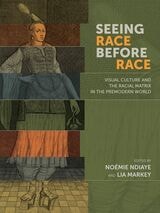
cover of Seeing Race Before Race: Visual Culture and the Racial Matrix in the Premodern World

Seeing Race Before Race

Visual Culture and the Racial Matrix in the Premodern World

Edited by Noémie Ndiaye and Lia Markey

Arizona Center for Medieval and Renaissance Studies, 2023

Explores the deployment of racial thinking and racial formations in the visual culture of the pre-modern world.
 
The capacious visual archive studied in this volume includes a trove of materials such as annotated or illuminated manuscripts, Renaissance costume books and travel books, maps and cartographic volumes produced by Europeans as well as Indigenous peoples, mass-printed pamphlets, jewelry, decorative arts, religious iconography, paintings from around the world, ceremonial objects, festival books, and play texts intended for live performance.

Contributors explore the deployment of what coeditor Noémie Ndiaye calls “the racial matrix” and its interconnected paradigms across the medieval and early modern chronological divide and across vast transnational and multilingual geographies. This volume uses items from the Fall 2023 exhibition “Seeing Race Before Race”—a collaboration between RaceB4Race and the Newberry Library—as a starting point for an ambitious theoretical conversation between premodern race studies, art history, performance studies, book history, and critical race theory.

[more]
cover of Selected Writings on Visual Arts and Culture: Detour to the Imaginary

Selected Writings on Visual Arts and Culture

Detour to the Imaginary

Stuart Hall. Edited by Gilane Tawadros

Duke University Press, 2024
Stuart Hall’s work on culture, politics, race, and media is familiar to readers throughout the world. Equally important was his decades-long commitment to visual art. As the first collection to bring together Hall’s work on the visual, this volume assembles two dozen of Hall’s essays, lectures, reviews, catalog texts, and conversations on art, film, and photography. Providing rare insights into Hall’s engagement with the “radically different” intellectual and aesthetic space of the visual imaginary, these works articulate the importance of the visual as a site of contestation at the same time as it is a space in which Black artists and filmmakers reframe questions about diaspora, identity, and globalization. Selected Writings on Visual Arts and Culture demonstrates the breadth and range of Hall’s thinking on art, film, photography, archives, and museums. In so doing, it enables us to arrive at radical and innovative ways of understanding the world.
[more]
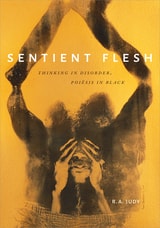
cover of Sentient Flesh: Thinking in Disorder, Poiesis in Black

Sentient Flesh

Thinking in Disorder, Poiesis in Black

R. A. Judy

Duke University Press, 2020

 In Sentient Flesh R. A. Judy takes up freedman Tom Windham’s 1937 remark “we should have our liberty 'cause . . . us is human flesh" as a point of departure for an extended meditation on questions of the human, epistemology, and the historical ways in which the black being is understood. Drawing on numerous fields, from literary theory and musicology, to political theory and phenomenology, as well as Greek and Arabic philosophy, Judy engages literary texts and performative practices such as music and dance that express knowledge and conceptions of humanity appositional to those grounding modern racialized capitalism. Operating as critiques of Western humanism, these practices and modes of being-in-the-world—which he theorizes as “thinking in disorder,” or “poiēsis in black”—foreground the irreducible concomitance of flesh, thinking, and personhood. As Judy demonstrates, recognizing this concomitance is central to finding a way past the destructive force of ontology that still holds us in thrall. Erudite and capacious, Sentient Flesh offers a major intervention in the black study of life. 
[more]
cover of Sex, or the Unbearable

Sex, or the Unbearable

Lauren Berlant and Lee Edelman

Duke University Press, 2014

Sex, or the Unbearable is a dialogue between Lauren Berlant and Lee Edelman, two of our leading theorists of sexuality, politics, and culture. In juxtaposing sex and the unbearable they don't propose that sex is unbearable, only that it unleashes unbearable contradictions that we nonetheless struggle to bear. In Berlant and Edelman's exchange, those terms invoke disturbances produced in encounters with others, ourselves, and the world, disturbances that tap into threats induced by fears of loss or rupture as well as by our hopes for repair.

Through virtuoso interpretations of works of cinema, photography, critical theory, and literature, including Lydia Davis's story "Break It Down" (reprinted in full here), Berlant and Edelman explore what it means to live with negativity, with those divisions that may be irreparable. Together, they consider how such negativity affects politics, theory, and intimately felt encounters. But where their critical approaches differ, neither hesitates to voice disagreement. Their very discussion—punctuated with moments of frustration, misconstruction, anxiety, aggression, recognition, exhilaration, and inspiration—enacts both the difficulty and the potential of encounter, the subject of this unusual exchange between two eminent critics and close friends.

[more]
cover of Shelter for the Night: On Afghanistan, Language, and Detours

Shelter for the Night

On Afghanistan, Language, and Detours

Fatima Mojaddedi

Duke University Press, 2026
Shelter for the Night is an ethnographic meditation on language and psychic life in 2010s Afghanistan, where militarized violence has collapsed social worlds. Across Kabul and the countryside, in poetic and probing style, the book unpacks the precarious relationship between language, violence, and the self. As social and political worlds fracture through militarized violence, economic speculation, interpersonal sabotage, and ruptures in shared understanding, people are set on unexpected detours to discontinuity. Encounters in political life, love, and translation become fragmented, difficult to parse, and entangled in symbolic violence. Yet amid the harsh realities of contemporary life in Kabul, Fatima Mojaddedi finds moments of wonder and rich inner lives of reflexivity, understanding, and social connection. From narratives of modernist ambition and political violence to tragic romance and urbanite translators and their rural interlocutors, Shelter for the Night looks at the challenges of articulating the unspeakable to make a bold claim for the importance of thinking about the contemporary world starting from Afghanistan.
[more]
cover of Situatedness, or, Why We Keep Saying Where We're Coming From

Situatedness, or, Why We Keep Saying Where We're Coming From

David Simpson

Duke University Press, 2002

“Let me tell you where I'm coming from . . .”—so begins many a discussion in contemporary U.S. culture. Pressed by an almost compulsive desire to situate ourselves within a definite matrix of reference points (for example, “as a parent of two children” or “as an engineer” or “as a college graduate”) in both scholarly inquiry and everyday parlance, we seem to reject adamantly the idea of a universal human subject. Yet what does this rhetoric of self-affiliation tell us? What is its history? David Simpson’s Situatedness casts a critical eye on this currently popular form of identification, suggesting that, far from being a simple turn of phrase, it demarcates a whole structure of thinking.

Simpson traces the rhetorical syndrome through its truly interdisciplinary genealogy. Discussing its roles within the fields of legal theory, social science, fiction, philosophy, and ethics, he argues that the discourse of situatedness consists of a volatile fusion of modesty and aggressiveness. It oscillates, in other words, between accepting complete causal predetermination and advocating personal agency and responsibility. Simpson’s study neither fully rejects nor endorses the present-day language of self-specification. Rather it calls attention to the limitations and opportunities of situatedness—a notion whose ideological slippage it ultimately sees as allowing late-capitalist liberal democracies to function.

Given its wide scope and lively rendering, Situatedness will attract a range of scholars in the humanities and legal studies. It will also interest all those for whom the politics of subjectivity pose real problems of authority, identity, and belief.

[more]
cover of So Unimaginable a Price: Baldwin and the Black Atlantic

So Unimaginable a Price

Baldwin and the Black Atlantic

John E. Drabinski

Northwestern University Press, 2026

Rereading Baldwin’s nonfiction in the context of midcentury Black Atlantic thought
 
James Baldwin’s nonfiction offers some of the most important and challenging thinking on the experience of race, history, and memory in the Black Atlantic world. Yet much of the scholarly literature on Baldwin’s writing reads his work from inside the sociocultural context of the United States, alongside key interlocutors like Richard Wright, Ralph Ellison, and Lorraine Hansberry. So Unimaginable a Price: Baldwin and the Black Atlantic shifts the critical frame, examining Baldwin’s work as part of a midcentury moment across the wider Atlantic world and tying his reflections to those of thinkers in the Caribbean and Africa to underscore the widening sense, as well as the particularity, of his critical claims. Who is Baldwin to the Atlantic world? And who, then, is Baldwin to the United States? John E. Drabinski recasts Baldwin as a Black Atlantic writer whose unique qualities as a thinker are enhanced by their similarities and differences with fellow writers of liberation in the global Black world.
[more]
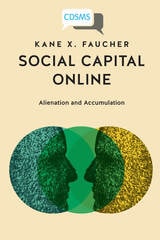
cover of Social Capital Online: Alienation and Accumulation

Social Capital Online

Alienation and Accumulation

Kane X. Faucher

University of Westminster Press, 2018

What is ‘social capital’? The enormous positivity surrounding it conceals the instrumental economic rationality underpinning the notion as corporations silently sell consumer data for profit. Status chasing is just one aspect of a process of transforming qualitative aspects of social interactions into quantifiable metrics for easier processing, prediction, and behavioural shaping.

A work of critical media studies, Social Capital Online examines the idea within the new ‘network spectacle’ of digital capitalism via the ideas of Marx, Veblen, Debord, Baudrillard and Deleuze. Explaining how such phenomena as online narcissism and aggression arise, Faucher offers a new theoretical understanding of how the spectacularisation of online activity perfectly aligns with the value system of neoliberalism and its data worship. Even so, at the centre of all, lie familiar ideas – alienation and accumulation – new conceptions of which he argues are vital for understanding today’s digital society.

[more]
cover of Space as Storyteller: Spatial Jumps in Architecture, Critical Theory, and Literature

Space as Storyteller

Spatial Jumps in Architecture, Critical Theory, and Literature

Laura Chiesa

Northwestern University Press, 2016

Walter Benjamin's Arcades Project suggests that space can become a storyteller: if so, plenty of fleeting stories can be read in the space of modernity, where repetition and the unexpected cross-pollinate. In Space as Storyteller, Laura Chiesa explores several stories across a wide range of time that narrate spatial jumps, from Benjamin's tangential take on the cityscape, the experimentalism of Futurist theatricality, the multiple and potential atlases narrated by Italo Calvino and Georges Perec, and the posturban thought and practice of Bernard Tschumi and Rem Koolhaas/OMA. Space as Storyteller diverts attention from isolated disciplines and historical or geographical contexts toward transdisciplinary encounters that mobilize the potential to invent new spaces of comparison, a potential the author describes as "architecturability."
[more]
cover of Strange Tastes: Aesthetics and the Public in Latin American and Latinx Feminisms

Strange Tastes

Aesthetics and the Public in Latin American and Latinx Feminisms

Monique Roelofs

Duke University Press, 2026
Strange Tastes is a philosophical excursion into aesthetic experience and the public through the works of contemporary Latin American and Latinx women writers and artists. In a careful study of this revelatory archive, Monique Roelofs shows how life lived aesthetically can embrace public space instead of surrendering it to the constrictive forces of gendering and racial capital. Joining notions of sensibility grounded in Enlightenment aesthetics with the creative capabilities of a decolonial aesthetics, Roelofs looks to practices that animate the public through intimate, social, and political registers, particularly by engaging the historical and critical potentialities of disinterested play and what she calls “strange tastes,” or the unusual, uncanny, and nonnormative desires and sensations of marginalized individuals. Through sustained attention to materiality and lived experience, Roelofs offers a feminist philosophy of aesthetics that takes seriously the role of the public, where strange tastes turn aesthetic imaginaries into powerful possibilities to remake self, city, nation, and world.
[more]
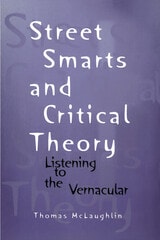
cover of Street Smarts and Critical Theory: Listening to the Vernacular

Street Smarts and Critical Theory

Listening to the Vernacular

Thomas McLaughlin

University of Wisconsin Press, 1996

    Everybody’s got a theory . . . or do they?
    Thomas McLaughlin argues that critical theory—raising serious, sustained questions about cultural practice and ideology—is practiced not only by an academic elite but also by savvy viewers of sitcoms and TV news, by Elvis fans and Trekkies, by labor organizers and school teachers, by the average person in the street.
    Like academic theorists, who are trained in a tradition of philosophical and political skepticism that challenges all orthodoxies, the vernacular theorists McLaughlin identifies display a lively and healthy alertness to contradiction and propaganda. They are not passive victims of ideology but active questioners of the belief systems that have power over their lives. Their theoretical work arises from the circumstances they confront on the job, in the family, in popular culture. And their questioning of established institutions, McLaughlin contends, is essential and healthy, for it energizes other theorists who clarify the purpose and strategies of institutions and justify the existence of cultural practices.
    Street Smarts and Critical Theory leads us through eye-opening explorations of social activism in the Southern Christian anti-pornography movement, fan critiques in the ‘zine scene, New Age narratives of healing and transformation, the methodical manipulations of the advertising profession, and vernacular theory in the whole-language movement. Emphasizing that theory is itself a pervasive cultural practice, McLaughlin calls on academic institutions to recognize and develop the theoretical strategies that students bring into the classroom.


“This book demystifies the idea of theory, taking it out of the hands of a priestly caste and showing it as the democratic endowment of the people.”—Daniel T. O’Hara, Temple University, author of Radical Parody:  American Culture and Critical Agency after Foucault and Lionel Trilling: The Work of Liberation.

“McLaughlin takes seriously the critical and theoretical activity of everyday people and does so in a way that will empower these very populations to take seriously their own activities as theorists. . . . A manifesto that is sure to be heard by the younger generation of thinkers in American cultural studies.”—Henry Jenkins, MIT, author of Textual Poachers: Television Fans and Participatory Culture

[more]
cover of Survival of a Perverse Nation: Morality and Queer Possibility in Armenia

Survival of a Perverse Nation

Morality and Queer Possibility in Armenia

Tamar R. Shirinian

Duke University Press, 2024

In Survival of a Perverse Nation, Tamar R. Shirinian traces two widespread rhetorics of perversion—sexual and moral—in postsocialist Armenia, showing how they are tied to anxieties about the nation’s survival. In her fieldwork with Armenians, Shirinian found that right-wing nationalists’ focus on sexual perversion centers the figure of the homosexual, while questions of moral perversion surround oligarchs and other members of the political-economic elite. While the homosexual is seen as non- or improperly reproductive, the oligarch’s moral deviations from the caring and paternalistic expectations associated with national leadership also endanger Armenia’s survival. Shirinian shows how both figures threaten the nation’s proper social reproduction, a source of great anxiety for a nation whose primary point of identity is surviving genocide. In the existential threat posed by these forms of perversion Shirinian finds paths where nonsurvival might mean the creation of futures that are queerer and more just. Detailing how the language of perversion offers trenchant critiques of capitalism as a perversion of life, Shirinian presents a new queer theory of political economy.
[more]