Results by title
87 books match the query 'Criticism, Textual' and 5 start with s
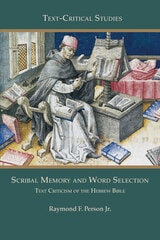
Scribal Memory and Word Selection
Text Criticism of the Hebrew BibleRaymond F. Person Jr.
SBL Press, 2023
What were ancient scribes doing when they copied a manuscript of a literary work? This question is especially problematic when we realize that ancient scribes preserved different versions of the same literary texts. In Scribal Memory and Word Selection: Text Criticism of the Hebrew Bible, Raymond F. Person Jr. draws from studies of how words are selected in everyday conversation to illustrate that the same word-selection mechanisms were at work in scribal memory. Using examples from manuscripts of the Hebrew Bible, Person provides new ways of understanding the cognitive-linguistic mechanisms at work during the composition/transmission of texts. Person reveals that, while our modern perspective may consider textual variants to be different literary texts, from the perspective of the ancient scribes and their audiences, these variants could still be understood as the same literary text.

Shadow of My Shadow
Jennifer Doyle
Duke University Press, 2024

Sherwood Anderson’s Winesburg, Ohio
With Variant Readings and AnnotationsSherwood Anderson
Ohio University Press, 2000
In 1919 a middle-aged Chicago advertising writer from Ohio, a failure as a businessman, husband, and father, published a small yellow book of short stories intended to “reform” American literature. Against all expectations, Winesburg, Ohio: A Group of Tales of Ohio Small Town Life achieved what its author intended: after 1919 and after Winesburg, Ohio, American literature would be written and read freshly and differently.
Winesburg, Ohio has never been out of print, but never has Anderson’s book been published in the form and with the editorial care that the work has needed and deserved. The present text, authorized by the Sherwood Anderson Literary Estate Trust, is an expert text. The editor has relied on years of experience in editing Sherwood Anderson and has consulted all Anderson manuscripts, typescripts, letters, and diaries and all editions of the book to present the masterpiece in its intended state.
New to this expert edition of Winesburg, Ohio are historical and cultural annotations, documentation of changes in the various editions, identification of the Ohio originals for Anderson’s characters, and maps bearing the streets and buildings of the real town of Clyde, Ohio, which is the basis of Anderson’s fictional account.
Included as well are unique photographs of Anderson and Clyde, Ohio, illustrations that deepen knowledge and feeling for the author’s actual hometown and time, revealing Winesburg, Ohio to be an intensely local narrative—very much an “Ohio” book—and yet a book that has found and held worldwide attention.
Steps to a New Edition of the Hebrew Bible
Ronald Hendel
SBL Press, 2016
Understand the purpose and background of the new The Hebrew Bible: A Critical Edition project
Our understanding of the textual history of the Hebrew Bible has been transformed in the wake of the discovery of the Dead Sea Scrolls. Hendel explores and refines this new knowledge and formulates a rationale for a new edition of the Hebrew Bible. The chapters situate The Hebrew Bible; A Critical Edition project in a broad historical context, from the beginnings of textual criticism in late antiquity and the Renaissance to the controversies in contemporary theory and practice. This book combines close analysis with broad synthesis, yielding new perspectives on the text of the Hebrew Bible.
Features- Theory and practice of textual criticism
- Textual history of the Hebrew Bible
- History of text-critical scholarship
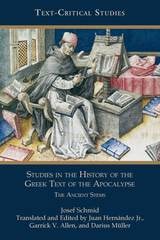
Studies in the History of the Greek Text of the Apocalypse
The Ancient StemsJosef Schmid
SBL Press, 2018
Now available in English
Josef Schmid's landmark publication, Studien zur Geschichte des Griechischen Apokalypse-Textes, has been the standard work for understanding Revelation's Greek manuscript tradition and textual history for more than sixty years. Despite the fact that most major studies on the book are based on Schmid's work, the work itself has long been out of print, making it difficult for the broader scholarly community to reassess Schmid's conclusions in light of recent manuscript discoveries and technological advances. This new translation of the work makes Schmid's detailed review of the history of textual scholarship; his comprehensive examination of the origin, history, and development of the Greek manuscripts of the book of Revelation; and his assessment of John's peculiar linguistic writing style accessible to a new generation of scholars.
Features
- A critical introduction that places Schmid's work in its historical and theoretical context
- Definitions and explanations of Schmid's text-critical terms and categories used in his construction of Revelation's Greek manuscript tradition
- The latest available information used to correct, update, and supplement Schmid's Greek manuscript data and historical and text-critical conclusions