Results by title
281 books match the query 'Criticism, interpretation, etc' and 15 start with s
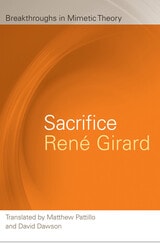
Sacrifice
René Girard
Michigan State University Press, 2011
In Sacrifice, René Girard interrogates the Brahmanas of Vedic India, exploring coincidences with mimetic theory that are too numerous and striking to be accidental. Even that which appears to be dissimilar fails to contradict mimetic theory, but instead corresponds to the minimum of illusion without which sacrifice becomes impossible.
The Bible reveals collective violence, similar to that which generates sacrifice everywhere, but instead of making victims guilty, the Bible and the Gospels reveal the persecutors of a single victim. Instead of elaborating myths, they tell the truth absolutely contrary to the archaic sense. Once exposed, the single victim mechanism can no longer function as the model for would-be sacrificers.
Recognizing that the Vedic tradition also converges on a revelation that discredits sacrifice, mimetic theory locates within sacrifice itself a paradoxical power of quiet reflection that leads, in the long run, to the eclipse of this institution which is violent but nevertheless fundamental to the development of human culture. Far from unduly privileging the Western tradition and awarding it a monopoly on the knowledge and repudiation of blood sacrifice, mimetic analysis recognizes comparable, but never truly identical, traits in the Vedic tradition.
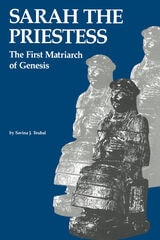
Sarah the Priestess
The First Matriarch of GenesisSavina Teubal
Ohio University Press, 1984
In a patriarchal environment such as the Canaan of Genesis, the situation is discordant and problematic. Dr. Teubal suggests that the difficulty is eliminated, however, if we understand that Sarah and the other matriarchs mentioned in the narratives acted within the established, traditional Mesopotamian role of priestess, of a class of women who retained a highly privileged position vis-a-vis their husbands.
Dr. Teubal shows that the “Sarah tradition” represents a nonpatriarchal system struggling for survival in isolation, in the patriarchal environment of what was for Sarah a foreign society. She further indicates that the insistence of Sarah and Rebekah that their sons and heirs marry wives from the old homeland had to do not so much with preference for endogamy and cousin marriage as with their intention of ensuring the continuation of their old kahina-tradition against the overwhelming odds represented by patriarchal Canaan.
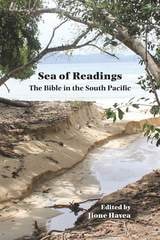
Sea of Readings
The Bible in the South PacificJione Havea
SBL Press, 2018
Readings by South Pacific islanders
This book offers readings of the Bible by native biblical critics from the South Pacific (Pasifika). An essay from editor Jione Havea introduces the volume by locating these essays within islander criticism and by explaining the flow of the book. Essays are presented in three sections. “Island Twists” offers readings that twist, like a whirlpool, biblical texts around insights of Pasifika novelists, composers, poets, and sages. “Island Turns” contains contextual readings that turn biblical texts toward Pasifika. “Across the Sea” contains responses by biblical critics from across the sea.
Features
- Contributions to islander criticism
- A showcase of texts by native writers, poets, and composers
- Crosscultural and postcolonial readings
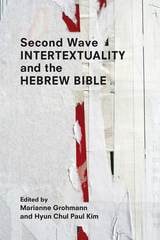
Second Wave Intertextuality and the Hebrew Bible
Marianne Grohmann
SBL Press, 2019
An innovative collection of inner-biblical, intertextual, and intercontextual dialogues
Essays from a diverse group of scholars offer new approaches to biblical intertextuality that examine the relationship between the Hebrew Bible, art, literature, sociology, and postcolonialism. Eight essays in part 1 cover inner-biblical intertextuality, including studies of Genesis, Judges, and Qoheleth, among others. The eight postbiblical intertextuality essays in part 2 explore Bakhtinian and dialogical approaches, intertextuality in the Dead Sea Scrolls, canonical critisicm, reception history, and #BlackLivesMatter. These essays on various genres and portions of the Hebrew Bible showcase how, why, and what intertextuality has been and presents possible potential directions for future research and application.
Features:
- Diverse methods and cases of intertextuality
- Rich examples of hermeneutical theory and interpretive applications
- Readings of biblical texts as mutual dialogues, among the authors, traditions, themes, contexts, and lived worlds
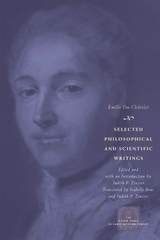
Selected Philosophical and Scientific Writings
Emilie Du Châtelet
University of Chicago Press, 2009
Though most historians remember her as the mistress of Voltaire, Emilie Du Châtelet (1706–49) was an accomplished writer in her own right, who published multiple editions of her scientific writings during her lifetime, as well as a translation of Newton’s Principia Mathematica that is still the standard edition of that work in French. Had she been a man, her reputation as a member of the eighteenth-century French intellectual elite would have been assured.
In the 1970s, feminist historians of science began the slow work of recovering Du Châtelet’s writings and her contributions to history and philosophy. For this edition, Judith P. Zinsser has selected key sections from Du Châtelet’s published and unpublished works, as well as related correspondence, part of her little-known critique of the Old and New Testaments, and a treatise on happiness that is a refreshingly uncensored piece of autobiography—making all of them available for the first time in English. The resulting volume will recover Châtelet’s place in the pantheon of French letters and culture.
Seven Days, Many Voices
Insights into the Biblical Story of CreationRabbi Benjamin David
Central Conference of American Rabbis, 2017
Few stories are as compelling as the Creation story in the Book of Genesis. Our readings of Creation are incredibly diverse. This collection gives us a lens into a wide range of creative and inspiring thinking about Creation. Important thinkers such as Rabbi Arthur Waskow, Dr. Alyssa Gray, Rabbi Aaron Panken, PhD, Rabbi Mira Wasserman, PhD, Rabbi Jill Jacobs, and many others, examine the Creation story through fields of midrash, biblical criticism, literature, theology, climate justice, human rights, history, and science. This diverse collection of some of today's finest thinkers will challenge assumptions and spark new ideas. Great for individual study or community learning!
Sex, Christ, and Embodied Cognition
Paul's Wisdom for CorinthRobert H. von Thaden Jr.
SBL Press, 2017
A sociorhetorical analysis of First Corinthians
Robert H. von Thaden Jr.'s sociorhetorical analysis examines Paul's construction of sexual Christian bodies in First Corinthians by utilizing new insights from conceptual integration (blending) theory about the embodied processes of meaning making. Paul's teaching about proper sexual behavior in this letter is best viewed as an example of early Christian wisdom discourse. This discourse draws upon apocalyptic and priestly cognitive frames to increase the rhetorical force of the argument. Reading Paul's argument through the lens of rhetorical invention, von Thaden demonstrates that Paul first attempts to show the Corinthians why sexual immorality is the worst of all bodily sins before shifting rhetorical focus to explain to them how they can best avoid this infraction against the body of Christ.
Features:
- A programmatic application of conceptual integration theory using a sociorhetorical mode of interpretation
- A vivid account of key aspects of conceptual integration theory and how they function in sociorhetorical interpretation
- A detailed application of these strategies to interpret 1 Corinthians 1-4; 6:12-7:7
Social Theory and the Study of Israelite Religion
Essays in Retrospect and ProspectSaul M. Olyan
SBL Press, 2012
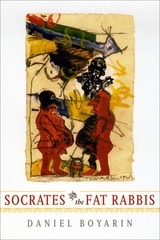
Socrates and the Fat Rabbis
Daniel Boyarin
University of Chicago Press, 2009
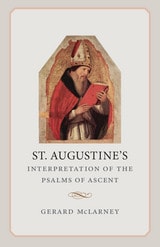
St. Augustine's Interpretaion of the Psalms of Ascent
Gerard McLarney
Catholic University of America Press, 2014
Strength to Strength
Essays in Honor of Shaye J. D. CohenMichael L. Satlow
SBL Press, 2018
Essays that engage the scholarship of Shaye J. D. Cohen
The essays in Strength to Strength honor Shaye J. D. Cohen across a range of ancient to modern topics. The essays seek to create an ongoing conversation on issues of identity, cultural interchange, and Jewish literature and history in antiquity, all areas of particular interest for Cohen. Contributors include: Moshe J. Bernstein, Daniel Boyarin, Jonathan Cohen, Yaakov Elman, Ari Finkelstein, Charlotte Elisheva Fonrobert, Steven D. Fraade, Isaiah M. Gafni, Gregg E. Gardner, William K. Gilders, Martin Goodman, Leonard Gordon, Edward L. Greenstein, Erich S. Gruen, Judith Hauptman, Jan Willem van Henten, Catherine Hezser, Tal Ilan, Richard Kalmin, Yishai Kiel, Ross S. Kraemer, Hayim Lapin, Lee I. Levine, Timothy H. Lim, Duncan E. MacRae, Ivan Marcus, Mahnaz Moazami, Rachel Neis, Saul M. Olyan, Jonathan J. Price, Jeffrey L. Rubenstein, Michael L. Satlow, Lawrence H. Schiffman, Daniel R. Schwartz, Joshua Schwartz, Karen Stern, Stanley Stowers, and Burton L. Visotzky.
Features:
- A full bibliography of Cohen’s published works
- An essay on the contributions of Cohen
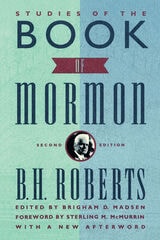
Studies of the Book of Mormon
Foreword by Sterling M. McMurrinB. H. Roberts
Signature Books, 1992
In this and other research, it was Roberts’s proclivity to go wherever the evidence took him, in this case anticipating and defending against potential future problems. Yet the manuscript was so poorly received by fellow church leaders that it was left to Roberts alone to decide whether he had overlooked some important piece of the puzzle or whether the Mormon scripture’s claims were, in fact, illegitimate. Clearly for most of his colleagues, institutional priorities overshadowed epistemological integrity.
But Roberts’s pathbreaking work has been judged by the editor to be methodologically sound–still relevant today. It shows the work of a keen mind, and illustrates why Roberts was one of the most influential Mormon thinkers of his day. The manuscript is accompanied by a preface and introduction, a history of the documents’ provenances, a biographical essay, correspondence to and from Roberts relating to the manuscript, a bibliography, and an afterword–all of which put the information into perspective.
Supplementation and the Study of the Hebrew Bible
Saul M. Olyan
SBL Press, 2018
Explore the role supplementation played in the development of the Hebrew Bible
This new volume includes ten original essays that demonstrate clearly how common, varied, and significant the phenomenon of supplementation in the Hebrew Bible is. Contributors examine instances of supplementation ranging from minor additions to aid pronunciation, to fill in abbreviations, or to clarify ambiguous syntax to far more elaborate changes, such as interpolations within a work of prose, in a prophetic text, or in a legal text. Scholars also examine supplementation by the addition of an introduction, a conclusion, or an introductory and concluding framework to a particular lyrical, legal, prophetic, or narrative text.
Features:
Surpassing Wonder
The Invention of the Bible and the TalmudsDonald Harman Akenson
University of Chicago Press, 2001
Surviving Lamentations
Catastrophe, Lament, and Protest in the Afterlife of a Biblical BookTod Linafelt
University of Chicago Press, 2000
In Surviving Lamentations, Tod Linafelt offers an alternative reading of Lamentations in light of the "literature of survival" (works written by survivors of catastrophe) as well as literary and philosophical reflections on "the survival of literature." He refocuses attention on the figure of Zion as a manifestation of a basic need to give voice to suffering, and traces the afterlife of Lamentations in Jewish literature, in which text after text attempts to provide the response to Zion's lament that is lacking in Lamentations itself.
Seen through Linafelt's eyes, Lamentations emerges as uncannily relevant to contemporary discourse on survival.