Results by title
60 books match the query 'Critique' and 6 start with s
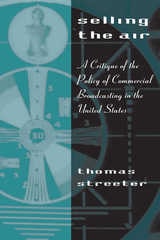
Selling the Air
A Critique of the Policy of Commercial Broadcasting in the United StatesThomas Streeter
University of Chicago Press, 1996
With an impressive command of broadcast history, as well as critical and cultural studies of the media, Streeter shows that liberal marketplace principles—ideas of individuality, property, public interest, and markets—have come into contradiction with themselves. Commercial broadcasting is dependent on government privileges, and Streeter provides a searching critique of the political choices of corporate liberalism that shape our landscape of cultural property and electronic intangibles.

Settler Colonialism is the Disaster
A Critique of New Orleans After Hurricane Katrina and During the COVID-19 PandemicCassandra Shepard
University of Illinois Press, 2026
Situation Critical
Critique, Theory, and Early American StudiesMax Cavitch and Brian Connolly, editors
Duke University Press, 2024
Contributors. Max Cavitch, Brian Connolly, Matthew Crow, John J. Garcia, Christopher Looby, Michael Meranze, Mark J. Miller, Justine S. Murison, Britt Rusert, Ana Schwartz, Joan W. Scott, Jordan Alexander Stein
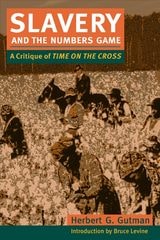
Slavery and the Numbers Game
A CRITIQUE OF TIME ON THE CROSSHerbert G. Gutman
University of Illinois Press, 1975
This detailed analysis of slavery in the antebellum South was written in 1975 in response to the prior year's publication of Robert Fogel and Stanley Engerman's controversial Time on the Cross, which argued that slavery was an efficient and dynamic engine for the southern economy and that its success was due largely to the willing cooperation of the slaves themselves.
Noted labor historian Herbert G. Gutman was unconvinced, even outraged, by Fogel and Engerman's arguments. In this book he offers a systematic dissection of Time on the Cross, drawing on a wealth of data to contest that book's most fundamental assertions. A benchmark work of historical inquiry, Gutman's critique sheds light on a range of crucial aspects of slavery and its economic effectiveness.
Gutman emphasizes the slaves' responses to their treatment at the hands of slaveowners. He shows that slaves labored, not because they shared values and goals with their masters, but because of the omnipresent threat of 'negative incentives,' primarily physical violence.
In his introduction to this new edition, Bruce Levine provides a historical analysis of the debate over Time on the Cross. Levine reminds us of the continuing influence of the latter book, demonstrated by Robert W. Fogel's 1993 Nobel Prize in Economic Sciences, and hence the importance and timeliness of Gutman's critique.
Stories Through Theories/ Theories Through Stories
North American Indian Writing, Storytelling, and CritiqueGordon D. Henry Jr.
Michigan State University Press, 2009
Stories Through Theories/Theories Through Stories explores the uneasy relations—often contentious, sometimes complicit—between American Indian Literature and literary theory. Some of the essays in this book open American Indian narratives to theoretical critique based on "western depth models." Others work from a very different direction, finding critique in storytelling and processes of narrative production, thereby exposing dimensions of literary theory that grow from the indigenous ground of Native stories themselves.
This collection of essays—sometimes playfully but always insistently—changes our readings of Native works and challenges our roles as intellectual guides until we step deeper into the ambiguous territories where writer, listener, reader, and critic intersect.
Taken together, these essays provide compelling evidence for looking at primary Native cultures, authors, and histories as enrichments of Native literature.

Subversive Affirmation
Critique of Critique RevisitedSylvia Sasse
Diaphanes, 2025
Since the 1960s, theory, the arts, and political activism have increasingly rejected the notion of resistance through negation, raising such arguments as: Doesn’t a critique based on negation make itself dependent on the very system it wants to overcome? Does it not remain trapped in a thinking of oppositions? Although coming from radically different angles, the formulation of concepts like subversive affirmation, hyperaffirmation, overidentification, paradoxical intervention, revolution of the yes, and affirmative sabotage all reflect the emergence of an affirmative critique that overcomes this negation while also making us aware of the difference between conscious consent and conformity, capitulation, indifference, or pragmatism. In her new book, Sylvia Sasse explores and analyzes subversive affirmation as a critical practice in different political systems. She examines the effectiveness of such criticism and its relevance at a time when various political actors have begun appropriating subversive affirmation and are no longer using it as a method of criticism.