Results by title
161 books match the query 'Cuba' and 9 start with s

Sab and Autobiography
By Gertrudis Gómez de Avellaneda y Arteaga
University of Texas Press, 1993
Eleven years before Uncle Tom's Cabin fanned the fires of abolition in North America, an aristocratic Cuban woman told an impassioned story of the fatal love of a mulatto slave for his white owner's daughter. So controversial was Sab's theme of miscegenation and its parallel between the powerlessness and enslavement of blacks and the economic and matrimonial subservience of women that the book was not published in Cuba until 1914, seventy-three years after its original 1841 publication in Spain.
Also included in the volume is Avellaneda's Autobiography (1839), whose portrait of an intelligent, flamboyant woman struggling against the restrictions of her era amplifies the novel's exploration of the patriarchal oppression of minorities and women.
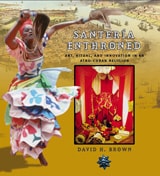
Santeria Enthroned
Art, Ritual, and Innovation in an Afro-Cuban ReligionDavid H. Brown
University of Chicago Press, 2003
Focusing on the royal throne as a potent metaphor in Santería belief and practice, Brown shows how negotiation among ideologically competing interests have shaped the religion's symbols, rituals, and institutions from the nineteenth century to the present. Rich case studies of change in Cuba and the United States, including a New Jersey temple and South Carolina's Oyotunji Village, reveal patterns of innovation similar to those found among rival Yoruba kingdoms in Nigeria. Throughout, Brown argues for a theoretical perspective on culture as a field of potential strategies and "usable pasts" that actors draw upon to craft new forms and identities—a perspective that will be invaluable to all students of the African Diaspora.
American Acemy of Religion Award for Excellence in the Study of Religion (Analytical-Descriptive Category)

Screening Cuba
Film Criticism as Political Performance during the Cold WarHector Amaya
University of Illinois Press, 2010

Secretaries of the Moon
The Letters of Wallace Stevens and José Rodriguez FeoBeverly Coyle and Alan Filreis, eds.
Duke University Press, 1986
Coyle and Filreis present the entire extant correspondence between the two men. The fifty-one Rodriguez Feo letters and ten of the numerous Stevens letters are printed here for the first time, and the exchange between the two is unusually complete. The work includes a critical introduction and complete annotation of the letters.
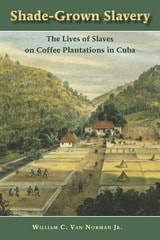
Shade-Grown Slavery
The Lives of Slaves on Coffee Plantations in CubaWilliam C. Van Norman
Vanderbilt University Press, 2013
In this broad, interdisciplinary study, William Van Norman describes how each type of plantation and the amount of manual labor it required directly influenced the nature of slave life in that community. Slaves on coffee plantations lived in a unique context in comparison to that of their fellow slaves on sugar plantations, one that gave them greater flexibility in cultural and artistic creativity. To gain a deeper understanding of plantation slavery in Cuba, Van Norman explores what life and labor was like for coffee slaves and how it was different from what sugar slaves experienced. Shade-Grown Slavery reconstructs their world and in turn deconstructs the picture we now have of Cuba in the late eighteenth and early nineteenth centuries.
Ultimately, Shade-Grown Slavery reveals the lives of enslaved Africans on Cuban coffee plantations and shows how they were able to maintain and transform their cultural traditions in spite of slavery.

Slave Society in Cuba during the Nineteenth Century
Franklin W. Knight
University of Wisconsin Press, 1970
Knight examines the conditions that maintained slavery in Cuba in the nineteenth century and perceptively analyzes the sociological effect of the institution on the island's politics, culture, and economy. He attacks the long-held theory that an Iberian cultural heritage and the Roman Catholic Church significantly modified the institution of slavery and shows that Cuban slave society shared many characteristics with other Caribbean societies, whether Anglo-Saxon, French, or Spanish. Knight's systematic study includes important new material from the archives of the Ministerio del Ultramar in Madrid.
Sowing Change
The Making of Havana's Urban AgricultureAdriana Premat
Vanderbilt University Press, 2012
Spain and the Abolition of Slavery in Cuba, 1817–1886
By Arthur F. Corwin
University of Texas Press, 1967
This book explores the abolition of African slavery in Spanish Cuba from 1817 to 1886—from the first Anglo-Spanish agreement to abolish the slave trade until the removal from Cuba of the last vestige of black servitude. Making extensive use of heretofore untapped research sources from the Spanish archives, the author has developed new perspectives on nineteenth-century Spanish policy in Cuba. He skillfully interrelates the problem of slavery with international politics, with Cuban conservative and liberal movements, and with political and economic developments in Spain itself.
Arthur Corwin finds that the study of this problem falls naturally into two phases, the first of which, 1817–1860, traces the gradual reduction of the African traffic to the Spanish Antilles and constitutes, in effect, a study in Anglo-Spanish diplomacy. He gives special attention here to the aggressive nature of British abolitionist diplomacy and the mounting but generally ineffective indignation resulting from Spanish failure to apply sanctions against the traffic, as well as the increasing North American interest in the annexation of Cuba. The first phase has for its principal theme the manner in which for decades Spain feigned compliance with agreements to end the slave trade while actually protecting slaveholding interests as the best means of holding Cuba.
The American Civil War, which destroyed the greatest bulwark of black slavery in the New World, marked the opening of a new phase, 1860–1886. The author strongly emphasizes here such influences as the rise of the Creole reform movement in Cuba and Puerto Rico, which, reading the signs of the times, gave the initial impulse to a Spanish abolitionist movement and contributed to closing the Cuban slave trade in 1866; the liberal revolution of 1868 in Spain and its promise of colonial reforms; the outbreak of the great Creole rebellion in Cuba, 1868–1878, and the abolitionist promises of the rebel chieftains; the threat of American intervention and the abolitionist pressure of American diplomacy; and the protests of the Spanish reactionaries in Spain and Cuba, leading to further procrastination in Madrid. The second phase has as its principal theme the shaping, through all these intertwined factors, of Spain’s first measure of gradual emancipation, the Moret Law of 1870, and all subsequent steps toward abolition.
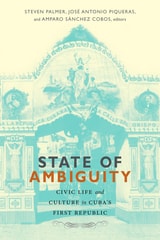
State of Ambiguity
Civic Life and Culture in Cuba's First RepublicSteven Palmer, José Antonio Piqueras, Amparo Sánchez Cobos, eds.
Duke University Press, 2014
Contributors. Imilcy Balboa Navarro, Alejandra Bronfman, Maikel Fariñas Borrego, Reinaldo Funes Monzote, Marial Iglesias Utset, Steven Palmer, José Antonio Piqueras Arenas, Ricardo Quiza Moreno, Amparo Sánchez Cobos, Rebecca J. Scott, Robert Whitney