Results by title
73 books match the query 'Cultural property' and 5 start with s
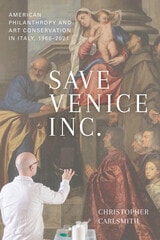
Save Venice Inc.
American Philanthropy and Art Conservation in Italy, 1966-2021Christopher Carlsmith
University of Massachusetts Press, 2022
In 1966, the most destructive flood in the history of Venice temporarily submerged the city and threatened its extraordinary art and architecture. Among the organizations that mobilized to protect this fragile heritage was Save Venice Inc. Founded in Boston and now headquartered in New York City, this nonprofit has become the largest and most active committee dedicated to preserving the artistic legacy of Venice.
Christopher Carlsmith tells the fascinating story of Save Venice Inc., from its origins to its fiftieth anniversary. It continues to provide an influential model for philanthropy in the cultural sector, raising substantial funds to conserve and restore paintings, sculptures, books, mosaics, and entire buildings at risk from human and environmental impacts. Employing extensive archival research, oral interviews, and newspaper accounts, Save Venice Inc. explores a range of topics, including leadership, conservation projects, fundraising, and educational outreach. Using a range of methodologies from cultural history and art history, Carlsmith traces the achievements and challenges faced by this and other historic preservation organizations and by this unique city on the sea.
Second-Order Preservation
Social Justice and Climate Action through Heritage PolicyErica Avrami
University of Minnesota Press, 2024
An urgent appeal to rethink the heritage enterprise
A critical reassessment of historic preservation policies in the United States, Second-Order Preservation brings needed attention to the hierarchical underpinnings and effects of established preservation frameworks. Questioning the criteria by which value is ascribed to historic buildings and neighborhoods, Erica Avrami works to elucidate and transform how—and which—claims to place become codified in and reinforced through public policy.
As she eschews dominant case-study approaches that center the individual object of preservation, such as a discrete building or site, Avrami develops the concept of second-order preservation as a means of integrating broader considerations around social justice, equitable land-use planning, and environmental sustainability. Ranging from municipal to state to national and international levels of governance, her critique of the origins and evolution of heritage policy reveals how this conventional emphasis on the object has contributed to policy tensions and systemic exclusion.
Stressing the need to reform current preservation practices to serve more diverse publics, Avrami encourages a turn to an approach that substantively considers contexts and implications of preservation in the scheme of climate and justice. Second-Order Preservation maintains the interrelation between theory and practice, serving as both a critical reflection and a provocation aimed at advancing a more just set of urban policy agendas.
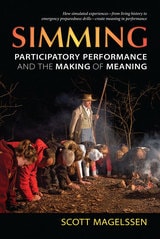
Simming
Participatory Performance and the Making of MeaningScott Magelssen
University of Michigan Press, 2014
At an ecopark in Mexico, tourists pretend to be illegal migrants, braving inhospitable terrain and the U.S. Border Patrol as they attempt to cross the border. At a living history museum in Indiana, daytime visitors return after dark to play fugitive slaves on the Underground Railroad. In the Mojave Desert, the U.S. Army simulates entire provinces of Iraq and Afghanistan, complete with bustling villages, insurgents, and Arabic-speaking townspeople, to train soldiers for deployment to the Middle East. At a nursing home, trainees put on fogged glasses and earplugs, thick bands around their finger joints, and sandbag harnesses to simulate the effects of aging and to gain empathy for their patients.
These immersive environments in which spectator-participants engage in simulations of various kinds—or “simming”—are the subject of Scott Magelssen’s book. His book lays out the ways in which simming can provide efficacy and promote social change through affective, embodied testimony. Using methodology from theater history and performance studies (particularly as these fields intersect with cultural studies, communication, history, popular culture, and American studies), Magelssen explores the ways these representational practices produce, reify, or contest cultural and societal perceptions of identity.

Sites, Bodies and Stories
Imagining Indonesian HistoryEdited by Susan Legêne, Bambang Purwanto, and Henk Schulte Nordholt
National University of Singapore Press, 2015
Contemporary heritage formation in Indonesia is intrinsically linked to a canon of Indonesian art and culture developed during Dutch colonial rule, institutionalized within Indonesia’s heritage infrastructure and in the Netherlands, and echoed in museums and exhibitions throughout the world. The authors in this volume acknowledge colonial legacies but argue against a colonial determinism, considering instead how contemporary heritage initiatives can lead to new interpretations of the past.

Stored in the Bones
Safeguarding Indigenous Living HeritagesAgnieszka Pawłowska-Mainville
University of Manitoba Press, 2023