Results by title
289 books match the query 'Dance' and 18 start with s
Salome and the Dance of Writing
Portraits of Mimesis in LiteratureFrançoise Meltzer
University of Chicago Press, 1987
Meltzer's readings of textual portraits—in the Gospel writers and Huysmans, Virgil and Stendhal, the Old Testament and Apuleius, Hawthorne and Poe, Kafka and Rousseau, Walter Scott and Mme de Lafayette—reveal an interplay of control and subversion: writing attempts to veil the visual and to erase the sensual in favor of "meaning," while portraiture, with its claims to bringing the natural object to "life," resists and eludes such control. Meltzer shows how this tension is indicative of a politics of repression and subversion intrinsic to the very act of representation. Throughout, she raises and illuminates fascinating issues: about the relation of flattery to caricature, the nature of the uncanny, the relation of representation to memory and history, the narcissistic character of representation, and the interdependency of representation and power.
Writing, thinking, speaking, dreaming, acting—the extent to which these are all controlled by representation must, Meltzer concludes, become "consciously unconscious." In the textual portrait, she locates the moment when this essential process is both revealed and repressed.
Salsa Crossings
Dancing Latinidad in Los AngelesCindy García
Duke University Press, 2013
Salsa World
A Global Dance in Local ContextsSydney Hutchinson
Temple University Press, 2013
Salsa Worldexamines the ways in which bodies relate to culture in specific places. The contributors, a notable group of scholars and practitioners, analyze dance practices in the U.S., Japan, Spain, France, Colombia, Cuba, Puerto Rico, and the Dominican Republic. Writing from the disciplines of ethnomusicology, anthropology, sociology, and performance studies, the contributors explore salsa’s kinetopias - places defined by movement, or vice versa- as they have arisen through the dance’s interaction with local histories, identities, and musical forms.
Contributors include Bárbara Balbuena Gutiérrez,Katherine Borland, Joanna Bosse, Rossy Díaz, Saúl Escalona, Kengo Iwanaga, Isabel Llano, Jonathan S. Marion, Priscilla Renta, Alejandro Ulloa Sanmiguel, and the editor.
In the series Studies in Latin American and Caribbean Music, edited by Peter Manuel
Sharing the Dance
Contact Improvisation and American CultureCynthia J. Novack
University of Wisconsin Press, 1990
While focusing on the changing practice of contact improvisation through two decades of social transformation, Novack’s work incorporates the history of rock dancing and disco, the modern and experimental dance movements of Merce Cunningham, Anna Halprin, and Judson Church, among others, and a variety of other physical activities, such as martial arts, aerobics, and wrestling.
Signs of the Spirit
Music and the Experience of Meaning in Ndau Ceremonial LifeTony Perman
University of Illinois Press, 2020
Perman's encounters with the spirits, the mediums who bring them back, and the accompanying rituals form the heart of his ethnographic account of how the Ndau experience ceremonial musicking. As Perman witnessed other ceremonies, he discovered that music and dancing shape the emotional lives of Ndau individuals by inviting them to experience life's milestones or cope with its misfortunes as a group. Signs of the Spirit explores the historical, spiritual, and social roots of ceremonial action and details how that action influences the Ndau's collective approach to their future. The result is a vivid ethnomusicological journey that delves into the immediacy of musical experience and the forces that transform ceremonial performance into emotions and community.
Smaddification
Dance and Decolonization in JamaicaAmanda Michelle Reid
Duke University Press, 2026
Social Choreography
Ideology as Performance in Dance and Everyday MovementAndrew Hewitt
Duke University Press, 2005
Hewitt focuses on the period between the mid-nineteenth century and the early twentieth and considers dancers and social theorists in Germany, Britain, France, and the United States. Analyzing the arguments of writers including Friedrich Schiller, Theodor Adorno, Hans Brandenburg, Ernst Bloch, and Siegfried Kracauer, he reveals in their thinking about the movement of bodies a shift from an understanding of play as the condition of human freedom to one prioritizing labor as either the realization or alienation of embodied human potential. Whether considering understandings of the Charleston, Isadora Duncan, Nijinsky, or the famous British chorus line the Tiller Girls, Hewitt foregrounds gender as he uses dance and everyday movement to rethink the relationship of aesthetics and social order.

Somatic Movement Dance Therapy
The Healing Art of Self-regulation and Co-regulationAmanda Williamson
Intellect Books, 2023
In this detailed anatomical text, Amanda Williamson shares her therapeutic practice, rooted in self-regulation, co-regulation, cardio-ception, breath awareness, soft-tissue-rolling in gravity, fascial release, and the importance of parasympathetic ease-and-release. The book attends to key body systems in detail, and how sense-perception of living tissues increases fluid flow and supports fascial health. It is grounded in detailed experiential encounters with afferent sensing, consciously sensed motor expression, interoception, proprioception, the vagus nerve, the cranial bones and nerves, scapulae, sacrum, fascia, and the nervous system. Clients and students share qualitative refl ections after sense-perceiving the state of their living tissues and easing tight tonus through self-regulatory movement.
Somatic Movement Dance Therapy pays detailed attention to applied experiential anatomy and physiology, improvisation underpinned by somatic awareness, the art of directing one’s awareness and attending gently to living breathing tissues, resting egoic mind and settling in the heart. The integral importance and compassion of the co-regulatory embodied witness is shared in this book. Williamson shares processes throughout that ease stress, depression, and anxiety.
Collective foreword from Sarah Whatley, Daniel Deslauriers, Celeste Snowber, and Karin Rugman.
Somatics in Dance, Ecology, and Ethics
The Flowing Live PresentSondra Fraleigh
Intellect Books, 2024
Somatics in Dance, Ecology, and Ethics explores the relationships between self, world, and earth to understand the experience of being alive and corporeal. In doing so, Sondra Fraleigh develops a philosophy of an ethical world gaze that promises to enliven the senses. Chapters borrow from wide-ranging intellectual influences—phenomenology, Buddhism, butoh, dialogics, aesthetics, poetry, feminism, ecology, and more—Fraleigh describes the ways somatics can help people to feel well, practice empathetic communication, and recognize the psychic, unpredictable edges of experience as they move. An interview with Amanda Williamson complements the chapters. “The body is the fascinating home for all our dispositions,” Fraleigh tells hers. “Spiritual qualities are embodied. We dance and sing them into being.”

Something Musical Happened at the Library
Rob Reid
American Library Association, 2007
Soulstepping
African American Step ShowsElizabeth C. Fine
University of Illinois Press, 2002
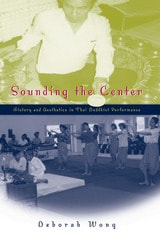
Sounding the Center
History and Aesthetics in Thai Buddhist PerformanceDeborah Wong
University of Chicago Press, 2001
Drawing on her extensive fieldwork, Wong lays out the ritual in detail: the way it is enacted, the foods and objects involved, and the people who perform it, emphasizing the way the performers themselves discuss and construct aspects of the ceremony.
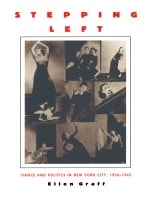
Stepping Left
Dance and Politics in New York City, 1928–1942Ellen Graff
Duke University Press, 1997
From Communist Party pageants to union hall performances to benefits for the Spanish Civil War, Graff documents the passionate involvement of American dancers in the political and social controversies that raged throughout the Depression era. Dancers formed collectives and experimented with collaborative methods of composition at the same time that they were marching in May Day parades, demonstrating for workers’ rights, and protesting the rise of fascism in Europe. Graff records the explosion of choreographic activity that accompanied this lively period—when modern dance was trying to establish legitimacy and its own audience. Stepping Left restores a missing legacy to the history of American dance, a vibrant moment that was supressed in the McCarthy era and almost lost to memory. Revisiting debates among writers and dancers about the place of political content and ethnicity in new dance forms, Stepping Left is a landmark work of dance history.
Still Moving
Conversations with Senior Professional Dancers Still PerformingSonia York-Pryce
Intellect Books, 2025
What does it mean to keep dancing against the tide of ageism? Still Moving offers an unprecedented glimpse into the lives of senior professional dancers, artists who continue to perform and create, defying expectations well beyond the conventional limits of a dancer’s career. Through in-depth conversations with twenty performers ranging from 41 to 109 years old, Sonia York-Pryce reveals stories of resilience, adaptation, and unwavering passion for movement.
These dancers, hailing from the United States, Canada, Europe, and Australia, challenge ingrained biases in the dance industry while embodying the limitless potential of an aging body. Their experiences inspire not only younger dancers wondering about longevity in their careers but also anyone invested in the intersections of creativity, aging, and well-being.
Still Moving is not simply a book about dance; it engages in a broader cultural dialogue about ageism and the evolving nature of artistic expression. For dancers, educators, researchers, and those in fields such as somatic practices, gerontology, and social sciences, this book champions a future where dance is not bound by age but enriched by experience.
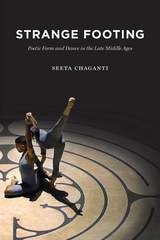
Strange Footing
Poetic Form and Dance in the Late Middle AgesSeeta Chaganti
University of Chicago Press, 2018
Exploring the complex relationship between medieval dance and medieval poetry, Strange Footing argues that the intersection of texts and dance produced an experience of poetic form based in disorientation, asymmetry, and even misstep. Medieval dance guided audiences to approach poetry not in terms of the body’s regular marking of time and space, but rather in the irregular and surprising forces of virtual motion around, ahead of, and behind the dancing body. Reading medieval poems through artworks, paintings, and sculptures depicting dance, Seeta Chaganti illuminates texts that have long eluded our full understanding, inviting us to inhabit their strange footings askew of conventional space and time.
Strange Footing deploys the motion of dance to change how we read medieval poetry, generating a new theory of poetic form for medieval studies and beyond.
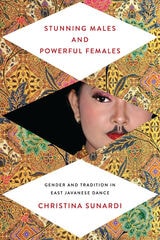
Stunning Males and Powerful Females
Gender and Tradition in East Javanese DanceChristina Sunardi
University of Illinois Press, 2015
Christina Sunardi ventures into the regency of Malang in east Java to study and perform with dancers. Through formal interviews and casual conversation, Sunardi learns about their lives and art. Her work shows how performers continually transform dance traditions to negotiate, and renegotiate, the boundaries of gender and sex--sometimes reinforcing lines of demarcation, sometimes transgressing them, and sometimes doing both simultaneously. But Sunardi's investigation moves beyond performance. It expands notions of the spiritual power associated with female bodies and feminine behavior, and the ways women, men, and waria (males who dress and live as female) access the magnetic power of femaleness.
A journey into understudied regions and ideas, Stunning Males and Powerful Females reveals how performances seemingly fixed by tradition are instead dynamic environments for cultural negotiation and change surrounding questions of sex and gender.
Sweating Saris
Indian Dance as Transnational LaborPriya Srinivasan
Temple University Press, 2011
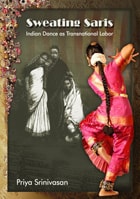
A groundbreaking book that seeks to understand dance as labor, Sweating Saris examines dancers not just as aesthetic bodies but as transnational migrant workers and wage earners who negotiate citizenship and gender issues.
Srinivasan merges ethnography, history, critical race theory, performance and post-colonial studies among other disciplines to investigate the embodied experience of Indian dance. The dancers’ sweat stained and soaked saris, the aching limbs are emblematic of global circulations of labor, bodies, capital, and industrial goods. Thus the sweating sari of the dancer stands in for her unrecognized labor.
Srinivasan shifts away from the usual emphasis on Indian women dancers as culture bearers of the Indian nation. She asks us to reframe the movements of late nineteenth century transnational Nautch Indian dancers to the foremother of modern dance Ruth St. Denis in the early twentieth century to contemporary teenage dancers in Southern California, proposing a transformative theory of dance, gendered-labor, and citizenship that is far-reaching.
Swinging the Machine
Modernity, Technology, and African American Culture between the World WarsJoel Dinerstein
University of Massachusetts Press, 2003
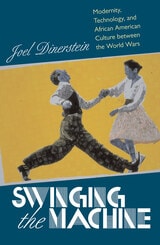
In any age and any given society, cultural practices reflect the material circumstances of people's everyday lives. According to Joel Dinerstein, it was no different in America between the two World Wars—an era sometimes known as the “machine age”—when innovative forms of music and dance helped a newly urbanized population cope with the increased mechanization of modern life. Grand spectacles such as the Ziegfeld Follies and the movies of Busby Berkeley captured the American ethos of mass production, with chorus girls as the cogs of these fast, flowing pleasure vehicles.
Yet it was African American culture, Dinerstein argues, that ultimately provided the means of aesthetic adaptation to the accelerated tempo of modernity. Drawing on a legacy of engagement with and resistance to technological change, with deep roots in West African dance and music, black artists developed new cultural forms that sought to humanize machines. In “The Ballad of John Henry,” the epic toast “Shine,” and countless blues songs, African Americans first addressed the challenge of industrialization. Jazz musicians drew on the symbol of the train within this tradition to create a set of train-derived aural motifs and rhythms, harnessing mechanical power to cultural forms. Tap dance and the lindy hop brought machine aesthetics to the human body, while the new rhythm section of big band swing mimicked the industrial soundscape of northern cities. In Dinerstein's view, the capacity of these artistic innovations to replicate the inherent qualities of the machine-speed, power, repetition, flow, precision-helps explain both their enormous popularity and social function in American life.