Results by title
75 books match the query 'Derrida, Jacques' and 6 start with s

Secrets of Responsibility
Jacques Derrida
University of Chicago Press, 2027
Jacques Derrida on the problem of secrecy, the first in a ten-seminar series on questions of responsibility.
Delivered at the École des hautes études en sciences sociales in Paris during the 1991–92 academic year, Secrets of Responsibility is the first of ten seminars given by Jacques Derrida under the umbrella “Questions of Responsibility,” a cycle that includes Hospitality, Perjury and Pardon, Death Penalty, and The Beast and the Sovereign—each also published by the University of Chicago Press.
In this seminar, Derrida asks a basic question—what is a secret?—which he then explores across scientific, technical, social, political, and religious domains. Over twelve sessions, we are treated to analyses of industrial, state, military, professional, and religious secrets as well as secret societies and secret police. Derrida also tackles secrecy in literary fiction (especially in Melville, James, Poe, and Baudelaire) and philosophical texts (including Freud, Kant, Heidegger, Kierkegaard, Patočka, Nietzsche, Levinas, and others). The result is a set of profound and surprising insights delivered as only Derrida can.

Signature Derrida
Jacques Derrida
University of Chicago Press, 2013
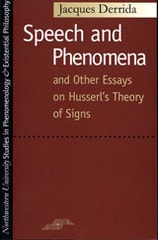
Speech and Phenomena
And Other Essays on Husserl's Theory of SignsJacques Derrida
Northwestern University Press, 1973

Spurs
Nietzsche's Styles/Eperons: Les Styles de NietzscheJacques Derrida
University of Chicago Press, 1981
Spurs, then, is aptly titled, for Derrida's "deconstructions" of Nietzsche's meanings will surely act as spurs to further thought and controversy. This dual-language edition offers the English-speaking reader who has some knowledge of French an opportunity to examine the stylistic virtuosity of Derrida's writing—of particular significance for his analysis of "the question of style."

Spurs
Nietzsche's Styles/Eperons: Les Styles de NietzscheJacques Derrida
University of Chicago Press, 1981
Spurs, then, is aptly titled, for Derrida's "deconstructions" of Nietzsche's meanings will surely act as spurs to further thought and controversy. This dual-language edition offers the English-speaking reader who has some knowledge of French an opportunity to examine the stylistic virtuosity of Derrida's writing—of particular significance for his analysis of "the question of style."

Strategies of Deconstruction
Derrida and the Myth of the VoiceJ. Claude Evans
University of Minnesota Press, 1991
Strategies of Deconstruction was first published in 1991. Minnesota Archive Editions uses digital technology to make long-unavailable books once again accessible, and are published unaltered from the original University of Minnesota Press editions.
In the past two decades, the "movement" of deconstruction has bad tremendous impact on a number of academic, disciplines in the United States. However, its force has been rather limited in the field of philosophy, despite the fact that in Europe the practice of deconstruction emerged in the work of philosophers. Although the reasons for this can be debated, two of the more obvious explanations are the mainstream Anglo-American philosophers rarely studied the German and French philosophical traditions in great detail, and deconstruction's focus on discourse and interpretation has made it more attractive to the literary and humanistic disciplines.
With this context, Strategies of Deconstruction focuses on the early work of Jacques Derrida, the French philosopher who introduced deconstruction in Speech and Phenomena,his study of Edmund Husserl, and Of Grammatology, and whose philosophical reputation stems in no small part from his work on Husserl. In examining the philosophical import of Derrida's theories of reading, text, and language, specifically as they related to Speech and Phenomena,J. Claude Evans makes careful reference to Husserl's own texts. His analysis indicates that there are many systematic irregularities in Derrida's study and that without those irregularities Derrida's conclusions cannot be substantiated.