Results by title
63 books match the query 'Detroit' and 3 start with s
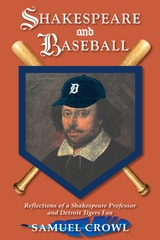
Shakespeare and Baseball
Reflections of a Shakespeare Professor and Detroit Tigers FanSamuel Crowl
Ohio University Press, 2024
Shakespeare and baseball are monuments of high and popular culture: Shakespeare is the most widely read and staged playwright in the world, and baseball is America’s game. Professor Samuel Crowl, a prize-winning teacher and international scholar of Shakespeare on film, explores his life as a champion of the Bard and a fan of the Detroit Tigers. He saw his first Tigers game in the summer of 1950 (Hal Newhouser beat the Chicago White Sox) and his first Shakespeare play in 1953 (Alec Guinness as Richard III at Ontario’s Stratford Festival) and has spent almost seventy-five years enjoying and writing about the pleasures of play that each provides. Shakespeare and Baseball is an unusual hybrid combining Crowl’s education as a Shakespeare and baseball fan, the resonances he perceives between the playwright and the game, the unexpected pleasures both forms of play have afforded his extended family of children and grandchildren, and a selection from the seventy letters he has written to them about Tigers games he has seen, from old Tiger Stadium, Fenway Park, Yankee Stadium, and ballparks in Cleveland. Crowl finds unexpected connections between his twin subjects, including beer, which funded and fueled both the establishment of Major League baseball clubs, like the Yankees and Cardinals, and the creation of the Shakespeare Memorial Theatre in Stratford-upon-Avon, the home of the Royal Shakespeare Company, visited by Shakespeare enthusiasts from around the world. A deeper linkage is that Shakespeare’s festive comedies kept the ideas, rituals, and customs of rural England alive in the dense urban world of Elizabethan London, just as baseball kept the image of the garden—the rural American past in which the game took shape—alive in the twentieth-century American city. The book is written in a style that captures what one reader has called Crowl’s “warm, rich midwestern voice” and will be of interest to fans of the game and of the Bard, from high schoolers on up.
[more]
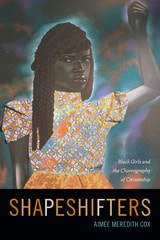
Shapeshifters
Black Girls and the Choreography of CitizenshipAimee Meredith Cox
Duke University Press, 2015
In Shapeshifters Aimee Meredith Cox explores how young Black women in a Detroit homeless shelter contest stereotypes, critique their status as partial citizens, and negotiate poverty, racism, and gender violence to create and imagine lives for themselves. Based on eight years of fieldwork at the Fresh Start shelter, Cox shows how the shelter's residents—who range in age from fifteen to twenty-two—employ strategic methods she characterizes as choreography to disrupt the social hierarchies and prescriptive narratives that work to marginalize them. Among these are dance and poetry, which residents learn in shelter workshops. These outlets for performance and self-expression, Cox shows, are key to the residents exercising their agency, while their creation of alternative family structures demands a rethinking of notions of care, protection, and love. Cox also uses these young women's experiences to tell larger stories: of Detroit's history, the Great Migration, deindustrialization, the politics of respectability, and the construction of Black girls and women as social problems. With Shapeshifters Cox gives a voice to young Black women who find creative and non-normative solutions to the problems that come with being young, Black, and female in America.
[more]
Solidarity and Fragmentation
Working People and Class Consciousness in Detroit, 1875-1900Richard Jules Oestreicher
University of Illinois Press, 1985
How did the interplay between class and ethnicity play out within the working class during the Gilded Age? Richard Jules Oestreicher illuminates the immigrant communities, radical politics, worker-employer relationships, and the multiple meanings of workers' affiliations in Detroit at the end of the nineteenth century.
[more]