Results by title
429 books match the query 'Development' and 24 start with s

Saving Seeds, Preserving Taste
Heirloom Seed Savers in AppalachiaBill Best
Ohio University Press, 2013
The Brown Goose, the White Case Knife, Ora’s Speckled Bean, Radiator Charlie’s Mortgage Lifter—these are just a few of the heirloom fruits and vegetables you’ll encounter in Bill Best’s remarkable history of seed saving and the people who preserve both unique flavors and the Appalachian culture associated with them. As one of the people at the forefront of seed saving and trading for over fifty years, Best has helped preserve numerous varieties of beans, tomatoes, corn, squashes, and other fruits and vegetables, along with the family stories and experiences that are a fundamental part of this world. While corporate agriculture privileges a few flavorless but hardy varieties of daily vegetables, seed savers have worked tirelessly to preserve genetic diversity and the flavors rooted in the Southern Appalachian Mountains—referred to by plant scientists as one of the vegetative wonders of the world.
Saving Seeds, Preserving Taste will introduce readers to the cultural traditions associated with seed saving, as well as the remarkable people who have used grafting practices and hand-by-hand trading to keep alive varieties that would otherwise have been lost. As local efforts to preserve heirloom seeds have become part of a growing national food movement, Appalachian seed savers play a crucial role in providing alternatives to large-scale agriculture and corporate food culture. Part flavor guide, part people’s history, Saving Seeds, Preserving Taste will introduce you to a world you’ve never known—or perhaps remind you of one you remember well from your childhood.

Saving Seeds, Preserving Taste
Heirloom Seed Savers in AppalachiaBill Best
Ohio University Press, 0
Saving Seeds, Preserving Taste will introduce readers to the cultural traditions associated with seed saving, as well as the remarkable people who have used grafting practices and hand-by-hand trading to keep alive varieties that would otherwise have been lost. As local efforts to preserve heirloom seeds have become part of a growing national food movement, Appalachian seed savers play a crucial role in providing alternatives to large-scale agriculture and corporate food culture. Part flavor guide, part people’s history, Saving Seeds, Preserving Taste will introduce you to a world you’ve never known — or perhaps remind you of one you remember well from your childhood.
Saving the World
A Brief History of Communication for Devleopment and Social ChangeEmile G. McAnany
University of Illinois Press, 2012
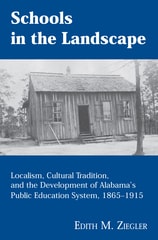
Schools in the Landscape
Localism, Cultural Tradition, and the Development of Alabama's Public Education System, 1865-1915Edith M. Ziegler
University of Alabama Press, 2010
Where culture met classroom—how Alabama’s past shaped its public schools.
Schools in the Landscape offers a richly detailed and deeply contextualized history of public education in Alabama during the transformative half-century following the Civil War. In this groundbreaking study, Edith M. Ziegler examines how localism, cultural tradition, and social conservatism shaped the development of Alabama’s public school system between 1865 and 1915—a period marked by Reconstruction, Redemption, and the entrenchment of racial segregation.
Ziegler explores how Alabama’s rural, economically challenged, and culturally conservative communities influenced the structure and function of public education. Drawing on a wide range of archival sources, she investigates the roles of teachers, schoolhouses, funding mechanisms, and community rituals in shaping educational experiences. The book also delves into the dual system of Black and white schools, highlighting the systemic inequalities and the resilience of African American communities in the face of institutionalized racism.
Through chapters on Progressive Era reforms, local festivals, and the symbolic role of schools in civic life, Ziegler reveals how education in Alabama was not merely a top-down initiative but a deeply local and contested process. Her analysis underscores the importance of understanding regional identity and cultural values in the broader narrative of American educational history.
Schools in the Landscape is essential reading for scholars of Southern history, education policy, and cultural studies, offering a nuanced portrait of how public schooling evolved in one of the nation’s most complex and tradition-bound regions.
Science, Money, and Politics
Political Triumph and Ethical ErosionDaniel S. Greenberg
University of Chicago Press, 2001
Second Economy In Tanzania
Eastern African StudiesT. L. Maliyamkono
Ohio University Press, 1990
Every country has its second, underground, unofficial, irregular or parallel economy. By their nature they are hidden and defy accurate and formal measurement. They provoke conceptual and definitional arguments among analysts. There has recently been a surge of interest; anecdote, newspaper reports and ‘educated guesses’ have increasingly been replaced by serious analysis. However, most of the new generation of studies are of developed economies.
This book examines the effect on a developing economy. It explores the causes, identifies the key sectoral manifestations and reveals the various groups of actors. It attempts to establish the size of the second economy of Tanzania.
Various factors drove the official economy into distress. Tanzanian peasants, wage earners and firms resorted to legitimate and illegitimate activities to overcome state control and shortage of basic necessities.
This pioneering study will be invaluable for policy makers, international funding bodies and for students who are faced with trying to understand the realities of life behind the formal facade of economic theory and official statistics.

Seeing Like a Citizen
Decolonization, Development, and the Making of Kenya, 1945–1980Kara Moskowitz
Ohio University Press, 2019
In Seeing Like a Citizen, Kara Moskowitz approaches Kenya’s late colonial and early postcolonial eras as a single period of political, economic, and social transition. In focusing on rural Kenyans—the vast majority of the populace and the main targets of development interventions—as they actively sought access to aid, she offers new insights into the texture of political life in decolonizing Kenya and the early postcolonial world.
Using multisited archival sources and oral histories focused on the western Rift Valley, Seeing Like a Citizen makes three fundamental contributions to our understanding of African and Kenyan history. First, it challenges the widely accepted idea of the gatekeeper state, revealing that state control remained limited and that the postcolonial state was an internally varied and often dissonant institution. Second, it transforms our understanding of postcolonial citizenship, showing that its balance of rights and duties was neither claimed nor imposed, but negotiated and differentiated. Third, it reorients Kenyan historiography away from central Kenya and elite postcolonial politics. The result is a powerful investigation of experiences of independence, of the meaning and form of development, and of how global political practices were composed and recomposed on the ground in local settings.
Senate and Treaties, 1789-1817
The Development of the Treaty-Making Functions of the United States Senate During Their Formative PeriodRalston Hayden, Ph.D.
University of Michigan Press, 1920

Sex in Development
Science, Sexuality, and Morality in Global PerspectiveVincanne Adams and Stacy Leigh Pigg, eds.
Duke University Press, 2005
Sex in Development combines the cultural analysis of sexuality, critiques of global development, and science and technology studies. Whether considering the resistance encountered by representatives of an American pharmaceutical company attempting to teach Russian doctors a “value free” way to offer patients birth control or the tension between Tibetan Buddhist ideas of fertility and the modernization schemes of the Chinese government, these essays show that attempts to make sex a universal moral object to be managed and controlled leave a host of moral ambiguities in their wake as they are engaged, resisted, and reinvented in different ways throughout the world.
Contributors. Vincanne Adams, Leslie Butt, Lawrence Cohen, Heather Dell, Vinh-Kim Nguyen, Shanti Parikh, Heather Paxson, Stacy Leigh Pigg, Michele Rivkin-Fish
Shortcut or Piecemeal
Economic Development Strategies and Structural ChangeJan Winiecki
Central European University Press, 2016
Small Privatization
The Transformation of Retail Trade and Consumer Services in the Czech Republic, Hungary and PolandRoman Frydman
Central European University Press, 1994
Social Capital and Poor Communities
Susan Saegert
Russell Sage Foundation, 2001
Social Science Knowledge and Economic Development
An Institutional Design PerspectiveVernon W. Ruttan
University of Michigan Press, 2003
With its emphasis on interdisciplinarity, Social Science Knowledge and Economics Developmentis important reading for social scientists, development economists, and in the development studies classroom.
Vernon W. Ruttan is Regents Professor Emeritus in the Department of Applied Economics at the University of Minnesota.

Social Security Pension Reform in Europe
Edited by Martin Feldstein and Horst Siebert
University of Chicago Press, 2002
The essays here highlight the problems that the European pension reform process faces and how it differs from that of the United States. This timely volume will significantly enrich the debate on pension reform worldwide.
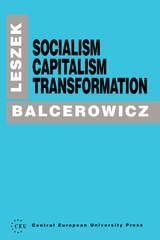
Socialism, Capitalism, Transformation
Leszek Balcerowicz
Central European University Press, 1995

Socialist States and the Environment
Lessons for Eco-Socialist FuturesSalvatore Engel-Di Mauro
Pluto Press, 2021
More than thirty years after the collapse of the USSR, the critique of state socialism is still used to deny alternatives to capitalism, irrespective of global capitalist ecological and social devastation. There is seemingly nothing worthwhile salvaging from decades of state socialist experiences.
As the climate crisis deepens, Engel-Di Mauro argues that we need to re-evaluate the environmental practices and policies of state socialism, especially as they had more environmentally beneficial than destructive effects. Rather than dismissing state socialism’s heritage out of hand, we should reclaim it for contemporary eco-socialist ends.
By means of a comparative and multiple-scaled approach, Engel-Di Mauro points to highly diverse and environmentally constructive state socialist experiences. Taking the reader from the USSR to China and Cuba, this is a fiery and contentious look at what worked, what didn’t, and how we can move towards an eco-socialist future.
South Vietnam Trial and Experience
A Challenge for DevelopmentAng Tuan Nguyen
Ohio University Press, 1987
Dr. Nguyen Anh Tuan, former Minister of Finance of the Republic of South Vietnam, addresses a common perception of Vietnam: that South Vietnam was a fragmented society which did not deserve to succeed because of its internal weaknesses. According to Tuan, however, South Vietnam in the last decade of its life developed considerable governmental cohesion and internal social strength. Before the final failure of will, the South and its defenders were well on the way to becoming a viable society that had managed with American assistance to lift itself by its bootstraps to the point to economic take-off. Tuan argues that South Vietnam’s fall was not inevitable. This controversial book will be of great interest to all those concerned with the Vietnamese experience during the period 1954-1975.
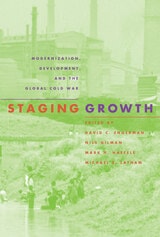
Staging Growth
Modernization, Development, and the Global Cold WarDavid C. Engerman
University of Massachusetts Press, 2003
Beginning in the 1950s, the theory of modernization emerged as the dominant paradigm of economic, social, and political development within the American foreign policy establishment. Purporting to explain the stages through which all nations pass on the road to industrial modernity, it provided a rationale for a broad range of cultural and political projects aimed at fostering Third World growth while simultaneously combating communism.
But modernization theory was more than simply an expression of Cold War ideology. As the essays in this volume show, the ideal of modernization proliferated throughout the postcolonial world and across ideological lines in places as diverse as East Asia, Southern Africa, and South Asia. Indeed, it was embraced by all who shared the American enthusiasm for the increased production and higher standards of living promised by industrialization—enemies and allies alike.
Situating modernization theory historically, Staging Growth avoids conventional chronologies and categories of analysis, particularly the traditional focus on conflicts between major powers. The contributors employ a variety of approaches—from economic and intellectual history to cultural criticism and biography—to shed fresh light on the global forces that shaped the Cold War and its legacies. Most of the pieces are comparative, exploring how different countries and cultures have grappled with the implications of modern development. At the same time, all of the essays address similar fundamental questions. Is modernization the same thing as Westernization? Is the idea of modernization universally valid? Do countries follow similar trajectories as they undertake development? Does modernization bring about globalization?
In addition to the editors and Akira Iriye, contributors include Michael Adas, Laura Belmonte, Gregg Andrew Brazinsky, Christina Klein, J. Victor Koschmann, and Michael R. Mahoney.

Start-Up Poland
The People Who Transformed an EconomyJan Cienski
University of Chicago Press, 2018
As the Warsaw bureau chief for the Financial Times, Jan Cienski spent more than a decade talking with the people who did something that had never been done before: recreating a market economy out of a socialist one. Poland had always lagged behind wealthier Western Europe, but in the 1980s the gap had grown to its widest in centuries. But the corrupt Polish version of communism also created the conditions for its eventual revitalization, bringing forth a remarkably resilient and entrepreneurial people prepared to brave red tape and limited access to capital. In the 1990s, more than a million Polish people opened their own businesses, selling everything from bicycles to leather jackets, Japanese VCRs, and romance novels. The most business-savvy turned those primitive operations into complex corporations that now have global reach.
Well researched and accessibly and entertainingly written, Start-Up Poland tells the story of the opening bell in the East, painting lively portraits of the men and women who built successful businesses there, what their lives were like, and what they did to catapult their ideas to incredible success. At a time when Poland’s new right-wing government plays on past grievances and forms part of the populist and nationalist revolution sweeping the Western world, Cienski’s book also serves as a reminder that the past century has been the most successful in Poland’s history.

Striking a Balance
Making National Economic PolicyAlbert Rees
University of Chicago Press, 1984
Striking a Balance sets forth in clear, nontechnical language the principal goals of national economic policy, the instruments used to achieve these goals, and the political and economic problems arising from conflicting goals and the choice of inappropriate instruments. It is written not for economics students but for the general public and for students in the related fields of public policy, journalism, and law. Unlike economics textbooks, it is not organized according to theoretical categories such as supply and demand, but around issues such as full employment and inflation. It has no ideological axe to grind and tries to present different views of controversial issues fairly.
Striking a Balance benefits from the wisdom and experience of a mature economist. Albert Rees achieves the rare feat of explicating complex issues without oversimplification or trivialization.
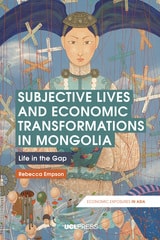
Subjective Lives and Economic Transformations in Mongolia
Life in the GapRebecca M. Empson
University College London, 2020
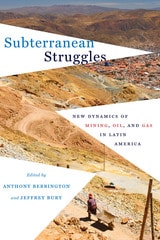
Subterranean Struggles
New Dynamics of Mining, Oil, and Gas in Latin AmericaEdited by Anthony Bebbington and Jeffrey Bury
University of Texas Press, 2013

Supporting Diversity through Collection Evaluation, Development, and Weeding
Erika Barber
Assoc of College & Research Libraries, 2024
Supporting Diversity through Collection Evaluation, Development, and Weeding: CLIPP #48
contains a thorough literature review and bibliography, analysis and discussion of survey results, and sample library collection development policies; diversity, equity, and justice statements; and a harmful content policy.
There are emerging practices for evaluating collection diversity and for diversifying collections via acquisitions, but the question of how collection diversity factors into weeding—either in theory or in practice—has not been thoroughly explored. CLIPP #48 provides a comprehensive survey of how diversity-enhancing collection management practices have filtered into the day-to-day work of average small and medium-sized academic libraries, and offers models for library workers who want to incorporate diversity concerns and policies into collection management practices.
Sustaining the Borderlands in the Age of NAFTA
Development, Politics, and Participation on the US-Mexico BorderSuzanne Simon
Vanderbilt University Press, 2014
Although the key to the side accords' anticipated success lay in their ostensibly generous encouragement of a participatory politics and sustainable development opportunities, Sustaining the Borderlands reveals that the Mexican border populations for which they were largely created are effectively excluded from participating due to the ongoing online, territorial, class, and cultural barriers that shape the borderlands. Rather than experiencing the side accords and their companion institutions as transparent and accessible, residents experienced them as opaque and indecipherable. Simon concludes that the side accords have failed to deliver on their promise of bringing democracy to Mexico because practical mechanisms that would ensure their effective implementation were never put in place.
NAFTA took effect at a time when Mexico was undergoing a democratic transition. The treaty was supposed to encourage this transition and improve environmental and labor conditions on the US-Mexico border. This book demonstrates that, twenty years later, the promises of NAFTA have not come to pass.