Results by title
81 books match the query 'Disasters & Disaster Relief' and 6 start with s

Severe Storms and Society
Seeking Resilience and Understanding Human Behavior in Meteorology, the Weather Enterprise, and PublicsJack R. Friedman, Daphne S. LaDue, Laura Myers, and Melissa J. Lamkin
American Meteorological Society, 2021
[more]
Sites Unseen
Uncovering Hidden Hazards in American CitiesScott Frickel
Russell Sage Foundation, 2018
Winner of the 2020 Robert E. Park Award for Best Book from the Community and Urban Sociology Section of the American Sociological Association
From a dive bar in New Orleans to a leafy residential street in Minneapolis, many establishments and homes in cities across the nation share a troubling and largely invisible past: they were once sites of industrial manufacturers, such as plastics factories or machine shops, that likely left behind carcinogens and other hazardous industrial byproducts. In Sites Unseen, sociologists Scott Frickel and James Elliott uncover the hidden histories of these sites to show how they are regularly produced and reincorporated into urban landscapes with limited or no regulatory oversight. By revealing this legacy of our industrial past, Sites Unseen spotlights how city-making has become an ongoing process of social and environmental transformation and risk containment.
To demonstrate these dynamics, Frickel and Elliott investigate four very different cities—New Orleans, Minneapolis, Philadelphia, and Portland, Oregon. Using original data assembled and mapped for thousands of former manufacturers’ locations dating back to the 1950s, they find that more than 90 percent of such sites have now been converted to urban amenities such as parks, homes, and storefronts with almost no environmental review. And because manufacturers tend to open plants on new, non-industrial lots rather than on lots previously occupied by other manufacturers, associated hazards continue to spread relatively unabated. As they do, residential turnover driven by gentrification and the rising costs of urban living further obscure these sites from residents and regulatory agencies alike.
Frickel and Elliott show that these hidden processes have serious consequences for city-dwellers. While minority and working class neighborhoods are still more likely to attract hazardous manufacturers, rapid turnover in cities means that whites and middle-income groups also face increased risk. Since government agencies prioritize managing polluted sites that are highly visible or politically expedient, many former manufacturing sites that now have other uses remain invisible. To address these oversights, the authors advocate creating new municipal databases that identify previously undocumented manufacturing sites as potential environmental hazards. They also suggest that legislation limiting urban sprawl might reduce the flow of hazardous materials beyond certain boundaries.
A wide-ranging synthesis of urban and environmental scholarship, Sites Unseen shows that creating sustainable cities requires deep engagement with industrial history as well as with the social and regulatory processes that continue to remake urban areas through time.
A Volume in the American Sociological Association's Rose Series in Sociology.
[more]
Soaking the Middle Class
Suburban Inequality and Recovery from DisasterAnna Rhodes
Russell Sage Foundation, 2022
Extreme weather is increasing in scale and severity as global warming worsens. While poorer communities are typically most vulnerable to the negative effects of climate change, even well-resourced communities are increasingly vulnerable as climate-related storms intensify. Yet little is known about how middle-class communities are responding to these storms and the resulting damage. In Soaking the Middle Class, sociologists Anna Rhodes and Max Besbris examine how a middle-class community recovers from a climate-related disaster and how this process fosters inequality within these kinds of places.
In 2017, Hurricane Harvey dropped record-breaking rainfall in Southeast Texas resulting in more than $125 billion in direct damages. Rhodes and Besbris followed 59 flooded households in Friendswood, Texas, for two years after the storm to better understand the recovery process in a well-resourced, majority-White, middle-class suburban community. As such, Friendswood should have been highly resilient to storms like Harvey, yet Rhodes and Besbris find that the recovery process exacerbated often-invisible economic inequality between neighbors. Two years after Harvey, some households were in better financial positions than they were before the storm, while others still had incomplete repairs, were burdened with large new debts, and possessed few resources to draw on should another disaster occur.
Rhodes and Besbris find that recovery policies were significant drivers of inequality, with flood insurance playing a key role in the divergent recovery outcomes within Friendswood. Households with flood insurance prior to Harvey tended to have higher incomes than those that did not. These households received high insurance payouts, enabling them to replace belongings, hire contractors, and purchase supplies. Households without coverage could apply for FEMA assistance, which offered considerably lower payouts, and for government loans, which would put them into debt. Households without coverage found themselves exhausting their financial resources, including retirement savings, to cover repairs, which put them in even more financially precarious positions than they were before the flood.
The vast majority of Friendswood residents chose to repair and return to their homes after Hurricane Harvey. Even this devastating flood did not alter their plans for long-term residential stability, and the structure of recovery policies only further oriented homeowners towards returning to their homes. Prior to Harvey, many Friendswood households relied on flood damage from previous storms to judge their vulnerability and considered themselves at low risk. After Harvey, many found it difficult to assess their level of risk for future flooding. Without strong guidance from federal agencies or the local government on how to best evaluate risk, many residents ended up returning to potentially unsafe places.
As climate-related disasters become more severe, Soaking the Middle Class illustrates how inequality in the United States will continue to grow if recovery policies are not fundamentally changed.
[more]
Subjunctive Aesthetics
Mexican Cultural Production in the Era of Climate ChangeCarolyn Fornoff
Vanderbilt University Press, 2024
Premio al Mejor Libro en Humanidades, Latin American Studies Association–Mexico Section, 2025
Honorable Mention, LASA Environment Best Book Prize, Latin American Studies Association–Environment Section, 2025
During the twenty-first century, Mexico has escalated extractive concessions at the same time that it has positioned itself as an international leader in the fight against climate change. Cultural production emergent from this contradiction frames this impasse as a crisis of imagination. Subjunctive Aesthetics studies how contemporary writers, filmmakers, and visual artists grapple with the threat that climate change and extractivist policies pose to Mexico's present and future. It explores how artists rise to the challenge of envisioning alternative forms of territoriality (ways of being in relation to the environment) through strategies ranging from rewriting to counterfactual speculation.
Whereas ecocritical studies have often focused on art's evidentiary role—its ability to visualize and prove the urgency of environmental damage—author Carolyn Fornoff argues that what unites the artists under consideration is their use of more hypothetical, uncertain representational modes, or "subjunctive aesthetics." In English, the subjunctive is a grammatical mode that articulates the imagined, desired, and possible. In the Spanish language, it is even more widely used to express doubts, denials, value judgments, and emotions. Each chapter of Subjunctive Aesthetics takes up one of these modalities to examine how Mexican artists, writers, and filmmakers activate approaches to the planet not just as it is, but as it could be or should be.
[more]
Superstorm Sandy
The Inevitable Destruction and Reconstruction of the Jersey ShoreBates, Diane C
Rutgers University Press, 2015
Sandy was the costliest hurricane in U.S. history after Katrina, but the waters had barely receded from the Jersey coast when massive efforts began to “Restore the Shore.” Why do people build in areas open to repeated natural disasters? And why do they return to these areas in the wake of major devastation? Drawing on a variety of insights from environmental sociology, Superstorm Sandy answers these questions as it looks at both the unique character of the Jersey Shore and the more universal ways that humans relate to their environment.
Diane C. Bates offers a wide-ranging look at the Jersey Shore both before and after Sandy, examining the many factors—such as cultural attachment, tourism revenues, and governmental regulation—that combined to create a highly vulnerable coastal region. She explains why the Shore is so important to New Jerseyans, acting as a key cultural touchstone in a state that lacks a central city or even a sports team to build a shared identity among the state’s residents. She analyzes post-Sandy narratives about the Jersey Shore that trumpeted the dominance of human ingenuity over nature (such as the state’s “Stronger than the Storm” advertising campaign) or proclaimed a therapeutic community (“Jersey Strong”)—narratives rooted in emotion and iconography, waylaying any thought of the near-certainty of future storms. The book also examines local business owners, politicians, real estate developers, and residents who have vested interests in the region, explaining why the Shore was developed intensively prior to Sandy, and why restoration became an imperative in the post-storm period.
Engagingly written and insightful, Superstorm Sandy highlights the elements that compounded the disaster on the Shore, providing a framework for understanding such catastrophes and preventing them in the future.
[more]
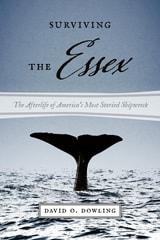
Surviving the Essex
The Afterlife of America's Most Storied ShipwreckDavid O. Dowling
University Press of New England, 2016
Surviving the “Essex” tells the captivating story of a ship’s crew battered by whale attack, broken by four months at sea, and forced—out of necessity—to make meals of their fellow survivors. Exploring the Rashomon-like Essex accounts that complicate and even contradict first mate Owen Chase’s narrative, David O. Dowling examines the vital role of viewpoint in shaping how an event is remembered and delves into the ordeal’s submerged history—the survivors’ lives, ambitions, and motives, their pivotal actions during the desperate moments of the wreck itself, and their will to reconcile those actions in the short- and long-term aftermath of this storied event. Mother of all whale tales, Surviving the “Essex” acts as a sequel to Nathaniel Philbrick’s In the Heart of the Sea, while probing deeper into the nature of trauma and survival accounts, an extreme form of notoriety, and the impact that the story had on Herman Melville and the writing of Moby-Dick.
[more]