Results by title
57 books match the query 'Discourse' and 4 start with s

Science as Power
Discourse and Ideology in Modern SocietyStanley Aronowitz
University of Minnesota Press, 1988
Science as Power was first published in 1988. Minnesota Archive Editions uses digital technology to make long-unavailable books once again accessible, and are published unaltered from the original University of Minnesota Press editions.
Science has established itself as not merely the dominant but the only legitimate form of human knowledge. By tying its truth claims to methodology, science has claimed independence from the influence of social and historical conditions. Here, Aronowitz asserts that the norms of science are by no means self-evident and that science is best seen as a socially constructed discourse that legitimates its power by presenting itself as truth.
Stanley Aronowitz is professor of sociology in the graduate school of City University of New York. His books include Working Class Hero: A New Strategy for Labor and, with Henry Giroux, Education Under Siege.
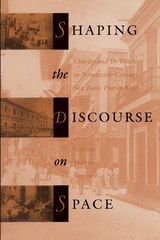
Shaping the Discourse on Space
Charity and Its Wards in Nineteenth-Century San Juan, Puerto RicoBy Teresita Martínez-Vergne
University of Texas Press, 1999
As an inchoate middle class emerged in Puerto Rico in the early nineteenth century, its members sought to control not only public space, but also the people, activities, and even attitudes that filled it. Their instruments were the San Juan town council and the Casa de Beneficencia, a state-run charitable establishment charged with responsibility for the poor.
In this book, Teresita Martínez-Vergne explores how municipal officials and the Casa de Beneficencia shaped the discourse on public and private space and thereby marginalized the worthy poor and vagrants, "liberated" Africans, indigent and unruly women, and destitute children. Drawing on extensive and innovative archival research, she shows that the men who comprised the San Juan ayuntamiento and the board of charity regulated the public discourse on topics such as education, religious orthodoxy, hygiene, and family life, thereby establishing norms for "correct" social behavior and chastising the "deviant" lifestyles of the working poor.
This research clarifies the ways in which San Juan's middle class defined itself in the midst of rapid social and economic change. It also offers new insights into notions of citizenship and the process of nation-building in the Caribbean.

Social Contract, Discourse on the Virtue Most Necessary for a Hero, Political Fragments, and Geneva Manuscript
Jean-Jacques Rousseau
Dartmouth College Press, 1994
Storytelling and Conversation
Discourse in Deaf CommunitiesElizabeth A. Winston
Gallaudet University Press, 1999
In this intriguing book, renowned sociolinguistics experts explore the importance of discourse analysis, a process that examines patterns of language to understand how users build cooperative understanding in dialogues. It presents discourse analyses of sign languages native to Bali, Italy, England, and the United States.
Studies of internal context review the use of space in ASL to discuss space, how space in BSL is used to “package” complex narrative tasks, how signers choose linguistic tools to structure storytelling, and how affect, emphasis, and comment are added in text telephone conversations. Inquiries into external contexts observe the integration of deaf people and sign language into language communities in Bali, and the language mixing that occurs between deaf parents and their hearing children.
Both external and internal contexts are viewed together, first in an examination of applying internal ASL text styles to teaching written English to Deaf students and then in a consideration of the language choices of interpreters who must shift footing to manage the “interpreter’s paradox.” Storytelling and Conversation casts new light on discourse analysis, which will make it a welcome addition to the sociolinguistics canon.