Results by title
130 books match the query 'Educators' and 5 start with s
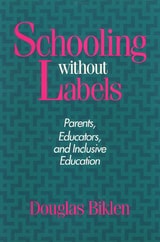
Schooling Without Labels
Parents, Educators, and Inclusive EducationDouglas Biklen
Temple University Press, 1992
Douglas Biklen closely examines the experiences of six families in which children with disabilities are full participants in family life in order to understand how people who have been labeled disabled might become full participants in the other areas of society as well. He focuses on the contradictions between what some families have achieved, what they want for their children, and what society and its social policies allow. He demonstrates how the principles of inclusion that govern the lives of these families can be extended to education, community life, and other social institutions.
The parents who tell their stories here have actively sought inclusion of their children in regular schools and community settings; several have children with severe or multiple disabilities. In discussing issues such as normalization, acceptance, complete schooling, circles of friends, and community integration, these parents describe the challenge and necessity of their children's "leading regular lives."
In the series Health, Society, and Policy, edited by Sheryl Ruzek and Irving Kenneth Zola.
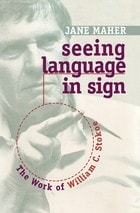
Seeing Language in Sign
The Work of William C. StokoeJane Maher
Gallaudet University Press, 2010
In 1955 William C. Stokoe arrived at Gallaudet College (later Gallaudet University) to teach English where he was first exposed to deaf people signing. While most of his colleagues dismissed signing as mere mimicry of speech, Stokoe saw in it elements of a distinctive language all its own. Seeing Language in Sign traces the process that Stokoe followed to prove scientifically and unequivocally that American Sign Language (ASL) met the full criteria of linguistics—phonology, morphology, syntax, semantics and use of language—to be classified a fully developed language.
This perceptive account dramatically captures the struggle Stokoe faced in persuading the establishment of the truth of his discovery. Other faculty members ridiculed or reviled him, and many deaf members of the Gallaudet community laughed at his efforts. Seeing Language in Sign rewards the reader with a rich portrayal of an undaunted advocate who, like a latter-day Galileo, pursued his vision doggedly regardless of relentless antagonism. He established the Linguistics Research Laboratory, then founded the journal Sign Language Studies to sustain an unpopular dialogue until the tide changed. His ultimate vindication corresponded with the recognition of the glorious culture and community that revolves around Deaf people and their language, ASL.
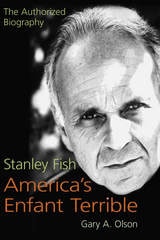
Stanley Fish, America's Enfant Terrible
The Authorized BiographyGary A. Olson
Southern Illinois University Press, 2016
Born into a tumultuous family, Fish survived life with an emotionally absent father and a headstrong mother through street sports and troublemaking as much as through his success at a rigorous prep school. As Olson shows, Fish’s escape from the working-class neighborhoods of 1940s and 1950s Providence, Rhode Island, came with his departure for the university life at the University of Pennsylvania and then Yale. His meteoric rise through the academic ranks at a troubled Vietnam-era UC-Berkeley was complemented by a 1966 romp through Europe that included drag racing through the streets of Seville in his Alfa Romeo. He went on to become an internationally prominent scholar at Johns Hopkins before moving to Duke, where he built a star-studded academic department that became a key site in the culture and theory wars of the 1980s and 1990s. Olson discusses Fish’s tenure as a highly visible dean at the University of Illinois at Chicago who clashed publicly with the state legislature. He also covers Fish’s most remarkable and controversial books, including Fish’s masterpiece, Surprised by Sin: The Reader in "Paradise Lost," which was a critical sensation and forever changed the craft of literary criticism, as well as Professional Correctness and Save the World on Your Own Time, two books that alienated Fish from most liberal-minded professors in English studies.
Olson concludes his biography of Fish with an in-depth analysis of the contradictions between Fish’s public persona and his private personality, examining how impulses and events from Fish’s childhood shaped his lifelong practices and personality traits. Also included are a chronology of the major events of Fish’s life and never-before-published photos.
Based on hundreds of hours of recorded interviews with friends, enemies, colleagues, former students, family members, and Fish himself, along with material from the Stanley Fish archive, Stanley Fish, America’s Enfant Terrible is a clearly written narrative of the life of an important and controversial scholar.
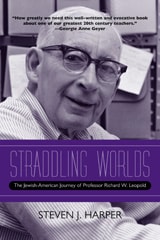
Straddling Worlds
The Jewish-American Journey of Professor Richard W. LeopoldSteven J. Harper
Northwestern University Press, 2008
Author Steven J. Harper pays tribute to a well-respected teacher with this biography of a distinguished William Smith Mason Professor of History at Northwestern University, Richard W. Leopold. Harper had maintained contact with his former professor, as had hundreds of other alumni, meeting with him in the apartment to which his age and health confined him. When Leopold invited him to review his biographical materials to prepare a New York Times obituary, Harper began to catch glimpses of a deeper history in Leopold’s life: that of Jews in America after the turn of the century.
Across two years of Sundays, Leopold’s life came together and Harper began to notice parallels between the life of his professor and the life of his recently deceased father-in-law. Both grew up in less orthodox households but were still identified as Jewish by others; both attended Ivy League colleges, fighting (and beating) anti-Semitism there; and both served their country with distinction in World War II. The two men persevered through a twentieth century Jewish-American experience that they and many others shared, but rarely discussed. Steven Harper has caught them both on the page just in time to document their lives, their culture, and the nation that grew and changed alongside them.

Street of Dreams
The Nature and Legacy of the 1960sDouglas M. Knight
Duke University Press, 1989