Results by title
87 books match the query 'Emotions' and 6 start with s

Science and Emotions after 1945
A Transatlantic PerspectiveEdited by Frank Biess and Daniel M. Gross
University of Chicago Press, 2014
In Science and Emotions after 1945, Frank Biess and Daniel M. Gross chronicle the curious resurgence of emotion studies and show that it was fueled by two very different sources: social movements of the 1960s and brain science. A central claim of the book is that the relatively recent neuroscientific study of emotion did not initiate – but instead consolidated – the emotional turn by clearing the ground for multidisciplinary work on the emotions. Science and Emotions after 1945 tells the story of this shift by looking closely at scientific disciplines in which the study of emotions has featured prominently, including medicine, psychiatry, neuroscience, and the social sciences, viewed in each case from a humanities perspective.

Shame and Its Sisters
A Silvan Tomkins ReaderEve Kosofsky Sedgwick and Adam Frank, eds.
Duke University Press, 1995
SilvanTomkins (1911–1991) was one of the most radical and imaginative psychologists of the twentieth century. In Affect, Imagery, Consciousness, a four-volume work published over the last thirty years of his life, Tomkins developed an ambitious theory of affect steeped in cybernetics and systems theory as well as in psychoanalysis, ethology, and neuroscience. The implications of his conceptually daring and phenomenologically suggestive theory are only now—in the context of postmodernism—beginning to be understood. With Shame and Its Sisters, editors Eve Kosofsky Sedgwick and Adam Frank make available for the first time an engaging and accessible selection of Tomkins’s work.
Featuring intensive examination of several key affects, particularly shame and anger, this volume contains many of Tomkins’s most haunting, diagnostically incisive, and theoretically challenging discussions. An introductory essay by the editors places Tomkins’s work in the context of postwar information technologies and will prompt a reexamination of some of the underlying assumptions of recent critical work in cultural studies and other areas of the humanities. The text is also accompanied by a biographical sketch of Tomkins by noted psychologist Irving E. Alexander, Tomkins’s longtime friend and collaborator.

Snakes, Sunrises, and Shakespeare
How Evolution Shapes Our Loves and FearsGordon H. Orians
University of Chicago Press, 2014
In this ambitious and unusual work, evolutionary biologist Gordon H. Orians explores the role of evolution in human responses to the environment, beginning with why we have emotions and ending with evolutionary approaches to aesthetics. Orians reveals how our emotional lives today are shaped by decisions our ancestors made centuries ago on African savannas as they selected places to live, sought food and safety, and socialized in small hunter-gatherer groups. During this time our likes and dislikes became wired in our brains, as the appropriate responses to the environment meant the difference between survival or death. His rich analysis explains why we mimic the tropical savannas of our ancestors in our parks and gardens, why we are simultaneously attracted to danger and approach it cautiously, and how paying close attention to nature’s sounds has resulted in us being an unusually musical species. We also learn why we have developed discriminating palates for wine, and why we have strong reactions to some odors, and why we enjoy classifying almost everything.
By applying biological perspectives ranging from Darwin to current neuroscience to analyses of our aesthetic preferences for landscapes, sounds, smells, plants, and animals, Snakes, Sunrises, and Shakespeare transforms how we view our experience of the natural world and how we relate to each other.

Sound Diplomacy
Music and Emotions in Transatlantic Relations, 1850-1920Jessica C. E. Gienow-Hecht
University of Chicago Press, 2009
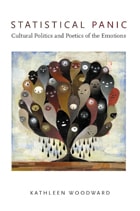
Statistical Panic
Cultural Politics and Poetics of the EmotionsKathleen Woodward
Duke University Press, 2009
Referring discreetly to her own experience, Woodward examines the interpenetration of social structures and subjectivity, considering how psychological emotions are social phenomena, with feminist anger, racial shame, old-age depression, and sympathy for non-human cyborgs (including robots) as key cases in point. She discusses how emerging institutional and discursive structures engender “new” affects that in turn can help us understand our changing world if we are attentive to them—the “statistical panic” produced by the risk society, with its numerical portents of disease and mortality; the rage prompted by impenetrable and bloated bureaucracies; the brutal shame experienced by those caught in the crossfire of the media; and the conservative compassion that is not an emotion at all, only an empty political slogan.
The orbit of Statistical Panic is wide, drawing in feminist theory, critical phenomenology, and recent theories of the emotions. But at its heart are stories. As an antidote to the vacuous dramas of media culture, with its mock emotions and scattershot sensations, Woodward turns to the autobiographical narrative. Stories of illness—by Joan Didion, Yvonne Rainer, Paul Monette, and Alice Wexler, among others—receive special attention, with the inexhaustible emotion of grief framing the book as a whole.

Stoicism and Emotion
Margaret Graver
University of Chicago Press, 2007
In this elegant and clearly written work, Margaret Graver gives a compelling new interpretation of the Stoic position. Drawing on a vast range of ancient sources, she argues that the chief demand of Stoic ethics is not that we should suppress or deny our feelings, but that we should perfect the rational mind at the core of every human being. Like all our judgments, the Stoics believed, our affective responses can be either true or false and right or wrong, and we must assume responsibility for them. Without glossing over the difficulties, Graver also shows how the Stoics dealt with those questions that seem to present problems for their theory: the physiological basis of affective responses, the phenomenon of being carried away by one’s emotions, the occurrence of involuntary feelings and the disordered behaviors of mental illness. Ultimately revealing the deeper motivations of Stoic philosophy, Stoicism and Emotion uncovers the sources of its broad appeal in the ancient world and illuminates its surprising relevance to our own.