Results by title
158 books match the query 'End' and 10 start with s

Savage Ecology
War and Geopolitics at the End of the WorldJairus Victor Grove
Duke University Press, 2019
Scientific History
Experiments in History and Politics from the Bolshevik Revolution to the End of the Cold WarElena Aronova
University of Chicago Press, 2021
The book explores the intertwined trajectories of six intellectuals and the larger programs they set in motion: Henri Berr (1863–1954), Nikolai Bukharin (1888–1938), Lucien Febvre (1878–1956), Nikolai Vavilov (1887–1943), Julian Huxley (1887–1975), and John Desmond Bernal (1901–1971). Though they held different political views, spoke different languages, and pursued different goals, these thinkers are representative of a larger motley crew who joined the techniques, approaches, and values of science with the writing of history, and who created powerful institutions and networks to support their projects.
In tracing these submerged stories, Aronova reveals encounters that profoundly shaped our knowledge of the past, reminding us that it is often the forgotten parts of history that are the most revealing.

Seamus Heaney and the End of Catholic Ireland
Kieran Quinlan
Catholic University of America Press, 2020
Semantic Tectonics
Writing Studies, Intersubjectivity, and the End of SolipsismDylan B. Dryer
Utah State University Press, 2026
Semantic Tectonics offers an engaging contribution to the ongoing conversation about the alliances of convenience and fissiparous relations among second--language writing, rhetoric, technical and professional communication, composition, and basic writing. From a theoretical perspective, the book brings together insights from a range of important scholars who have advanced relational alternatives to Cartesian dualisms of mind and body, self and other, thought and language. Naming these dualisms “solipsism,” the book extends these alternatives into empirical inquiries into the lexicogrammar of contemporary writing studies scholarship, using corpus analytics to bolster, and sometimes challenge, critical-discourse and content--analytic approaches.
With frequent pauses to explain and model corpus tools and applications, to pose questions for further inquiry, and to contemplate pedagogical or civic applications, Semantic Tectonics shows how the field’s social mission is constrained by tacit beliefs about critical concepts like language, self, context, genre, reflection, agency, and development. By foregrounding the empirical study of patterns in language itself, this book inspires readers to shift their perspective to the operational significance of word- and phrase-level discourse as sites for ideological and pedagogical intervention.

Shopping, or The End of Time
Emily Bludworth de Barrios
University of Wisconsin Press, 2022
A detective’s red thread spiderweb mapping the constellations among parenting, capitalism, aging, and ghosts, this stunning collection is wistful, unmoored, glamorous, and immense. These tour-de-force poems simultaneously capture an impression of emptiness and pleasure, of existing in a liminal space filled with both hollowness and potential.
It was difficult to tell when the world broke.
—Excerpt from “Ravine”
Spanish American Poetry at the End of the Twentieth Century
Textual DisruptionsBy Jill Kuhnheim
University of Texas Press, 2005
Has poetry lost its relevance in the postmodern age, unable to keep pace with other forms of cultural production such as film, mass media, and the Internet? Quite the contrary, argues Jill Kuhnheim in this pathfinding book, which explores how recent Spanish American poetry participates in the fundamental cultural debates of its time.
Using a variety of interdisciplinary approaches, Kuhnheim engages in close readings of numerous poetic works to show how contemporary Spanish American poetry struggles with the divisions between politics and aesthetics and between visual and written images; grapples with issues of ethnic, national, sexual, and urban identities; and incorporates rather than rejects technological innovations and elements from the mass media. Her analysis illuminates the ways in which contemporary issues such as indigenismo and Latin America's postcolonial legacy, modernization, immigration, globalization, economic shifts toward neoliberalism and informal economies, urbanization, and the technological revolution have been expressed in—and even changed the very form of—Spanish American poetry since the 1970s.
Stardust
Cinematic Archives at the End of the WorldHannah Goodwin
University of Minnesota Press, 2024
An exploration of the fundamental bond between cinema and the cosmos
The advent of cinema occurred alongside pivotal developments in astronomy and astrophysics, including Albert Einstein’s theories of relativity, all of which dramatically altered our conception of time and provided new means of envisioning the limits of our world. Tracing the many aesthetic, philosophical, and technological parallels between these fields, Stardust explores how cinema has routinely looked toward the cosmos to reflect our collective anxiety about a universe without us.
Employing a “cosmocinematic gaze,” Hannah Goodwin uses the metaphorical frameworks from astronomy to posit new understandings of cinematic time and underscore the role of light in generating archives for an uncertain future. Surveying a broad range of works, including silent-era educational films, avant-garde experimental works, and contemporary blockbusters, she carves out a distinctive area of film analysis that extends its reach far beyond mainstream science fiction to explore films that reckon with a future in which humans are absent.
This expansive study details the shared affinities between cinema and the stars in order to demonstrate how filmmakers have used cosmic imagery and themes to respond to the twentieth century’s moments of existential dread, from World War I to the atomic age to our current moment of environmental collapse. As our outlook on the future continues to change, Stardust illuminates the promise of cinema to bear witness to humanity’s fragile existence within the vast expanse of the universe.
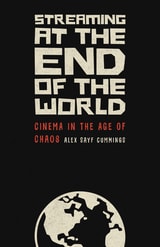
Streaming at the End of the World
Cinema in the Age of ChaosAlex Sayf Cummings
Rutgers University Press, 2027
Streaming at the End of the World explores the pessimistic and often apocalyptic themes that have pervaded popular culture in the United States and global cinema in the new millennium. The book argues that recent films, from the art-house fare of Melancholia (2011) to the popular science fiction of Annihilation (2018), embody an ambient feeling that continually haunts people in today's capitalist world—an ineluctable impression there is no alternative to the status quo. It seems like nothing is ever really going to change; hence, we are drawn to visions of the end of everything. Written in an accessible, conversational style, this book offers a popular culture spin on the late British philosopher Mark Fisher's maxim that it’s "easier to imagine an end to the world than an end to capitalism."
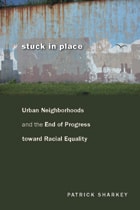
Stuck in Place
Urban Neighborhoods and the End of Progress toward Racial EqualityPatrick Sharkey
University of Chicago Press, 2013
In the 1960s, many believed that the civil rights movement’s successes would foster a new era of racial equality in America. Four decades later, the degree of racial inequality has barely changed. To understand what went wrong, Patrick Sharkey argues that we have to understand what has happened to African American communities over the last several decades. In Stuck in Place, Sharkey describes how political decisions and social policies have led to severe disinvestment from black neighborhoods, persistent segregation, declining economic opportunities, and a growing link between African American communities and the criminal justice system.

Surge to Freedom
The End of Communist Rule in Eastern EuropeJ. F. Brown
Duke University Press, 1991
"Nobody has yet produced a more perceptive and inclusive work on the events of what is arguably the most important year of our lifetimes. This book is essential for anyone with an interest in Eastern Europe, radical social change, or post-bipolar global politics."—Joel M. Jenswold, Social Science Quarterly
"Brown has been a close observer of the region for decades, and the breadth of his knowledge and the acuity of his judgments are evident throughout."—Michael Bernhard, Political Science Quarterly
"There is no surer guide than Brown to an understanding of these events, and no one better qualified to describe the complex and daunting problems facing the new non-communist governments."—John C. Campbell, Foreign Affairs