Results by title
60 books match the query 'Energy' and 5 start with s

Saharan Winds
Energy Systems and Aeolian Imaginaries in Western SaharaAllan, Joanna
West Virginia University Press, 2024
Winner, ASLE-UKI Critical Book Prize, 2025
Finalist, Ecocritical Book Award, 2025, Association for the Study of Literature and Environment (ASLE)
Longlisted, Bread and Roses Award for Radical Publishing, 2025
Saharan Winds contributes to a fairer energy horizon by illuminating the role of imaginaries--how we understand energy sources such as wind and the meanings we attach to wind--in determining the wider politics, whether oppressive or just, associated with energy systems. This book turns to various cultures and communities across different time periods in one space, Western Sahara, to explore how wind imaginaries affect the development, management, and promotion of windfarms; the distribution of energy that windfarms produce; and, vitally, the type of politics mediated by all these elements combined. Highlighting the wind-fueled oppression of colonial energy systems, the book shows the potential offered by nomadic, Indigenous wind imaginaries for contributing to a fairer energy future.
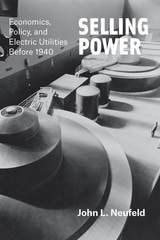
Selling Power
Economics, Policy, and Electric Utilities Before 1940John L. Neufeld
University of Chicago Press, 2016
John L. Neufeld offers a comprehensive historical treatment of the economics that shaped electric utilities. Compared with most industries, the organization of the electric utility industry is not—and cannot be—economically efficient. Most industries are kept by law in a state of fair competition, but the capital necessary to start an electric company—generators, transmission and distribution systems, and land and buildings—is so substantial that few companies can enter the market and compete. Therefore, the natural state of the electric utility industry since its inception has been a monopoly subject to government oversight. These characteristics of electric utilities—and electricity’s importance—have created over time sharp political controversies, and changing public policies have dramatically changed the industry’s structure to an extent matched by few other industries. Neufeld outlines the struggles that shaped the industry’s development, and shows how the experience of electric utilities provides insight into the design of economic institutions, including today’s new large-scale markets.
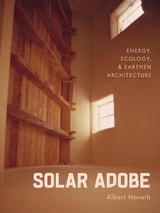
Solar Adobe
Energy, Ecology, and Earthen ArchitectureAlbert Narath
University of Minnesota Press, 2024
How a centuries-old architectural tradition reemerged as a potential solution to the political and environmental crises of the 1970s
Against the backdrop of a global energy crisis, a widespread movement embracing the use of raw earth materials for building construction emerged in the 1970s. Solar Adobe examines this new wave of architectural experimentation taking place in the United States, detailing how an ancient tradition became a point of convergence for issues of environmentalism, architecture, technology, and Indigenous resistance.
Utilized for centuries by the Pueblo people of the American Southwest and by Spanish colonialists, adobe construction found renewed interest as various groups contended with the troubled legacies of modern architecture and an increasingly urgent need for sustainable design practices. In this period of critical experimentation, design networks that included architects, historians, counterculture communities, government weapons labs, and Indigenous activists all looked to adobe as a means to address pressing environmental and political issues.
Albert Narath charts the unique capacities of adobe construction across a wide range of contexts, consistently troubling simple distinctions between traditional and modern technologies, high design and vernacular architecture. Drawing insightful parallels between architecture, environmentalism, and movements for Indigenous sovereignty, Solar Adobe stresses the importance of considering the history of the built environment in conjunction with architecture’s larger impact on the natural world.
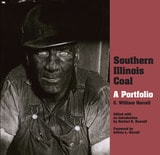
Southern Illinois Coal
A PortfolioC. William Horrell. Edited with an Introduction by Herbert K. Russell. Foreword by Jeffrey L. Horrell
Southern Illinois University Press, 1995
The coal mining photographs of C. William Horrell, taken across the southern Illinois Coal Belt over a twenty-year period from 1966 to 1986, are extraordinary examples of documentary photography—so stark and striking that captions often seem superfluous.
Horrell’s photographs capture the varied phenomena of twentieth-century coal mining technology: the awesome scale of surface mining machines and their impact on the land; massive machines forced into narrow passageways with inches to spare as they carry coal from the face to conveyer belts; and, more significant, the advent of continuous miners, machines that can handle four previously separate processes and which have been a fixture in underground or “deep” mines since the mid-1960s.
Horrell was also intrigued by the related activities of mining, including coal’s processing, cleaning, and transportation, as well as the daily, behind-the-scenes operations that keep mines and miners working. His photographs reflect the beauty of the commonplace—the clothes of the miners, their dinner pails, and their tools—and reveal the picturesque remnants of closed mines: the weathered boards of company houses, the imposing iron beauty of an ancient tipple, and an abandoned building against the lowering sky of an approaching storm. Finally, his portraits of coal minersshow the strength, dignity, and enduring spirit of the men and women who work the southern Illinois coal mines.

Spaceship in the Desert
Energy, Climate Change, and Urban Design in Abu DhabiGökçe Günel
Duke University Press, 2019