Results by title
177 books match the query 'Equality' and 12 start with s
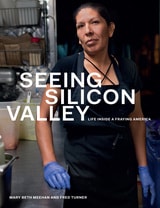
Seeing Silicon Valley
Life inside a Fraying AmericaMary Beth Meehan and Fred Turner
University of Chicago Press, 2021
It’s hard to imagine a place more central to American mythology today than Silicon Valley. To outsiders, the region glitters with the promise of extraordinary wealth and innovation. But behind this image lies another Silicon Valley, one segregated by race, class, and nationality in complex and contradictory ways. Its beautiful landscape lies atop underground streams of pollutants left behind by decades of technological innovation, and while its billionaires live in compounds, surrounded by redwood trees and security fences, its service workers live in their cars.
With arresting photography and intimate stories, Seeing Silicon Valley makes this hidden world visible. Instead of young entrepreneurs striving for efficiency in minimalist corporate campuses, we see portraits of struggle—families displaced by an impossible real estate market, workers striving for a living wage, and communities harmed by environmental degradation. If the fate of Silicon Valley is the fate of America—as so many of its boosters claim—then this book gives us an unvarnished look into the future.
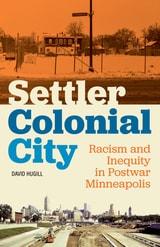
Settler Colonial City
Racism and Inequity in Postwar MinneapolisDavid Hugill
University of Minnesota Press, 2021
Revealing the enduring link between settler colonization and the making of modern Minneapolis
Colonial relations are often excluded from discussions of urban politics and are viewed instead as part of a regrettable past. In Settler Colonial City, David Hugill confronts this culture of organized forgetting by arguing that Minnesota’s largest city is enduringly bound up with the power dynamics of settler-colonial politics. Examining several distinct Minneapolis sites, Settler Colonial City tracks how settler-colonial relations were articulated alongside substantial growth in the Twin Cities Indigenous community during the second half of the twentieth century—creating new geographies of racialized advantage.
Studying the Phillips neighborhood of Minneapolis in the decades that followed the Second World War, Settler Colonial City demonstrates how colonial practices and mentalities shaped processes of urban reorganization, animated non-Indigenous “advocacy research,” informed a culture of racialized policing, and intertwined with a broader culture of American imperialism. It reveals how the actions, assumptions, and practices of non-Indigenous people in Minneapolis produced and enforced a racialized economy of power that directly contradicts the city’s “progressive” reputation.
Ultimately, Settler Colonial City argues that the hierarchical and racist political dynamics that characterized the city’s prosperous beginnings are not exclusive to a bygone era but rather are central to a recalibrated settler-colonial politics that continues to shape contemporary cities across the United States.
Sign Language, Sustainable Development, and Equal Opportunities
Envisioning the Future for Deaf StudentsGoedele A. M. De Clerck
Gallaudet University Press, 2016
The contributors to this volume offer creative and open-minded explorations of the construct of sustainability that are informed by their work with deaf individuals, deaf communities, families of deaf children, and other stakeholders. Sign Language, Sustainable Development, and Equal Opportunities describes sustainability in relation to:
· identity, resilience, and well-being
· participatory citizenship
· historical perspectives on sign language use in educational contexts
· sign language learning and teaching
· human rights and inclusive education
· literate thought and literacy
· the sign language factor and the development of sign language communities in sub-Saharan Africa
· sign language legislation
These changing communities’ understanding of what is required to become sustainable—in areas such as full participation and citizenship in society, economic well-being, access to quality education, and cultural and linguistic identity—is also taking new forms. This work contributes to the paradigm shifts regarding deaf emancipation and deaf education taking place around the world.

Sisters in the Faith
Shaker Women and Equality of the SexesGlendyne R. Wergland
University of Massachusetts Press, 2011
In 1788, following the death of charismatic founder Mother Ann Lee, the celibate religious group known as the Shakers set out to institutionalize equality of the sexes in their theology, government, and daily practice. In this book, Glendyne Wergland evaluates how well they succeeded in that mission by examining the experiences of women within Shaker communities over more than a century.
Drawing on an extensive archive of primary documents, Wergland discusses topics ranging from girlhood, health, and dress to why women joined the Shakers and how they were viewed by those outside their community. She analyzes the division of labor between men and women, showing that there was considerable cooperation and reciprocity in carrying out most tasks—from food production to laundering to gathering firewood—even as gendered conflicts remained.
In her conclusion, Wergland draws together all of these threads to show that Shaker communities achieved a remarkable degree of gender equality at a time when women elsewhere still suffered under the legal and social strictures of the traditional patriarchal order. In so doing, she argues, the experience of Shaker women served as a model for promoting women's rights in American political culture.
Skepticism
Aryeh Botwinick
Temple University Press, 1990
Aryeh Botwinick argues for the recovery of a radical democratic tradition that emphasizes the role of individual participation in the development and control of social and political institutions. Such involvement implies philosophical skepticism—the assumption that the truth about what is the best course of action cannot be known with certainty and that, therefore, every person’s opinion has an equal claim to be considered. The crucial stumbling block to reappropriating this radical egalitarian tradition is the supposed unviability of a consistent skepticism. In an effort to chart a new course of philosophical inquiry into political matters, Botwinick grapples with the formulation of a consistent version of skepticism, claiming that it provides "a continually renewing impetus for the expansion of political participation."
Twentieth-century philosophers have, for the most part, opted for some version of mitigated skepticism, which, the author argues, "has blinded them to the radical political implications of skepticism." Underscoring a pattern of convergence between Anglo-American and Continental philosophy, Botwinick proposes a number of strategies to rehabilitate the rationality of participatory democratic political institutions by articulating an acceptable version of consistent skepticism.
Social Inequality
Kathryn Neckerman
Russell Sage Foundation, 2004
Sons, Daughters, and Sidewalk Psychotics
Mental Illness and Homelessness in Los AngelesNeil Gong
University of Chicago Press, 2024
Drawing on the nuanced experiences of patients and care providers, Sons, Daughters, and Sidewalk Psychotics introduces readers to two drastically different forms of community psychiatric services: public safety net clinics focused on keeping people housed and out of jail and elite private care trying to push clients toward respectable futures.
In downtown Los Angeles, many people in psychiatric crisis only receive help after experiencing homelessness or arrest. Public providers engage in guerrilla social work to secure housing and safety, but these programs are rarely able to deliver true rehabilitation for psychological distress and addiction. Patients are free to refuse treatment or use illegal drugs—so long as they do so away from public view. Across town in West LA or Malibu, wealthy people diagnosed with serious mental illness attend luxurious treatment centers. Programs may offer yoga and organic meals alongside personalized therapeutic treatments, but patients can feel trapped, as their families pay exorbitantly to surveil and “fix” them. Meanwhile, middle-class families—stymied by private insurers, unable to afford elite providers, and yet not poor enough to qualify for social services—struggle to find care at all.
Examining this divergent treatment of people facing similar mental struggles, Gong raises provocative questions about urban policy, individual freedom, and what it would take to create a fundamentally different psychiatric system—one that will meet the needs of patients, their loved ones, and society at large.
Spheres of Influence
The Social Ecology of Racial and Class InequalityDouglas S. Massey
Russell Sage Foundation, 2014

Split
Class Divides UncoveredBen Tippet
Pluto Press, 2020
Foregrounding the economic nature of class, Split challenges the idea that class can be reduced to the cultural. From precarious labor to rising debt; from the housing crisis to environmental catastrophe; from an inflated prison population to the welfare state; Ben Tippet traces the class divide at the heart of all exploitation. Myth-busting meritocracy, he exposes the role that tax havens, colonialism and inheritance play in the wealth of the elite.
Split highlights the potential for a diverse and eclectic working-class bloc to fight back in an age of austerity and uncertainty.
Stacked Decks
Building Inspectors and the Reproduction of Urban InequalityRobin Bartram
University of Chicago Press, 2022
Though we rarely see them at work, building inspectors have the power to significantly shape our lives through their discretionary decisions. The building inspectors of Chicago are at the heart of sociologist Robin Bartram’s analysis of how individuals impact—or attempt to impact—housing inequality. In Stacked Decks, she reveals surprising patterns in the judgment calls inspectors make when deciding whom to cite for building code violations. These predominantly white, male inspectors largely recognize that they work within an unequal housing landscape that systematically disadvantages poor people and people of color through redlining, property taxes, and city spending that favor wealthy neighborhoods. Stacked Decks illustrates the uphill battle inspectors face when trying to change a housing system that works against those with the fewest resources.
Status
Why Is It Everywhere? Why Does It Matter?Cecilia L. Ridgeway
Russell Sage Foundation, 2019
Ridgeway’s research on status has important implications for our understanding of social inequality. Distinct from power or wealth, status is prized because it provides affirmation from others and affords access to valuable resources. Ridgeway demonstrates how the conferral of status inevitably contributes to differing life outcomes for individuals, with impacts on pay, wealth creation, and health and wellbeing. Status beliefs are widely held views about who is better in society than others in terms of esteem, wealth, or competence. These beliefs confer advantages which can exacerbate social inequality. Ridgeway notes that status advantages based on race, gender, and class—such as the belief that white men are more competent than others—are the most likely to increase inequality by facilitating greater social and economic opportunities.
Ridgeway argues that status beliefs greatly enhance higher status groups’ ability to maintain their advantages in resources and access to positions of power and make lower status groups less likely to challenge the status quo. Many lower status people will accept their lower status when given a baseline level of dignity and respect—being seen, for example, as poor but hardworking. She also shows that people remain willfully blind to status beliefs and their effects because recognizing them can lead to emotional discomfort. Acknowledging the insidious role of status in our lives would require many higher-status individuals to accept that they may not have succeeded based on their own merit; many lower-status individuals would have to acknowledge that they may have been discriminated against.
Ridgeway suggests that inequality need not be an inevitable consequence of our status beliefs. She shows how status beliefs can be subverted—as when we reject the idea that all racial and gender traits are fixed at birth, thus refuting the idea that women and people of color are less competent than their male and white counterparts. This important new book demonstrates the pervasive influence of status on social inequality and suggests ways to ensure that it has a less detrimental impact on our lives.
Stuck in Place
Urban Neighborhoods and the End of Progress toward Racial EqualityPatrick Sharkey
University of Chicago Press, 2013
In the 1960s, many believed that the civil rights movement’s successes would foster a new era of racial equality in America. Four decades later, the degree of racial inequality has barely changed. To understand what went wrong, Patrick Sharkey argues that we have to understand what has happened to African American communities over the last several decades. In Stuck in Place, Sharkey describes how political decisions and social policies have led to severe disinvestment from black neighborhoods, persistent segregation, declining economic opportunities, and a growing link between African American communities and the criminal justice system.