60 books match the query 'Evangelicalism' and 11 start with s

cover of SILENT REVOLUTION MAKING OF VICTORIAN

SILENT REVOLUTION MAKING OF VICTORIAN

HERBERT SCHLOSSBERG

The Ohio State University Press, 2000

[more]
cover of Science and Salvation: Evangelical Popular Science Publishing in Victorian Britain

Science and Salvation

Evangelical Popular Science Publishing in Victorian Britain

Aileen Fyfe

University of Chicago Press, 2004

Threatened by the proliferation of cheap, mass-produced publications, the Religious Tract Society issued a series of publications on popular science during the 1840s. The books were intended to counter the developing notion that science and faith were mutually exclusive, and the Society's authors employed a full repertoire of evangelical techniques—low prices, simple language, carefully structured narratives—to convert their readers. The application of such techniques to popular science resulted in one of the most widely available sources of information on the sciences in the Victorian era.

A fascinating study of the tenuous relationship between science and religion in evangelical publishing, Science and Salvation examines questions of practice and faith from a fresh perspective. Rather than highlighting works by expert men of science, Aileen Fyfe instead considers a group of relatively undistinguished authors who used thinly veiled Christian rhetoric to educate first, but to convert as well. This important volume is destined to become essential reading for historians of science, religion, and publishing alike.
[more]
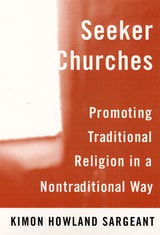
cover of Seeker Churches: Promoting Traditional Religion in a Nontraditional Way

Seeker Churches

Promoting Traditional Religion in a Nontraditional Way

Kimon Howland Sargeant

Rutgers University Press, 2000

America’s religious landscape is in flux. New churches are springing up and many older churches are redefining themselves to survive. At the forefront of this denominational free-for-all are evangelical “seeker” churches.

These churches target “seekers”—individuals of any faith or denominational background who seek spiritual fulfillment but are not currently affiliated with any specific church. By focusing on this largely untapped group, seeker churches have become one of the fastest-growing religious movements in the country. In his study, Kimon Sargeant provides a sociological context for the rise of these churches by exploring the rituals, messages, strategies, and denominational functions of this emerging form of American evangelical Protestantism. 

Featuring live bands, professional lighting and sound systems, and multi-media presentations, seeker churches are attracting many people who have “dropped out” of organized religion.  To broaden their appeal, they offer attenders advice on everyday issues ranging from relationships to finance.
Sargeant focuses on the success of the Willow Creek Association, the seeker church association started by the Willow Creek Community Church near Chicago.  With over 5,000 member churches, the seven-year old association has already outdistanced 90 percent of American denominations and is the leader of the seeker church movement.  Through eyewitness accounts and careful research, Sargeant reveals the “seeker” movement to be a “reformation” of American Protestantism.
[more]
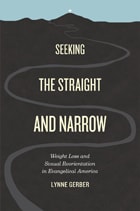
cover of Seeking the Straight and Narrow: Weight Loss and Sexual Reorientation in Evangelical America

Seeking the Straight and Narrow

Weight Loss and Sexual Reorientation in Evangelical America

Lynne Gerber

University of Chicago Press, 2011
Losing weight and changing your sexual orientation are both notoriously difficult to do successfully. Yet many faithful evangelical Christians believe that thinness and heterosexuality are godly ideals—and that God will provide reliable paths toward them for those who fall short. Seeking the Straight and Narrow is a fascinating account of the world of evangelical efforts to alter our strongest bodily desires.
 
Drawing on fieldwork at First Place, a popular Christian weight-loss program, and Exodus International, a network of ex-gay ministries, Lynne Gerber explores why some Christians feel that being fat or gay offends God, what exactly they do to lose weight or go straight, and how they make sense of the program’s results—or, frequently, their lack. Gerber notes the differences and striking parallels between the two programs, and, more broadly, she traces the ways that other social institutions have attempted to contain the excesses associated with fatness and homosexuality. Challenging narratives that place evangelicals in constant opposition to dominant American values, Gerber shows that these programs reflect the often overlooked connection between American cultural obsessions and Christian ones.
[more]
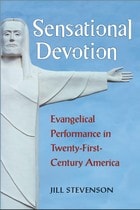
cover of Sensational Devotion: Evangelical Performance in Twenty-First-Century America

Sensational Devotion

Evangelical Performance in Twenty-First-Century America

Jill Stevenson

University of Michigan Press, 2015
Sensational Devotion examines contemporary Passion plays, biblical theme parks, Holy Land recreations, creationist museums, and megachurches in order to understand how they serve their evangelical believer-users while also shaping larger cultural and national dialogues. Jill Stevenson explores how performative media support specific theologies and core beliefs by creating sensual, live experiences for those who use them. The book explores evangelical performance across a range of media and sites, including film, television, theater, tourist attractions, museums, and places of worship. Using historical research coupled with firsthand experiences, it critically examines these spaces and events within their specific religious, cultural, and national contexts, while placing them within a long devotional tradition to suggest how they cultivate religious belief by generating vivid, sensual, affectively oriented, and individualized experiences. Stevenson’s analysis builds upon existing work on performance and cognition, as well as theories of affect, as it contributes to existing scholarship on American evangelicalism and evangelical Christian media. 
[more]
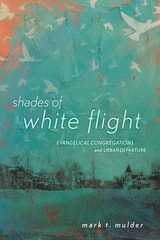
cover of Shades of White Flight: Evangelical Congregations and Urban Departure

Shades of White Flight

Evangelical Congregations and Urban Departure

Mark T. Mulder

Rutgers University Press, 2015
Since World War II, historians have analyzed a phenomenon of “white flight” plaguing the urban areas of the northern United States. One of the most interesting cases of “white flight” occurred in the Chicago neighborhoods of Englewood and Roseland, where seven entire church congregations from one denomination, the Christian Reformed Church, left the city in the 1960s and 1970s and relocated their churches to nearby suburbs. In Shades of White Flight, sociologist Mark T. Mulder investigates the migration of these Chicago church members, revealing how these churches not only failed to inhibit white flight, but actually facilitated the congregations’ departure.
 
Using a wealth of both archival and interview data, Mulder sheds light on the forces that shaped these midwestern neighborhoods and shows that, surprisingly, evangelical religion fostered both segregation as well as the decline of urban stability. Indeed, the Roseland and Englewood stories show how religion—often used to foster community and social connectedness—can sometimes help to disintegrate neighborhoods. Mulder describes how the Dutch CRC formed an insular social circle that focused on the local church and Christian school—instead of the local park or square or market—as the center point of the community. Rather than embrace the larger community, the CRC subculture sheltered themselves and their families within these two places. Thus it became relatively easy—when black families moved into the neighborhood—to sell the church and school and relocate in the suburbs. This is especially true because, in these congregations, authority rested at the local church level and in fact they owned the buildings themselves. 
 
Revealing how a dominant form of evangelical church polity—congregationalism—functioned within the larger phenomenon of white flight, Shades of White Flight lends new insights into the role of religion and how it can affect social change, not always for the better. 
 
 
[more]
cover of Shaking the World for Jesus: Media and Conservative Evangelical Culture

Shaking the World for Jesus

Media and Conservative Evangelical Culture

Heather Hendershot

University of Chicago Press, 2004

In 1999, the Reverend Jerry Falwell outed Tinky-Winky, the purple character from TV's Teletubbies. Events such as this reinforced in many quarters the common idea that evangelicals are reactionary, out of touch, and just plain paranoid. But reducing evangelicals to such caricatures does not help us understand their true spiritual and political agendas and the means they use to advance them. Shaking the World for Jesus moves beyond sensationalism to consider how the evangelical movement has effectively targeted Americans—as both converts and consumers—since the 1970s.

Thousands of products promoting the Christian faith are sold to millions of consumers each year through the Web, mail order catalogs, and even national chains such as Kmart and Wal-Mart. Heather Hendershot explores in this book the vast industry of film, video, magazines, and kitsch that evangelicals use to spread their message. Focusing on the center of conservative evangelical culture—the white, middle-class Americans who can afford to buy "Christian lifestyle" products—she examines the industrial history of evangelist media, the curious subtleties of the products themselves, and their success in the religious and secular marketplace.

To garner a wider audience, Hendershot argues, evangelicals have had to carefully temper their message. But in so doing, they have painted themselves into a corner. In the postwar years, evangelical media wore the message of salvation on its sleeve, but as the evangelical media industry has grown, many of its most popular products have been those with heavily diluted Christian messages. In the eyes of many followers, the evangelicals who purvey such products are sellouts—hucksters more interested in making money than spreading the word of God.

Working to understand evangelicalism rather than pass judgment on it, Shaking the World for Jesus offers a penetrating glimpse into a thriving religious phenomenon.
[more]
cover of Sin in the City: Chicago and Revivalism, 1880-1920

Sin in the City

Chicago and Revivalism, 1880-1920

Thekla Ellen Joiner

University of Missouri Press, 2013

  Long before today’s culture wars, the “Third Great Awakening” rocked America. During the late nineteenth and early twentieth centuries, evangelists such as Dwight L. Moody and Billy Sunday roused citizens to renounce sin as it manifested in popular culture, moral ambiguity, and the changing role of women.

            Sin in the City examines three urban revivals in turn-of-the-century Chicago to show how revivalists negotiated that era’s perceived racial, sexual, and class threats. While most studies of this movement have focused on its male leaders and their interactions with society, Thekla Ellen Joiner raises new questions about gender and race by exploring Third Awakening revivalism as the ritualized performance of an evangelical social system defined by middle-class Protestant moral aspirations for urban America. Rather than approaching these events merely as the achievements of persuasive men, she views them as choreographed collective rituals reinforcing a moral order defined by ideals of femininity, masculinity, and racial purity.

            Joiner reveals how revivalist rhetoric and ritual shifted from sentimentalist identification of sin with males to a more hard-nosed focus on females, castigating “loose women” whose economic and sexual independence defied revivalist ideals and its civic culture. She focuses on Dwight L. Moody’s 1893 World’s Fair revival, the 1910 Chapman-Alexander campaign, and the 1918 Billy Sunday revival, comparing the locations, organization, messages, and leaders of these three events to depict the shift from masculinized to feminized sin. She identifies the central role women played in the Third Awakening as the revivalists promoted feminine virtue as the corrective to America’s urban decline. She also shows that even as its definition of sin became more feminized, Billy Sunday’s revivalism began to conform to Chicago’s emerging color line.

            Enraged by rapid social change in cities like Chicago, these preachers spurred Protestant evangelicals to formulate a gendered and racialized moral regime for urban America. Yet, as Joiner shows, even as revivalists demonized new forms of entertainment, they used many of the modern cultural practices popularized in theaters and nickelodeons to boost the success of their mass conversions.

            Sin in the City shows that the legacy of the Third Awakening lives on today in the religious right’s sociopolitical activism; crusade for family values; disparagement of feminism; and promotion of spirituality in middle-class, racial, and cultural terms. Providing cultural and gender analysis too often lacking in the study of American religious history, it offers a new model for understanding the development of a gendered theology and set of religious practices that influenced Protestantism in a period of enormous social change.
[more]
cover of Sins of Christendom: Anti-Mormonism and the Making of Evangelicalism

Sins of Christendom

Anti-Mormonism and the Making of Evangelicalism

Nathaniel Wiewora

University of Illinois Press, 2024
Evangelical criticism of the Church of Jesus Christ of Latter-day Saints dates back to the earliest days of the Church. Nathaniel Wiewora uses the diverse animus expressed by evangelicals to illuminate how they used an imaginary Church as a proxy to disagree, attack, compromise, and settle differences among themselves. As Wiewora shows, the evangelical practice to contrast itself with the emerging faith not only encompassed but also went beyond religious matters. If Joseph Smith was accused of muddling religious truth, he and his followers also faced accusations of immoral economic practices and a sinful regard for wealth that reflected worries within the evangelical world. Attacks on Latter-day Saints’ emotional religious displays, the Book of Mormon’s authenticity, and the dangerous ideas represented by Nauvoo paralleled similar conflicts. Wiewora traces how the failure to blunt the Church’s success led evangelicals to change their own methods and pursue the religious education infrastructure that came to define parts of the movement.
[more]
cover of Stained Glass Ceilings: How Evangelicals Do Gender and Practice Power

Stained Glass Ceilings

How Evangelicals Do Gender and Practice Power

Lisa Weaver Swartz

Rutgers University Press, 2023
Stained Glass Ceilings speaks to the intersection of gender and power within American evangelicalism by examining the formation of evangelical leaders in two seminary communities.Southern Baptist Theological Seminary inspires a vision of human flourishing through gender differentiation and male headship. Men practice “Godly Manhood," and are taught to act as the "head" of a family, while their wives are socialized into codes of “Godly Womanhood" that prioritize prescribed gender roles. This power structure privileges men yet offers agency to their wives in women-centered spaces and through marital relationships. Meanwhile, Asbury Theological Seminary promises freedom from gendered hierarchies. Appealing to a story of gender-blind equality, Asbury welcomes women into classrooms, administrative offices, and pulpits. But the institution’s construction of egalitarianism obscures the fact that women are rewarded for adapting to an existing male-centered status quo rather than for developing their own voices as women. Featuring high-profile evangelicals such as Al Mohler and Owen Strachan, along with young seminarians poised to lead the movement in the coming decades, Stained Glass Ceilings illustrates the liabilities of white evangelical toolkits and argues that evangelical culture upholds male-centered structures of power even as it facilitates meaning and identity.
[more]
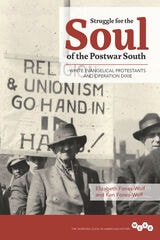
cover of Struggle for the Soul of the Postwar South: White Evangelical Protestants and Operation Dixie

Struggle for the Soul of the Postwar South

White Evangelical Protestants and Operation Dixie

Elizabeth Fones-Wolf and Ken Fones-Wolf

University of Illinois Press, 2015

In 1946, the Congress of Industrial Organizations (CIO) undertook Operation Dixie, an initiative to recruit industrial workers in the American South. Elizabeth and Ken Fones-Wolf plumb rarely used archival sources and rich oral histories to explore the CIO's fraught encounter with the evangelical Protestantism and religious culture of southern whites.
 
The authors' nuanced look at working class religion reveals how laborers across the surprisingly wide evangelical spectrum interpreted their lives through their faith. Factors like conscience, community need, and lived experience led individual preachers to become union activists and mill villagers to defy the foreman and minister alike to listen to organizers. As the authors show, however, all sides enlisted belief in the battle. In the end, the inability of northern organizers to overcome the suspicion with which many evangelicals viewed modernity played a key role in Operation Dixie's failure, with repercussions for labor and liberalism that are still being felt today.
 
Identifying the role of the sacred in the struggle for southern economic justice, and placing class as a central aspect in southern religion, Struggle for the Soul of the Postwar South provides new understandings of how whites in the region wrestled with the options available to them during a crucial period of change and possibility.
[more]