Results by title
79 books match the query 'Evolution (Biology)' and 5 start with s
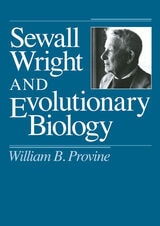
Sewall Wright and Evolutionary Biology
William B. Provine
University of Chicago Press, 1986
"Provine's thorough and thoroughly admirable examination of Wright's life and influence, which is accompanied by a very useful collection of Wright's papers on evolution, is the best we have for any recent figure in evolutionary biology."—Joe Felsenstein, Nature
"In Sewall Wright and Evolutionary Biology . . . Provine has produced an intellectual biography which serves to chart in considerable detail both the life and work of one man and the history of evolutionary theory in the middle half of this century. Provine is admirably suited to his task. . . . The resulting book is clearly a labour of love which will be of great interest to those who have a mature interest in the history of evolutionary theory."-John Durant, ;ITimes Higher Education Supplement;X
"In Sewall Wright and Evolutionary Biology . . . Provine has produced an intellectual biography which serves to chart in considerable detail both the life and work of one man and the history of evolutionary theory in the middle half of this century. Provine is admirably suited to his task. . . . The resulting book is clearly a labour of love which will be of great interest to those who have a mature interest in the history of evolutionary theory."-John Durant, ;ITimes Higher Education Supplement;X
[more]
Shaking the Tree
Readings from Nature in the History of LifeEdited by Henry Gee
University of Chicago Press, 2000
Nature has published news about the history of life ever since its first issue in 1869, in which T. H. Huxley ("Darwin's bulldog") wrote about Triassic dinosaurs. In recent years, the field has enjoyed a tremendous flowering due to new investigative techniques drawn from cladistics (a revolutionary method for charting evolutionary relationships) and molecular biology.
Shaking the Tree brings together nineteen review articles written for Nature over the past decade by many of the major figures in paleontology and evolution, from Stephen Jay Gould to Simon Conway Morris. Each article is brief, accessible, and opinionated, providing "shoot from the hip" accounts of the latest news and debates. Topics covered include major extinction events, homeotic genes and body plans, the origin and evolution of the primates, and reconstructions of phylogenetic trees for a wide variety of groups. The editor, Henry Gee, gives new commentary and updated references.
Shaking the Tree is a one-stop resource for engaging overviews of the latest research in the history of life on Earth.
[more]

Snakes, Sunrises, and Shakespeare
How Evolution Shapes Our Loves and FearsGordon H. Orians
University of Chicago Press, 2014
Our breath catches and we jump in fear at the sight of a snake. We pause and marvel at the sublime beauty of a sunrise. These reactions are no accident; in fact, many of our human responses to nature are steeped in our deep evolutionary past—we fear snakes because of the danger of venom or constriction, and we welcome the assurances of the sunrise as the predatory dangers of the dark night disappear. Many of our aesthetic preferences—from the kinds of gardens we build to the foods we enjoy and the entertainment we seek—are the lingering result of natural selection.
In this ambitious and unusual work, evolutionary biologist Gordon H. Orians explores the role of evolution in human responses to the environment, beginning with why we have emotions and ending with evolutionary approaches to aesthetics. Orians reveals how our emotional lives today are shaped by decisions our ancestors made centuries ago on African savannas as they selected places to live, sought food and safety, and socialized in small hunter-gatherer groups. During this time our likes and dislikes became wired in our brains, as the appropriate responses to the environment meant the difference between survival or death. His rich analysis explains why we mimic the tropical savannas of our ancestors in our parks and gardens, why we are simultaneously attracted to danger and approach it cautiously, and how paying close attention to nature’s sounds has resulted in us being an unusually musical species. We also learn why we have developed discriminating palates for wine, and why we have strong reactions to some odors, and why we enjoy classifying almost everything.
By applying biological perspectives ranging from Darwin to current neuroscience to analyses of our aesthetic preferences for landscapes, sounds, smells, plants, and animals, Snakes, Sunrises, and Shakespeare transforms how we view our experience of the natural world and how we relate to each other.
[more]
Somatic Selection and Adaptive Evolution
On the Inheritance of Acquired CharactersE. J. Steele
University of Chicago Press, 1981
If the thesis advanced in this book can be corroborated by experiments currently being carried out in a number of laboratories around the world, it will signify an intellectual revolution and a landmark in the history of science. E. J. Steele here suggests that on the basis of his own immunological research, the theory originally put forward by Lamarck 170 years ago and subsequently rejected—the notion that organisms may transmit characters acquired in their lifetimes to their offspring—may in fact be right. In the new postscript to the second edition, Steele presents his latest findings and replies to the enormous body of criticism his research has engendered.
[more]
Species and Speciation in the Fossil Record
Edited by Warren D. Allmon and Margaret M. Yacobucci
University of Chicago Press, 2016
Although the species is one of the fundamental units of biological classification, there is remarkably little consensus among biologists about what defines a species, even within distinct sub-disciplines. The literature of paleobiology, in particular, is littered with qualifiers and cautions about applying the term to the fossil record or equating such species with those recognized among living organisms. In Species and Speciation in the Fossil Record, experts in the field examine how they conceive of species of fossil animals and consider the implications these different approaches have for thinking about species in the context of macroevolution.
After outlining views of the Modern Synthesis of evolutionary disciplines and detailing the development within paleobiology of quantitative methods for documenting and analyzing variation within fossil assemblages, contributors explore the challenges of recognizing and defining species from fossil specimens—and offer potential solutions. Addressing both the tempo and mode of speciation over time, they show how with careful interpretation and a clear species concept, fossil species may be sufficiently robust for meaningful paleobiological analyses. Indeed, they demonstrate that the species concept, if more refined, could unearth a wealth of information about the interplay between species origins and extinctions, between local and global climate change, and greatly deepen our understanding of the evolution of life.
After outlining views of the Modern Synthesis of evolutionary disciplines and detailing the development within paleobiology of quantitative methods for documenting and analyzing variation within fossil assemblages, contributors explore the challenges of recognizing and defining species from fossil specimens—and offer potential solutions. Addressing both the tempo and mode of speciation over time, they show how with careful interpretation and a clear species concept, fossil species may be sufficiently robust for meaningful paleobiological analyses. Indeed, they demonstrate that the species concept, if more refined, could unearth a wealth of information about the interplay between species origins and extinctions, between local and global climate change, and greatly deepen our understanding of the evolution of life.
[more]