Results by title
128 books match the query 'Feminism and literature' and 5 start with s

Scenes of Instruction
A MemoirMichael Awkward
Duke University Press, 1999
With a recurring focus on how his mother’s tragic weaknesses and her compelling strengths affected his development, Awkward intersperses the chronologically arranged autobiographical sections with ruminations on his own interests in literary and cultural criticism. As a male scholar who has come under fire for describing himself as a feminist critic, he reflects on such issues as identity politics and the politics of academia, affirmative action, and the Million Man March.
By connecting his personal experiences with larger political, cultural, and professional questions, Awkward uses his life as a palette on which to blend equations of race and reading, urbanity and mutilation, alcoholism, pain, gender, learning, sex, literature, and love.

Simone de Beauvoir’s Political Thinking
Edited by Lori Jo Marso and Patricia Moynagh
University of Illinois Press, 2006
By exploring the life and work of the influential feminist thinker Simone de Beauvoir, this book shows how each of us lives within political and social structures that we can--and must--play a part in transforming. It argues that Beauvoir’s careful examination of her own existence can also be understood as a dynamic method for political thinking.
As the contributors illustrate, Beauvoir's political thinking proceeds from the bottom up, using examples from individual lives as the basis for understanding and transforming our collective existence. For example, she embraced her responsibility as a French citizen as making her complicit in the French war against Algeria. Here, she sees her role as an oppressor. In other contexts, she looks to the lives of individual women, including herself, to understand the dimensions of gender inequality.
This volume’s six tightly connected essays home in on the individual’s relationship to community, and how one’s freedom interacts with the freedom of other people. Here, Beauvoir is read as neither a liberal nor a communitarian. The authors focus on her call for individuals to realize their freedom while remaining consistent with ethical obligations to the community. Beauvoir's account of her own life and the lives of others is interpreted as a method to understand individuals in relations to others, and as within structures of personal, material, and political oppression. Beauvoir's political thinking makes it clear that we cannot avoid political action. To do nothing in the face of oppression denies freedom to everyone, including oneself.
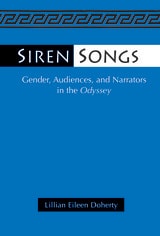
Siren Songs
Gender, Audiences, and Narrators in the OdysseyLillian Eileen Doherty
University of Michigan Press, 1995
Siren Songs synthesizes audience-oriented and narratological approaches, and examines the relationships among three kinds of audiences: internal, implied, and actual. The author prefaces her own reading of the Odyssey with an analysis of the issues posed by the earlier feminist readings on which she builds. Should the Odyssey be read as a "closed" text, that is, as one whose meaning is highly determined, or as an "open" text whose contradictions and ambiguities undercut its overt meanings?
Siren Songs presents a feminist critique of the Odyssey in an accessible manner aimed at a more general audience. All Greek is translated, and critical terminology is clearly defined.
Lillian Eileen Doherty is Associate Professor of Classics, University of Maryland, College Park.
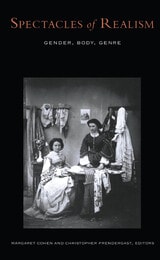
Spectacles Of Realism
Gender, Body, GenreMargaret Cohen
University of Minnesota Press, 1995
A rethinking of realism that reveals its relevance to sexual and cultural politics.
Despite rumors of its demise in literary theory and practice, realism persists. Why this is, and how realism is relevant to current interdisciplinary debates in gender studies and cultural studies, are the questions underlying Spectacles of Realism. With particular reference to nineteenth-century French culture, the contributors explore the role realism has played in the social construction of gender and sexuality. Among their subjects are nineteenth-century physiologies, photographs, caricatures, and Balzac’s Comédie humaine; the ethnographic claims of Goncourt’s naturalism and the historical claims of Zola’s; and the allure of exotica displayed at new museums and international expositions.
Contributors: April Alliston, Princeton U; Emily Apter, UCLA; Charles Bernheimer, U of Pennsylvania; Rhonda Garelick; Judith Goldstein, Vassar; Anne Higonnet, Wellesley; Roger Huss, Queen Mary and Westfield College; Dorothy Kelly, Boston U; Diana Knight, U of Nottingham; Jann Matlock, Harvard U; Linda Nochlin, NYU; Patrick O’Donovan, King’s College; Vanessa Schwartz, American U; Naomi Segal, U of Reading; Barbara Vinken, NYU.
Starting Over
Feminism and the Politics of Cultural CritiqueJudith Newton
University of Michigan Press, 1994