Results by title
183 books match the query 'Feminist' and 13 start with s
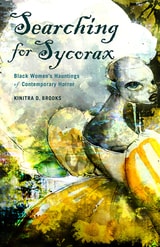
Searching for Sycorax
Black Women's Hauntings of Contemporary HorrorBrooks, Kinitra D
Rutgers University Press, 2018
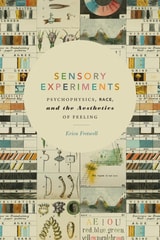
Sensory Experiments
Psychophysics, Race, and the Aesthetics of FeelingErica Fretwell
Duke University Press, 2020
Separate Spheres No More
Gender Convergence in American Literature, 1830-1930Monika Elbert
University of Alabama Press, 2000
Examines the intersection of male and female spheres in American literature
Although they wrote in the same historical milieu as their male counterparts, women writers of the 19th- and early 20th-centuries have generally been "ghettoized" by critics into a separate canonical sphere. These original essays argue in favor of reconciling male and female writers, both historically and in the context of classroom teaching.
While some of the essays pair up female and male authors who write in a similar style or with similar concerns, others address social issues shared by both men and women, including class tensions, economic problems, and the Civil War experience. Rather than privileging particular genres or certain well-known writers, the contributors examine writings ranging from novels and poetry to autobiography, utopian fiction, and essays. And they consider familiar figures like Harriet Beecher Stowe, Emily Dickinson, and Ralph Waldo Emerson alongside such lesser-known writers as Melusina Fay Peirce, Susie King Taylor, and Mary Gove Nichols.
Each essay revises the binary notions that have been ascribed to males and females, such as public and private, rational and intuitive, political and domestic, violent and passive. Although they do not deny the existence of separate spheres, the contributors show the boundary between them to be much more blurred than has been assumed until now.
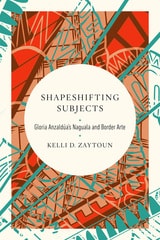
Shapeshifting Subjects
Gloria Anzaldua's Naguala and Border ArteKelli D. Zaytoun
University of Illinois Press, 2022
An original and moving analysis, Shapeshifting Subjects draws on unpublished archival material to apply Anzaldúa's ideas to new areas of thought and action.
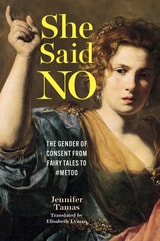
She Said No
The Gender of Consent from Fairy Tales to #MeTooJennifer Tamas
University of Delaware Press, 2027
She Said NO investigates the gender inequality in the authority to speak—and therefore to refuse—that prevailed in the establishment and interpretation of the French classics. By selecting authors deemed essential to French cultural heritage and erasing the works of women writers, this biased canon has systematically undervalued female agency—even in well-known works by both men and women, such as Beauty and the Beast, The Princess of Clèves, and "Little Red Riding Hood." With this book, Jennifer Tamas fills a striking gap in early modern French studies by conceptualizing consent in a society where being a woman made it structurally difficult to say "no." Yet, women did refuse. The history Tamas explores is one of forgotten, erased, misunderstood, or inadmissible refusals, and how they have been obscured. The #MeToo movement has brought questions of female agency and consent to the fore, and this book retraces an "archive of refusal" to serve as a source of inspiration for contemporary feminist discourse and to change our reception of the French canon.

Sleep Tight Satellite
StoriesCarol Guess
Tupelo Press, 2023

Solidarity with the Other Beings on the Planet
Alice Walker, Ecofeminism, and Animals in LiteraturePamela B. June
Northwestern University Press, 2020
Grounded in ecofeminist theory, this literary analysis examines Walker’s evolving views on animals in relation to her discussions of other oppressed groups. Pamela B. June argues that Walker’s fiction can help readers understand and perhaps challenge American culture’s mistreatment of nonhuman animals. Walker has withstood criticism for her decision to abandon vegetarianism, and this book also problematizes the slippery territory of viewing writers as moral guides. Solidarity with the Other Beings on the Planet will appeal to readers in literary studies, ecofeminist studies, African American studies, and critical animal studies.
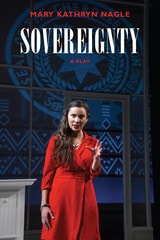
Sovereignty
A PlayMary Kathryn Nagle
Northwestern University Press, 2020
A powerful meditation of the echoes of history and the never-ending struggle for sovereignty
Sovereignty unfolds over two parallel timelines. In present-day Oklahoma, a young Cherokee lawyer, Sarah Ridge Polson, and her colleague Jim Ross defend the inherent jurisdiction of Cherokee Nation in the U.S. Supreme Court when a non-Indian defendant challenges the Nation’s authority to prosecute non-Indian perpetrators of domestic violence. Their collaboration is juxtaposed with scenes from 1835, when Cherokee Nation was eight hundred miles to the east in the southern Appalachians. That year, Sarah’s and Jim’s ancestors, historic Cherokee rivals, were bitterly divided over a proposed treaty with the administration of Andrew Jackson, the Treaty of New Echota, which led to the nation’s removal to Oklahoma on the infamous Trail of Tears.
A direct descendant of nineteenth-century Cherokee leaders John Ridge and Major Ridge, Mary Kathryn Nagle has penned a play that twists and turns from violent outbursts to healing monologues, illuminating a provocative double meaning for the sovereignty of both tribal territory and women’s bodies. Taking as its point of departure the story of one lawyer’s passionate defense of the rights of her people to prosecute non-natives who commit crimes on reservations, Sovereignty opens up into an expansive exploration of the circular continuity of history, human memory, and the power of human relationships.
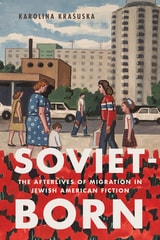
Soviet-Born
The Afterlives of Migration in Jewish American FictionKarolina Krasuska
Rutgers University Press, 2024
Entering an immigrant, Soviet-born standpoint creates an alternative and sometimes complementary pattern of how the Eastern and Central European past and present resonate with American Jewishness. The novels, short stories, and graphic novels considered here often stage strikingly fresh variations on key older themes, including cultural geography, the memory of World War II and the Holocaust, communism, gender and sexuality, genealogy, and finally, migration. Soviet-Born demonstrates how these diasporic writers, with their critical stance toward identity categories, open up the field of what is canonically Jewish American to broader contemporary debates.
This book is also freely available online as an open-access digital edition.
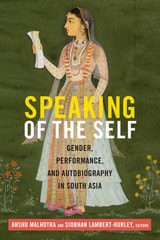
Speaking of the Self
Gender, Performance, and Autobiography in South AsiaAnshu Malhotra and Siobhan Lambert-Hurley, editors
Duke University Press, 2015
Contributors: Asiya Alam, Afshan Bokhari, Uma Chakravarti, Kathryn Hansen, Siobhan Lambert-Hurley, Anshu Malhotra, Ritu Menon, Shubhra Ray, Shweta Sachdeva Jha, Sylvia Vatuk
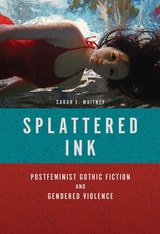
Splattered Ink
Postfeminist Gothic Fiction and Gendered ViolenceSarah E Whitney
University of Illinois Press, 2016
Sarah E. Whitney explores the genre's challenge to postfeminist assumptions of women's equality and empowerment. The authors she examines--Patricia Cornwell, Jodi Picoult, Susanna Moore, Sapphire, and Alice Sebold--construct narratives around socially invisible and physically broken protagonists who directly experience consequences of women's ongoing disempowerment. Their works ask readers to inhabit women's suffering and to face the uncomfortable, all-too-denied fact that today's women must navigate lives fraught with risk. Whitney's analysis places the authors within a female gothic tradition that has long given voice to women's fears of their own powerlessness. But she also reveals the paradox that allows the genre to powerfully critique postfeminism's often sunshiney outlook while uneasily coexisting within the same universe.
Spoiling the Stories
The Rise of Israeli Women's FictionTamar Merin
Northwestern University Press, 2016
Statistical Panic
Cultural Politics and Poetics of the EmotionsKathleen Woodward
Duke University Press, 2009
Referring discreetly to her own experience, Woodward examines the interpenetration of social structures and subjectivity, considering how psychological emotions are social phenomena, with feminist anger, racial shame, old-age depression, and sympathy for non-human cyborgs (including robots) as key cases in point. She discusses how emerging institutional and discursive structures engender “new” affects that in turn can help us understand our changing world if we are attentive to them—the “statistical panic” produced by the risk society, with its numerical portents of disease and mortality; the rage prompted by impenetrable and bloated bureaucracies; the brutal shame experienced by those caught in the crossfire of the media; and the conservative compassion that is not an emotion at all, only an empty political slogan.
The orbit of Statistical Panic is wide, drawing in feminist theory, critical phenomenology, and recent theories of the emotions. But at its heart are stories. As an antidote to the vacuous dramas of media culture, with its mock emotions and scattershot sensations, Woodward turns to the autobiographical narrative. Stories of illness—by Joan Didion, Yvonne Rainer, Paul Monette, and Alice Wexler, among others—receive special attention, with the inexhaustible emotion of grief framing the book as a whole.