70 books match the query 'Folk music' and 6 start with s
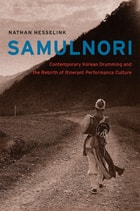
cover of SamulNori: Contemporary Korean Drumming and the Rebirth of Itinerant Performance Culture

SamulNori

Contemporary Korean Drumming and the Rebirth of Itinerant Performance Culture

Nathan Hesselink

University of Chicago Press, 2012
In 1978, four musicians crowded into a cramped basement theater in downtown Seoul, where they, for the first time, brought the rural percussive art of p’ungmul to a burgeoning urban audience. In doing so, they began a decades-long reinvention of tradition, one that would eventually create an entirely new genre of music and a national symbol for Korean culture.
                Nathan Hesselink’s SamulNori traces this reinvention through the rise of the Korean supergroup of the same name, analyzing the strategies the group employed to transform a museum-worthy musical form into something that was both contemporary and historically authentic, unveiling an intersection of traditional and modern cultures and the inevitable challenges such a mix entails. Providing everything from musical notation to a history of urban culture in South Korea to an analysis of SamulNori’s teaching materials and collaborations with Euro-American jazz quartet Red Sun, Hesselink offers a deeply researched study that highlights the need for traditions—if they are to survive—to embrace both preservation and innovation. 
[more]
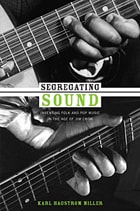
cover of Segregating Sound: Inventing Folk and Pop Music in the Age of Jim Crow

Segregating Sound

Inventing Folk and Pop Music in the Age of Jim Crow

Karl Hagstrom Miller

Duke University Press, 2010

In Segregating Sound, Karl Hagstrom Miller argues that the categories that we have inherited to think and talk about southern music bear little relation to the ways that southerners long played and heard music. Focusing on the late nineteenth century and the early twentieth, Miller chronicles how southern music—a fluid complex of sounds and styles in practice—was reduced to a series of distinct genres linked to particular racial and ethnic identities. The blues were African American. Rural white southerners played country music. By the 1920s, these depictions were touted in folk song collections and the catalogs of “race” and “hillbilly” records produced by the phonograph industry. Such links among race, region, and music were new. Black and white artists alike had played not only blues, ballads, ragtime, and string band music, but also nationally popular sentimental ballads, minstrel songs, Tin Pan Alley tunes, and Broadway hits.

In a cultural history filled with musicians, listeners, scholars, and business people, Miller describes how folklore studies and the music industry helped to create a “musical color line,” a cultural parallel to the physical color line that came to define the Jim Crow South. Segregated sound emerged slowly through the interactions of southern and northern musicians, record companies that sought to penetrate new markets across the South and the globe, and academic folklorists who attempted to tap southern music for evidence about the history of human civilization. Contending that people’s musical worlds were defined less by who they were than by the music that they heard, Miller challenges assumptions about the relation of race, music, and the market.

[more]
cover of Singing Mennonite: Low German Songs Among the Mennonites

Singing Mennonite

Low German Songs Among the Mennonites

Doreen Helen Klassen

University of Manitoba Press, 1989
[more]
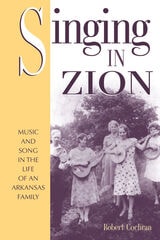
cover of Singing in Zion: Music and Song in the Life of One Arkansas Family

Singing in Zion

Music and Song in the Life of One Arkansas Family

Robert Cochran

University of Arkansas Press, 1999
This book is a lyrical, scholarly exploration of the connection between one family's musical traditions and its rural community of Zion, Arkansas. In 1959, three Gilbert sisters—Alma, Helen, and Phydella—began compiling songs they remembered as their own and sending them to one another in letters. Their tendency to center memory in sound rather than sight reveals an unusual musical birthright. Robert Cochran has constructed a composite portrait of this family for whom music is the center of life. He examines their lived experience as they anchor their history through song, singing, and the playing of musical instruments. The Gilberts are wonderful exemplars of the "mediation of oral tradition," and when approached through their music, they reveal themselves as remarkable individuals with an elaborate and firmly held sense of their unique identities. A decade in the making, Singing in Zion is written with a memoirist's sense of family history and an ethnographer's sense of the rich encounter of worlds. This narrative has a seductive simplicity that conveys much of the Gilbert family's charm while at the same time establishing a broader framework that is firmly academic. It will be enjoyed by all readers.
[more]
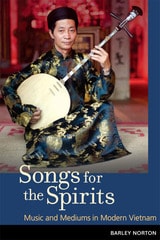
cover of Songs for the Spirits: Music and Mediums in Modern Vietnam

Songs for the Spirits

Music and Mediums in Modern Vietnam

Barley Norton

University of Illinois Press, 2008
Songs for the Spirits examines the Vietnamese practice of communing with spirits through music and performance. During rituals dedicated to a pantheon of indigenous spirits, musicians perform an elaborate sequence of songs--a "songscape"--for possessed mediums who carry out ritual actions, distribute blessed gifts to disciples, and dance to the music's infectious rhythms. Condemned by French authorities in the colonial period and prohibited by the Vietnamese Communist Party in the late 1950s, mediumship practices have undergone a strong resurgence since the early 1990s, and they are now being drawn upon to promote national identity and cultural heritage through folklorized performances of rituals on the national and international stage. By tracing the historical trajectory of traditional music and religion since the early twentieth century, this groundbreaking study offers an intriguing account of the political transformation and modernization of cultural practices over a period of dramatic and often turbulent transition. An accompanying DVD contains numerous video and music extracts that illustrate the fascinating ways in which music evokes the embodied presence of spirits and their gender and ethnic identities.
[more]
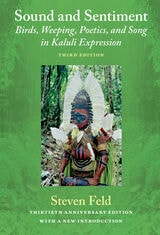
cover of Sound and Sentiment: Birds, Weeping, Poetics, and Song in Kaluli Expression, 3rd edition with a new introduction by the author

Sound and Sentiment

Birds, Weeping, Poetics, and Song in Kaluli Expression, 3rd edition with a new introduction by the author

Steven Feld

Duke University Press, 2012

This thirtieth anniversary edition of Sound and Sentiment makes Steven Feld's landmark, field-defining book available to a new generation of scholars and students. A sensory ethnography set in the rain forest of Papua New Guinea, among the Kaluli people of Bosavi, Sound and Sentiment introduced the anthropology of sound, or the cultural study of sound. After it was first published in 1982, a second edition, incorporating additional field research and a new postscript, was released in 1990. The third edition includes all of the material from the first two editions, along with a substantial new introduction in which Feld discusses Bosavi's recent history and reflects on the challenges it poses for contemporary theory and representation.
[more]