Results by title
107 books match the query 'Form' and 7 start with s
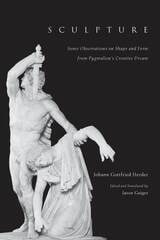
Sculpture
Some Observations on Shape and Form from Pygmalion's Creative DreamJohann Gottfried Herder
University of Chicago Press, 2002
Long recognized as one of the most important eighteenth-century works on aesthetics and the visual arts, Johann Gottfried Herder's Plastik (Sculpture, 1778) has never before appeared in a complete English translation. In this landmark essay, Herder combines rationalist and empiricist thought with a wide range of sources—from the classics to Norse legend, Shakespeare to the Bible—to illuminate the ways we experience sculpture.
Standing on the fault line between classicism and romanticism, Herder draws most of his examples from classical sculpture, while nevertheless insisting on the historicity of art and of the senses themselves. Through a detailed analysis of the differences between painting and sculpture, he develops a powerful critique of the dominance of vision both in the appreciation of art and in our everyday apprehension of the world around us. One of the key articulations of the aesthetics of Sturm und Drang, Sculpture is also important as an anticipation of subsequent developments in art theory.
Jason Gaiger's translation of Sculpture includes an extensive introduction to Herder's thought, explanatory notes, and illustrations of all the sculptures discussed in the text.
Seeing MAD
Essays on MAD Magazine's Humor and LegacyJudith Yaross Lee
University of Missouri Press, 2021
Mad magazine stands near the heart of post-WWII American humor, but at the periphery in scholarly recognition from American cultural historians, including humor specialists. This book fills that gap, with perceptive, informed, engaging, but also funny essays by a variety of scholars. The chapters, written by experts on humor, comics, and popular culture, cover the genesis of Mad; its editors and prominent contributors; its regular features and departments and standout examples of their contents; perspectives on its cultural and political significance; and its enduring legacy in American culture.
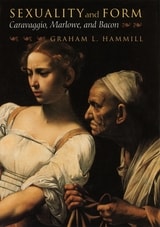
Sexuality and Form
Caravaggio, Marlowe, and BaconGraham Hammill
University of Chicago Press, 2000
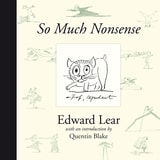
So Much Nonsense
Edward Lear
Bodleian Library Publishing, 2007
Which they ate with a runcible spoon;
And hand in hand, on the edge of the sand,
They danced by the light of the moon,
The moon,
The moon,
They danced by the light of the moon.
The Owl and the Pussycat is only the most familiar of Edward Lear’s numerous nonsense verses, which have delighted millions worldwide for the last two centuries. Now his beloved verse and drawings are compiled here in a handsomely produced volume of classic material.
Leariana runs rampant in this enchanting treasury; readers encounter such indelible Lear creations as “snail mail,” while drawings of the Stripy Bird and images of the heroic and irrepressible Foss in heraldic poses are scattered throughout. Lear’s zany illustrations are reproduced here in their full vibrancy, and the goofily delightful art, including his illustrated nonsense alphabets, infuses Lear’s fanciful phrases and humorously incomprehensible limericks with their original liveliness and irresistible spirit. Rarely has the powerful charm and timeless appeal of Edward Lear’s work been available in such a beautifully produced edition, and So Much Nonsense is a gift that will unleash the imaginations of young and old alike.
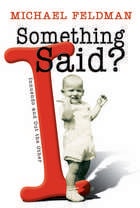
Something I Said?
Innuendo and Out the OtherMichael Feldman
University of Wisconsin Press, 2004
What we have here is another mighty slim volume from Michael Feldman, best known (when known at all) for his public radio show "Whad'ya Know" (sic). Feldman, who spouts off about things he knows "not much" about weekly, here writes them down:
· how to get your own radio show and what you can do with it once you do
· paranoia
· marriage (or as Feldman likes to refer to it, "a long-term bad relationship")
· Hitler
· SUVs
· child-rearing (although it sounds like it's the author who is being reared)
· a number of short pieces on places he and his crew have visited for their "remote possibilities"
· more references to "gentiles" than absolutely necessary (seems to be an issue for Feldman, although he is tickled with the
notion that, to a Mormon, he is one)
· some attempts to misrepresent scientific or social research for humorous purposes
· many personal revelations that prove the examined life is not necessarily worth living either
· and pages and pages of fluff.
Mr. Feldman has not been compared, to our knowledge, to S. J. Perlman.
But here is some of what Michael Feldman says in Something I Said:
"The paranoid no longer is: paranoia has outlived its usefulness when everybody is out to get us."
"Take the phrase 'no problem': I can use it, although it is the very opposite of my two-word world view ('Nothing works')."
"Whatever latitude beauty may have in the eye of the beholder, funny is not readily apparent to all, and, who knows, they may be right. More importantly, they may be bigger."
Includes a music CD by Michael Feldman and John Sieger.
Sound and Form in Modern Poetry
A Study of Prosody from Thomas Hardy to Robert LowellHarvey Gross
University of Michigan Press, 1964
Sound and Form in Modern Poetry
Second EditionHarvey Gross and Robert McDowell
University of Michigan Press, 1996
Poet, critic, and editor Robert McDowell has updated this classic text in the light of the poetic and critical developments of the last three decades. Segments on Dickinson, Robinson, Frost, Jeffers, and Lowell, among other poets, have been greatly expanded, and Ashbery, Creeley, Ginsberg, Hall, Kees, Kumin, Levertov, Levine, O'Hara, Plath, Rich, Simpson, and Wilbur added, among others. The epilogue discusses a new generation of poets whose works will likely be read well into the next century-- among others, Thomas M. Disch, Rita Dove, Dana Gioia, Emily Grosholz, Mark Jarman, Molly Peacock, Gjertrud Schnackenberg, Timothy Steele, Mary Swander, and Marilyn Nelson Waniek.
Over the last ten years, the most inspiring topic of conversation and argument among poets and their readers has been the resurgence of narrative and traditional forms. The new Sound and Form in Modern Poetry is a seminal text in this discussion, examining not only this movement but all of the important developments (Dadaism, Surrealism, Imagism, Language Poetry, and the Confessional School) that have defined our poetry in the twentieth century and have set the stage for poetry's continued life in the twenty-first. The original Sound and Form in Modern Poetry enjoyed extensive classroom use as a text; the revised version promises to be even more accessible, and more essential, for years to come.
The late Harvey Gross was Professor of Comparative Literature, State University of New York at Stony Brook.
Robert McDowell is publisher and editor of Story Line Press, and is also poet, critic, translator, fiction writer, and essayist.