Results by title
147 books match the query 'Freedom' and 5 start with s

Sailing to Freedom
Maritime Dimensions of the Underground RailroadEdited by Timothy D. Walker
University of Massachusetts Press, 2021
With innovative scholarship and thorough research, Sailing to Freedom highlights little-known stories and describes the less-understood maritime side of the Underground Railroad, including the impact of African Americans' paid and unpaid waterfront labor. These ten essays reconsider and contextualize how escapes were managed along the East Coast, moving from the Carolinas, Virginia, and Maryland to safe harbor in northern cities such as Philadelphia, New York, New Bedford, and Boston.
In addition to the volume editor, contributors include David S. Cecelski, Elysa Engelman, Kathryn Grover, Megan Jeffreys, Cheryl Janifer LaRoche, Mirelle Luecke, Cassandra Newby-Alexander, Michael D. Thompson, and Len Travers.
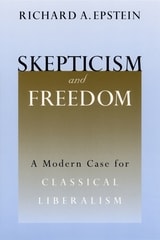
Skepticism and Freedom
A Modern Case for Classical LiberalismRichard A. Epstein
University of Chicago Press, 2003
He begins by laying out his own vision of the key principles of classical liberalism: respect for the autonomy of the individual, a strong system of private property rights, the voluntary exchange of labor and possessions, and prohibitions against force or fraud. Nonetheless, he not only recognizes but insists that state coercion is crucial to safeguarding these principles of private ordering and supplying the social infrastructure on which they depend. Within this framework, Epstein then shows why limited government is much to be preferred over the modern interventionist welfare state.
Many of the modern attacks on the classical liberal system seek to undermine the moral, conceptual, cognitive, and psychological foundations on which it rests. Epstein rises to this challenge by carefully rebutting each of these objections in turn. For instance, Epstein demonstrates how our inability to judge the preferences of others means we should respect their liberty of choice regarding their own lives. And he points out the flaws in behavioral economic arguments which, overlooking strong evolutionary pressures, claim that individual preferences are unstable and that people are unable to adopt rational means to achieve their own ends. Freedom, Epstein ultimately shows, depends upon a skepticism that rightly shuns making judgments about what is best for individuals, but that also avoids the relativistic trap that all judgments about our political institutions have equal worth.
A brilliant defense of classical liberalism, Skepticism and Freedom will rightly be seen as an intellectual landmark.
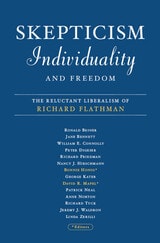
Skepticism, Individuality, and Freedom
The Reluctant Liberalism Of Richard FlathmanBonnie Honig
University of Minnesota Press, 2002
Major thinkers grapple with the challenge of this renowned liberal thinker.
As one of liberal theory’s most important gadflies, Richard Flathman has during the past four decades produced a significant body of work that is iconoclastic, idiosyncratic, and increasingly influential. Flathman criticizes liberal theory’s role in justifying a politics of governance that has drifted substantially from liberalism’s central commitments to individuality and freedom. It is this challenge, and its implications for the future of liberal theory, that brings together the diverse and distinguished authors of this volume. Topics include the relationships between theory and practice, skepticism and knowledge, individuality and egoism, negative and positive freedom, Hobbes and liberalism, as well as the uneasy connections among liberalism, feminism, and democratic politics.
Contributors: Ronald Beiner, U of Toronto; Jane Bennett, Goucher; William E. Connolly, Johns Hopkins; Peter Digeser, U of California, Santa Barbara; Richard Friedman, SUNY, Buffalo; Nancy J. Hirschmann, Cornell; George Kateb, Princeton; Patrick Neal, U of Vermont; Anne Norton, U of Pennsylvania; Richard Tuck, Harvard; Jeremy J. Waldron, Columbia; Linda Zerilli, Northwestern.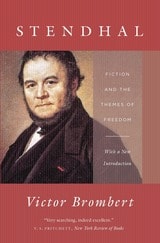
Stendhal
Fiction and the Themes of FreedomVictor Brombert
University of Chicago Press, 2017
For Brombert, Stendhal’s work is deeply personal; elsewhere, he has written about the myriad connections between Stendhal’s ironic inquiries into identity and his own boyhood in France on the brink of World War II. Proceeding via careful and nuanced readings of passages from Stendhal’s fiction and autobiography, Brombert pays particular attention to style, tone, and meaning. Paradoxically, Stendhal’s heroes often feel most free when in prison, and in a statement of stunning relevance for our contemporary world, Brombert contends that Stendhal is far clearer than any writer before him on the “crisis and contradictions of modern humanism that . . . render political freedom illusory.” Featuring a new introduction in which Brombert explores his earliest encounters with Stendhal—the beginnings of his “affair” during a year spent as a Fulbright scholar in Rome—Stendhal remains a spirited, elegant, and resonant account.

Surge to Freedom
The End of Communist Rule in Eastern EuropeJ. F. Brown
Duke University Press, 1991
"Nobody has yet produced a more perceptive and inclusive work on the events of what is arguably the most important year of our lifetimes. This book is essential for anyone with an interest in Eastern Europe, radical social change, or post-bipolar global politics."—Joel M. Jenswold, Social Science Quarterly
"Brown has been a close observer of the region for decades, and the breadth of his knowledge and the acuity of his judgments are evident throughout."—Michael Bernhard, Political Science Quarterly
"There is no surer guide than Brown to an understanding of these events, and no one better qualified to describe the complex and daunting problems facing the new non-communist governments."—John C. Campbell, Foreign Affairs