Results by title
54 books match the query 'Freedom of speech' and 7 start with s

SLAPPs
Getting Sued for Speaking OutGeorge Pring
Temple University Press, 1996
In a democracy that for over 200 years has prided itself on public participation and citizen involvement in government, thousands have been and will be the targets of multi-million-dollar lawsuits. They will be sued for such "all-American" activities as circulating a petition, writing a letter to the editor, testifying at a public hearing, reporting violations of the law, filing an official complaint, lobbying for legislation, or otherwise communicating their views. Such cases, named "Strategic Lawsuits Against Public Participation," with their apropos acronym, SLAPPs, are a shocking abuse of one of our most basic political rights—the Right to Petition. So extensive and grievous is the phenomenon that Justice Nicholas Colabella remarked, "Short of a gun to the head, a greater threat to First Amendment expression can scarcely be imagined."
George W. Pring and Penelope Canan explore the full range of SLAPP stories in this first study of SLAPPs— retaliatory lawsuits by real estate developers; teachers; police; politicians; opponents of civil rights; consumers' rights; women's rights; and many others. This comprehensive book examines what happens to the targets of SLAPPs and what is happening to public participation in American politics. Addressing the ultimate dilemma—what can be done to turn the tables and fight back—Pring and Canan offer concrete, well-supported, balanced solutions for preventing, managing, and curing SLAPPs at all levels of government.
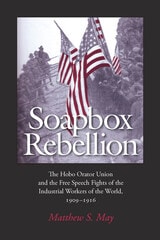
Soapbox Rebellion
The Hobo Orator Union and the Free Speech Fights of the Industrial Workers of the World, 1909-1916Matthew S. May
University of Alabama Press, 2013
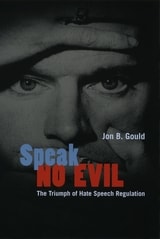
Speak No Evil
The Triumph of Hate Speech RegulationJon B. Gould
University of Chicago Press, 2005
Although college speech codes have been overturned by the courts, Speak No Evil argues that their rise has still had a profound influence on curtailing speech in other institutions such as the media and has also shaped mass opinion and common understandings of constitutional norms. Ultimately, Gould contends, this kind of informal law can have just as much power as the Constitution.
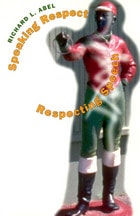
Speaking Respect, Respecting Speech
Richard L. Abel
University of Chicago Press, 1998
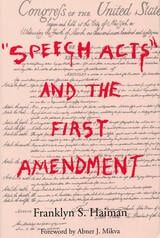
Speech Acts and the First Amendment
Franklyn S. Haiman. Foreword by Abner J. Mikva
Southern Illinois University Press, 1993
What can a democratic society reasonably do about the perplexing problems of racial intolerance, sexual harassment, incitements to violence, and invasions of privacy? Is it possible to preserve the constitutional ideal of free expression while protecting the community from those who would trample on the rights of others?
Franklyn S. Haiman critically examines the reasoning behind recent efforts to prohibit certain forms of speech and explores the possible consequences to democracy of such moves.
Speech act theory, well known to scholars of rhetoric, communication, and language, underlies this emerging trend in judicial and legislative thinking. The idea that "words are deeds," first articulated in language philosophy by Wittgenstein and elaborated by J. L. Austin and John Searle, is being invoked by some members of the legal community to target objectionable speech. For example, speech codes on some college campuses prohibit racist, sexist, and homophobic expression, and attempts have been made through local laws to classify pornography as a form of sex discrimination. By defining certain kinds of arguably immoral symbolic behavior such as hate speech, obscenity, or portrayals of violence as acts rather than as pure speech, speech act advocates make it easier to argue that such conduct should be subject to social control through the law.
Unlike totalitarian or theocratic societies that see no difference between their concept of morality and the law, however, a democracy must make a distinction between what it regards as immoral and what it makes illegal. Haiman maintains that in the realm of symbolic behavior the line between them should be drawn as closely as possible to expression that results in the most serious, direct, immediate, and physical harm to others. Thus, he joins with former Supreme Court Justice Louis Brandeis in concluding that, absent an emergency, more speech, not enforced silence, should be the aim of a free society.
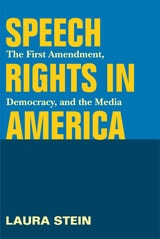
Speech Rights in America
The First Amendment, Democracy, and the MediaLaura Stein
University of Illinois Press, 2005
The First Amendment is the principle guarantor of speech rights in the United States. But the Supreme Court's interpretations of it often privilege the interests of media owners over those of the broader citizenry.
Laura Stein argues that such rulings alienate citizens from their rights, corrupt the essential workings of democracy, and prevent the First Amendment from performing its critical role as a protector of free speech. Drawing on the best of the liberal democratic tradition, Stein demonstrates that there is a significant gap between First Amendment law and the speech rights necessary to democratic communication, and proposes an alternative set of principles to guide future judicial, legislative, and cultural policy on old and new media.

Studies into Darkness
The Perils and Promise of Freedom of SpeechEdited by Carin Kuoni and Laura Raicovich
Amherst College Press, 2022
Contributions by Zach Blas, Mark Bray, Natalie Diaz, Aruna D’Souza, Silvia Federici and Gabriela López Dena, Jeanne van Heeswijk, shawné michaelain holloway, Prathibha Kanakamedala and Obden Mondésir, Amar Kanwar, Carin Kuoni, Lyndon, Debora, and Abou, Svetlana Mintcheva, Mendi + Keith Obadike, Vanessa Place, Laura Raicovich, Michael Rakowitz, Kameelah Janan Rasheed, and Nabiha Syed.