Results by title
267 books match the query 'Frontier and pioneer life' and 20 start with s

Savage Frontier Volume I
Rangers, Riflemen, and Indian Wars in Texas, 1835-1837Stephen L. Moore
University of North Texas Press, 2002
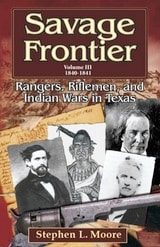
Savage Frontier Volume III
Rangers, Riflemen, and Indian Wars in Texas, 1840-1841Stephen L. Moore
University of North Texas Press, 2007
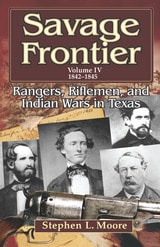
Savage Frontier Volume IV
Rangers, Riflemen, and Indian Wars in Texas, 1842-1845Stephen L. Moore
University of North Texas Press, 2002
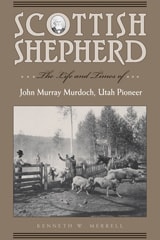
Scottish Shepherd
The Life and Times of John Murray Murdoch, Utah PioneerMerrell, Kenneth W
University of Utah Press, 2007
Murdoch embraced Mormonism and set out for the Utah Territory in 1852 with his wife, Ann, and their family. En route they suffered the deaths of their two young children. Two years later, John’s mother, Wee Granny, and Ann’s brother, James Steele, both perished, along with many others of the ill-fated Martin handcart company, as they attempted to immigrate to Salt Lake City.
Murdoch was a respected member of the community and participated in the military preparations and maneuvers against the U.S. Army in the 1857 Utah War. Eventually the family moved to the Heber valley as early settlers there. Murdoch later became one of Wasatch county’s first elected officials and helped establish the sheep-ranching industry in Utah. The 'everyman' aspect of John Murdoch’s life makes his a compelling story. It will fascinate anyone interested in the individuals who helped create Utah's history.
Winner of the Evans Handcart Award.
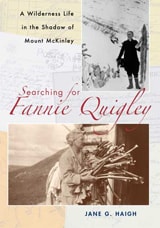
Searching for Fannie Quigley
A Wilderness Life in the Shadow of Mount McKinleyJane G. Haigh
Ohio University Press, 2007
At the age of 27, Fannie Sedlacek left her Bohemian homestead in Nebraska to join the gold rush to the Klondike. From the Klondike to the Tanana, Fannie continued north, finally settling in Katishna near Mount McKinley. This woman, later known as Fannie Quigley, became a prospector who staked her own claims and a cook who ran a roadhouse. She hunted and trapped and thrived for nearly forty years in an environment that others found unbearable.
Her wilderness lifestyle inspired many of those who met her to record their impressions of this self-sufficient woman, who died in 1944. To many of the 700,000 annual visitors to Denali National Park she is a symbol of the enduring spirit of the original pioneers.
Searching for Fannie Quigley: A Wilderness Life in the Shadow of Mount McKinley goes beyond the mere biographical facts of this unique woman’s journey. It also tells historian Jane G. Haigh’s own story of tracking and tracing the many paths that Fannie Quigley’s intriguing life took. Uncovering remote clues, digging through archives, and listening to oral accounts from a wide array of sources, Haigh has fashioned this rich lode into a compelling narrative.
In Searching for Fannie Quigley, Haigh separates fact from fiction to reveal the true story of this highly mythologized pioneer woman.
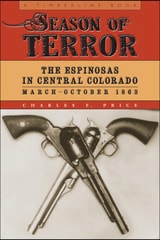
Season of Terror
The Espinosas in Central Colorado, March–October 1863Charles F. Price
University Press of Colorado, 2013
For eight months during the spring and fall of 1863, brothers Felipe Nerio and José Vivián Espinosa and their young nephew, José Vincente, New Mexico–born Hispanos, killed and mutilated an estimated thirty-two victims before their rampage came to a bloody end. Their motives were obscure, although they were members of the Penitentes, a lay Catholic brotherhood devoted to self-torture in emulation of the sufferings of Christ, and some suppose they believed themselves inspired by the Virgin Mary to commit their slaughters.
Until now, the story of their rampage has been recounted as lurid melodrama or ignored by academic historians. Featuring a fascinating array of frontier characters, Season of Terror exposes this neglected truth about Colorado’s past and examines the ethnic, religious, political, military, and moral complexity of the controversy that began as a regional incident but eventually demanded the attention of President Lincoln.
Seedtime on the Cumberland
Harriette Simpson Arnow
Michigan State University Press, 2013

Seven Summers
A Naturalist Homesteads in the Modern WestJulia Corbett
University of Utah Press, 2013
Seven Summers is the story of a naturalist-turned-professor who flees city life each summer with her pets and power tools to pursue her lifelong dream—building a cabin in the Wyoming woods. With little money and even less experience, she learns that creating a sanctuary on her mountain meadow requires ample doses of faith, patience, and luck. This mighty task also involves a gradual and sometimes painful acquisition of flexibility and humility in the midst of great determination and naive enthusiasm.
For Corbett, homesteading is not about wresting a living from the land, but respecting and immersing herself in it—observing owls and cranes, witnessing seasons and cycles, and learning the rhythms of wind and weather in her woods and meadow. The process changes her in unexpected ways, just as it did for women homesteaders more than a century ago. The more she works with wood, the more she understands the importance of “going with the grain” in wood as well as in life. She must learn to let go, to move through loss and grief, to trust her voice, and to balance independence and dependence. Corbett also gains a better understanding of her fellow Wyomingites, a mix of ranchers, builders, gas workers, and developers, who share a love of place but often hold decidedly different values. This beautifully written memoir will appeal to readers who appreciate stories of the western landscape, independent women, or the appreciation of the natural world.
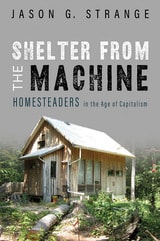
Shelter from the Machine
Homesteaders in the Age of CapitalismJason G. Strange
University of Illinois Press, 2020
Jason Strange shows where homesteaders fit, and don't fit, within contemporary America. Blending history with personal stories, Strange visits pig roasts and bohemian work parties to find people engaged in a lifestyle that offers challenge and fulfillment for those in search of virtues like self-employment, frugality, contact with nature, and escape from the mainstream. He also lays bare the vast differences in education and opportunity that leave some homesteaders dispossessed while charting the tensions that arise when people seek refuge from the ills of modern society—only to find themselves indelibly marked by the system they dreamed of escaping.
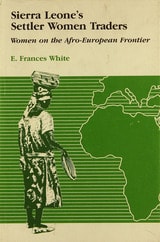
Sierra Leone's Settler Women Traders
Women on the Afro-European FrontierE. Frances White
University of Michigan Press, 1987
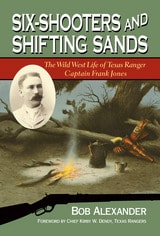
Six-Shooters and Shifting Sands
The Wild West Life of Texas Ranger Captain Frank JonesBob Alexander
University of North Texas Press, 2015

Skookum
An Oregon Pioneer Family’s History and LoreShannon Applegate
Oregon State University Press, 1988
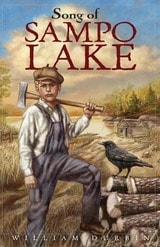
Song of Sampo Lake
William Durbin
University of Minnesota Press, 2011

Spaces between Us
Queer Settler Colonialism and Indigenous DecolonizationScott Lauria Morgensen
University of Minnesota Press, 2011
We are all caught up in one another, Scott Lauria Morgensen asserts, we who live in settler societies, and our interrelationships inform all that these societies touch. Native people live in relation to all non-Natives amid the ongoing power relations of settler colonialism, despite never losing inherent claims to sovereignty as indigenous peoples. Explaining how relational distinctions of “Native” and “settler” define the status of being “queer,” Spaces between Us argues that modern queer subjects emerged among Natives and non-Natives by engaging the meaningful difference indigeneity makes within a settler society.
Morgensen’s analysis exposes white settler colonialism as a primary condition for the development of modern queer politics in the United States. Bringing together historical and ethnographic cases, he shows how U.S. queer projects became non-Native and normatively white by comparatively examining the historical activism and critical theory of Native queer and Two-Spirit people.
Presenting a “biopolitics of settler colonialism”—in which the imagined disappearance of indigeneity and sustained subjugation of all racialized peoples ensures a progressive future for white settlers—Spaces between Us newly demonstrates the interdependence of nation, race, gender, and sexuality and offers opportunities for resistance in the United States.
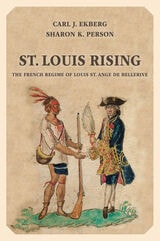
St. Louis Rising
The French Regime of Louis St. Ange de BelleriveCarl J. Ekberg and Sharon K. Person
University of Illinois Press, 2015
Drawing on new source materials, the authors delve into the complexities of politics, Indian affairs, slavery, and material culture that defined the city's founding period. Their alternative version of the oft-told tale uncovers the imperial realities--as personified by St. Ange--that truly governed in the Illinois Country of the time, and provide a trove of new information on everything from the fur trade to the arrival of the British and Spanish after the Seven Years' War.
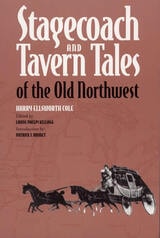
Stagecoach and Tavern Tales of the Old Northwest
Harry Ellsworth Cole. Edited by Louise Phelps Kellogg. Foreword by Patrick J. Brunet
Southern Illinois University Press, 1997
One journalist curious about life in the taverns along the stagecoach lines in Wisconsin and northern Illinois from the early 1800s until the 1880s was Harry Ellsworth Cole. While he could not sample strong ales at all of the taverns he wrote about, Cole did study newspaper accounts, wrote hundreds of letters to families of tavern owners, read widely in regional history, and traveled extensively throughout the territory. The result, according to Brunet, is a "nostalgic, sometimes romantic, well-written, and easily digested social history."
At Cole’s death, historian Louise Phelps Kellogg edited his manuscript, which in this case involved turning his notes and illustrations into a book and publishing it with the Arthur H. Clark Company in 1930.

Staking Her Claim
Life Of Belinda MulrooneyMelanie J. Mayer
Ohio University Press, 1999
In Staking Her Claim, Melanie Mayer and Robert N. DeArmond provide a faithful and comprehensive portrait of this unique character in North American frontier history. Their exhaustive research has resulted in a sweeping saga of determination and will, tempered by disaster and opportunity.
Like any good Horatio Alger hero, Belinda overcame the challenges that confronted her, including poverty, prejudice, a lack of schooling, and the early loss of parents. Her travels took her from her native Ireland as a young girl to a coal town in Pennsylvania to Chicago, San Francisco, and finally, in 1897, to the Yukon.
Staking Her Claim is a testament to the human spirit and to the idea of the frontier. It is a biography of a woman who made her own way in the world and in doing so left an indelible mark.

Still the Arena of Civil War
Violence and Turmoil in Reconstruction Texas, 1865-1874Kenneth W. Howell
University of North Texas Press, 2012
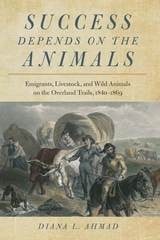
Success Depends on the Animals
Emigrants, Livestock, and Wild Animals on the Overland Trails, 1840–1869Diana L. Ahmad
University of Nevada Press, 2016
Between 1840 and 1869, thousands of people crossed the American continent looking for a new life in the West. Success Depends on the Animals explores the relationships and encounters that these emigrants had with animals, both wild and domestic, as they traveled the Overland Trail. In the longest migration of people in history, the overlanders were accompanied by thousands of work animals such as horses, oxen, mules, and cattle. These travelers also brought dogs and other companion animals, and along the way confronted unknown wild animals.
Ahmad’s study is the first to explore how these emigrants became dependent upon the animals that traveled with them, and how, for some, this dependence influenced a new way of thinking about the human-animal bond. The pioneers learned how to work with the animals and take care of them while on the move. Many had never ridden a horse before, let alone hitched oxen to a wagon. Due to the close working relationship that the emigrants were forced to have with these animals, many befriended the domestic beasts of burden, even attributing human characteristics to them.
Drawing on primary sources such as journals, diaries, and newspaper accounts, Ahmad explores how these new experiences influenced fresh ideas about the role of animals in pioneer life. Scholars and students of western history and animal studies will find this a fascinating and distinctive analysis of an understudied topic.