Results by title
153 books match the query 'Genres' and 8 start with s
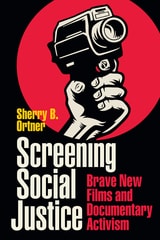
Screening Social Justice
Brave New Films and Documentary ActivismSherry B. Ortner
Duke University Press, 2023
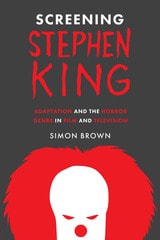
Screening Stephen King
Adaptation and the Horror Genre in Film and TelevisionBy Simon Brown
University of Texas Press, 2018
Since the 1970s, the name Stephen King has been synonymous with horror. His vast number of books has spawned a similar number of feature films and TV shows, and together they offer a rich opportunity to consider how one writer’s work has been adapted over a long period within a single genre and across a variety of media—and what that can tell us about King, about adaptation, and about film and TV horror. Starting from the premise that King has transcended ideas of authorship to become his own literary, cinematic, and televisual brand, Screening Stephen King explores the impact and legacy of over forty years of King film and television adaptations.
Simon Brown first examines the reasons for King’s literary success and then, starting with Brian De Palma’s Carrie, explores how King’s themes and style have been adapted for the big and small screens. He looks at mainstream multiplex horror adaptations from Cujo to Cell, low-budget DVD horror films such as The Mangler and Children of the Corn franchises, non-horror films, including Stand by Me and The Shawshank Redemption, and TV works from Salem’s Lot to Under the Dome. Through this discussion, Brown identifies what a Stephen King film or series is or has been, how these works have influenced film and TV horror, and what these influences reveal about the shifting preoccupations and industrial contexts of the post-1960s horror genre in film and TV.
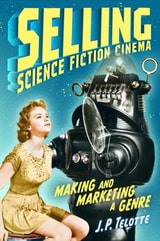
Selling Science Fiction Cinema
Making and Marketing a GenreJ. P. Telotte
University of Texas Press, 2023
How science fiction films in the 1950s were marketed and helped create the broader genre itself.
For Hollywood, the golden age of science fiction was also an age of anxiety. Amid rising competition, fluid audience habits, and increasing government regulation, studios of the 1950s struggled to make and sell the kinds of films that once were surefire winners. These conditions, the leading media scholar J. P. Telotte argues, catalyzed the incredible rise of science fiction.
Though science fiction films had existed since the earliest days of cinema, the SF genre as a whole continued to resist easy definition through the 1950s. In grappling with this developing genre, the industry began to consider new marketing approaches that viewed films as fluid texts and audiences as ever-changing. Drawing on trade reports, film reviews, pressbooks, trailers, and other archival materials, Selling Science Fiction Cinema reconstructs studio efforts to market a promising new genre and, in the process, shows how salesmanship influenced what that genre would become. Telotte uses such films as The Thing from Another World, Forbidden Planet, and The Blob, as well as the influx of Japanese monster movies, to explore the shifting ways in which the industry reframed the SF genre to market to no-longer static audience expectations. Science fiction transformed the way Hollywood does business, just as Hollywood transformed the meaning of science fiction.

Slow TV
An Analysis of Minute-by-Minute Television in NorwayRoel Puijk
Intellect Books, 2020
“Slow TV” refers to a form of broadcasting long events for their entire duration, preferably in real time. Popularized by the Norwegian Broadcasting Corporation (NRK), the form became a phenomenon in 2009 after NRK’s broadcast of a seven-hour train ride between Bergen and Oslo. Since then, slow TV programming has gained traction outside of Norway on television stations around the world and via streaming services like Netflix.
In this academic study, Roel Puijk combines quantitative and qualitative research methods to explore different aspects of the Norwegian slow TV phenomenon, from the programming’s production and development to its viewing and ultimate reception. Puijk relates slow TV to media events and media tourism, discussing its effects on cultural and economic developments and its evolving relationship to local and national identity. The result is an illuminating interdisciplinary study of media innovation and its effects on contemporary culture.

Small-Screen Supers
Adaptation, Sexuality, and Politics in Superhero TelevisionEdited by Anna F. Peppard and Dru Jeffries
University of Texas Press, 0
The first collected volume to define superhero television as a distinct cultural phenomenon, broadening horizons of what superhero stories have been and might become.
Superhero films dominate Hollywood and recent studies of popular culture. Superheroes are also abundant on television, and have been for decades, yet critics have largely neglected this intersection of genre and medium. Small-Screen Supers gathers an international group of scholars who, for the first time, examine superhero television as a distinct cultural and artistic phenomenon.
Informed by a range of critical perspectives, contributors examine animated and live-action shows aimed at children, teens, and adults, combining scholarship on popular contemporary programming with analysis of less-successful shows from the recent and distant past. Collectively, the anthology emphasizes how superhero television has reflected, informed, and transformed American culture and media. In particular, Small-Screen Supers argues that superhero TV—more so than film—foregrounds demographic diversity and social critique. Whether interpreting the 1980s cartoon Spider-Man and His Amazing Friends as a queer sitcom, underscoring the progressive politics of Supergirl, or investigating pandemic-inspired subjectivities in Werewolf by Night, the authors reflect on superhero television as a unique mode of expression with important implications for understanding American popular culture.
Star Wars Multiverse
Carmelo Esterrich
Rutgers University Press, 2021
Star Wars may have started out as a film about a Manichean battle between good and evil, but as countless filmmakers, novelists, animators, fan artists and even cosplayers have taken the opportunity to play in the fictional world George Lucas created, it has expanded into something far greater, resulting in a richly layered and diverse Star Wars multiverse.
Drawing from a full range of Star Wars media, including comics, children’s books, fan films, and television shows like Clone Wars and The Mandalorian, Carmelo Esterrich explores how these stories set in a galaxy far far away reflect issues that hit closer to home. He examines what they have to say about political oppression, authoritarianism, colonialism, discrimination, xenophobia, and perpetual war. Yet he also investigates subtler ways in which the personal is political within the multiverse, including its articulations of gender and sexuality, its cultural hierarchies of language use, and its complex relationships between humans, droids and myriad species. This book demonstrates that the Star Wars multiverse is not just a stage for thrilling interstellar battles, but also an exciting space for interpretation and discovery.
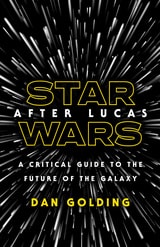
Star Wars after Lucas
A Critical Guide to the Future of the GalaxyDan Golding
University of Minnesota Press, 2019
Politics, craft, and cultural nostalgia in the remaking of Star Wars for a new age
A long time ago, in a galaxy far, far away—way back in the twenty-first century’s first decade—Star Wars seemed finished. Then in 2012 George Lucas shocked the entertainment world by selling the franchise, along with Lucasfilm, to Disney. This is the story of how, over the next five years, Star Wars went from near-certain extinction to what Wired magazine would call “the forever franchise,” with more films in the works than its first four decades had produced.
Focusing on The Force Awakens (2015), Rogue One (2016), The Last Jedi (2017), and the television series Rebels (2014–18), Dan Golding explores the significance of pop culture nostalgia in overcoming the skepticism, if not downright hostility, that greeted the Star Wars relaunch. At the same time he shows how Disney, even as it tapped a backward-looking obsession, was nonetheless creating genuinely new and contemporary entries in the Star Wars universe.
A host of cultural factors and forces propelled the Disney-engineered Star Wars renaissance, and all figure in Golding’s deeply informed analysis: from John Williams’s music in The Force Awakens to Peter Cushing’s CGI face in Rogue One, to Carrie Fisher’s passing, to the rapidly changing audience demographic. Star Wars after Lucas delves into the various responses and political uses of the new Star Wars in a wider context, as in reaction videos on YouTube and hate-filled, misogynistic online rants. In its granular textual readings, broad cultural scope, and insights into the complexities of the multimedia galaxy, this book is as entertaining as it is enlightening, an apt reflection of the enduring power of the Star Wars franchise.
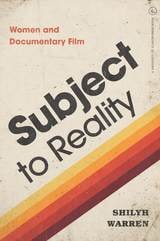
Subject to Reality
Women and Documentary FilmShilyh Warren
University of Illinois Press, 2019
Shilyh Warren reopens this understudied period and links it to a neglected era of women's filmmaking that took place from 1920 to 1940, another key period of thinking around documentary, race, and gender. Drawing women’s cultural expression during these two explosive times into conversation, Warren reconsiders key debates about subjectivity, feminism, realism, and documentary and their lasting epistemological and material consequences for film and feminist studies. She also excavates the lost ethnographic history of women's documentary filmmaking in the earlier era and explores the political and aesthetic legacy of these films in more explicitly feminist periods like the Seventies.
Filled with challenging insights and new close readings, Subject to Reality sheds light on a profound and unexamined history of feminist documentaries while revealing their influence on the filmmakers of today.